Get Full Government Meeting Transcripts, Videos, & Alerts Forever!
Get email alerts on the Maternal And Child Health Cash Transfer topic
No spam. Unsubscribe anytime.
Silber Foundation, Bridge Project present early results showing reduced housing instability and food insecurity for Milwaukee cohort
Summary
Silber Family Foundation and the Bridge Project presented one-year findings to the Finance & Personnel Committee showing early improvements in housing stability, savings and food security for 122 Milwaukee mothers receiving unconditional cash transfers; committee placed the communication on file.
Silber Family Foundation and the Bridge Project presented preliminary one-year results June 18 to the Milwaukee Common Council Finance & Personnel Committee from an unconditional cash transfer program for pregnant people and infants in several Milwaukee ZIP codes.
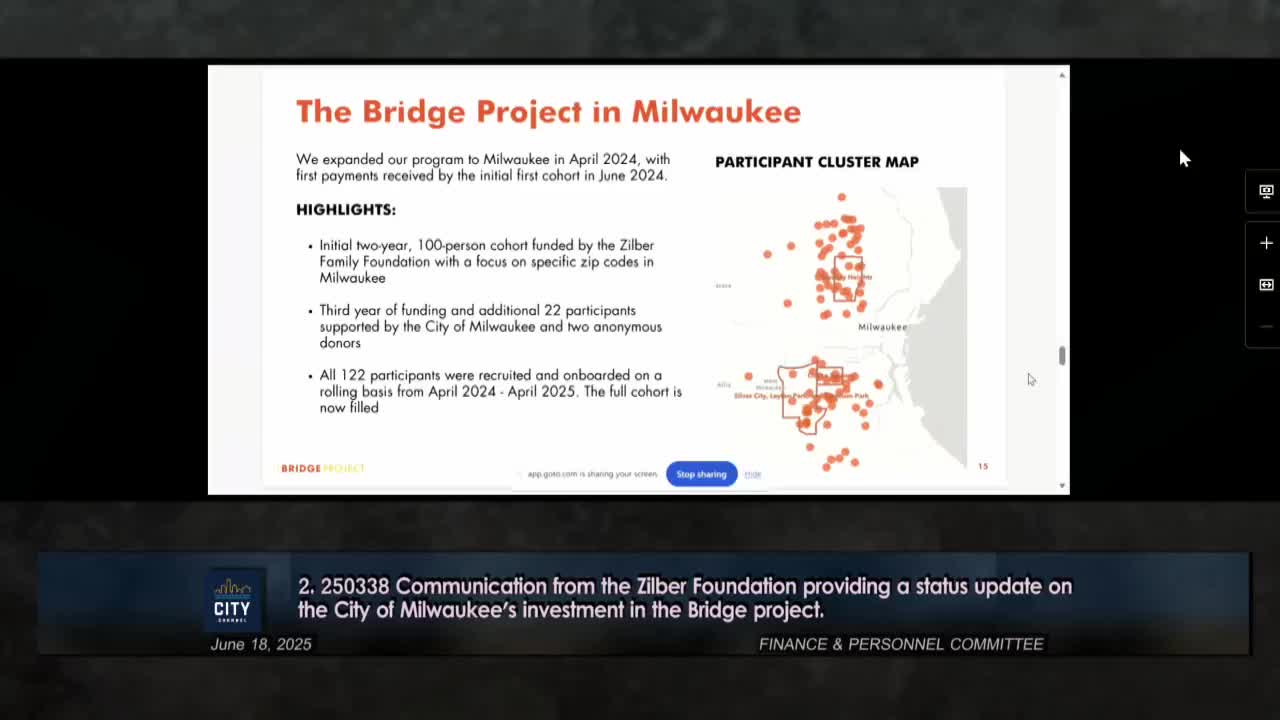
The Bridge Project, which delivers regular, unconditional cash payments to low-income mothers and babies, reported that Milwaukee’s cohort of 122 participants — launched in April 2024 with first payments that June — showed measurable improvements after roughly one year. The Silber Family Foundation provided initial philanthropic support and the city contributed funds to expand the cohort.
According to the presentation, the Milwaukee cohort received $750 per month for the first 15 months of participation and $375 per month thereafter for a planned three-year intervention. Presenters said the cohort’s average annual household income at baseline was about $7,500. Researchers reported that within the first year the share of participants experiencing housing instability fell from 17% to 6%, credit scores and savings increased, and food insecurity declined from 60% to 50%.
Liana Bishop, executive director of the Silber Family Foundation, and Steph Ziolkowski, director of policy for the Bridge Project, stressed that the findings are early and that the intervention runs three years for each participant. Ziolkowski said similar results in prior Bridge cohorts showed continued improvements into years two and three, and that the program’s research team will track outcomes over the full three-year period and consider an alumni research cohort to study longer-term effects.
Committee members asked for more granular data. Alderwoman Charline Moore asked whether participants live in public housing or market-rate rentals; Bridge Project staff said that specific housing program participation for Milwaukee participants was not in the meeting packet and that researchers would follow up. Alderman Scott Spiker asked whether housing gains persist after the intervention; presenters said durable improvements were observed in New York City cohorts and that the team plans to follow Milwaukee participants in years two and three and possibly afterward in a smaller alumni sample.
Bridge Project staff also described qualitative results: parents using cash to escape unsafe housing or domestic violence, to move to units with fewer lead hazards, and to invest in education or employment training. Presenters said the program combines cash with referral and wraparound supports and compensates participants for survey participation used in the research.
The communication file, including a slide deck and a five‑page research memo referenced during the presentation, was placed on file by committee action. Committee leaders said they would consider follow-up funding conversations based on the research and presentation.
The committee discussion noted the program’s mixed funding model — private philanthropy plus city investment — and the presenters urged that, given federal program uncertainty, now is a time to consider further local investments in early-childhood supports.