Get Full Government Meeting Transcripts, Videos, & Alerts Forever!
Get email alerts on the Bilingual Government topic
No spam. Unsubscribe anytime.
Maui County outlines timeline and staffing needs to post agendas in English and 'Olelo Hawai'i after Bill 127
Summary
Maui County officials told the County Council Committee on Aloha 'ina on June 19 they will pilot and then implement Bill 127, an ordinance requiring official public meeting agendas to be posted in both English and 'Olelo Hawai'i, with a July—September transition and a September effective date.
Maui County officials on June 19 told the Council Committee on Aloha 'ina they are preparing to implement Bill 127, the county ordinance that requires official public meeting agendas to be published in both English and 'Olelo Hawai'i.
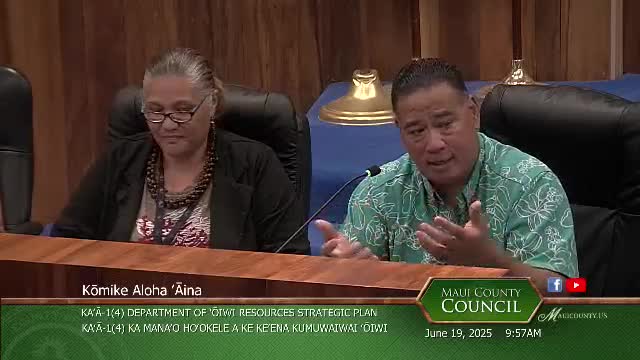
"It is a very momentous occasion," Kekai Robinson, deputy director of the Department of OUV Resources, said during the presentation. Robinson said the department will use July through September as a transition period for practice runs and that the ordinance itself takes effect in September.
Speakers tied the local move to the state constitutional amendment adopted in 1978 that designates English and Hawaiian as official state languages and to broader efforts to restore Hawaiian-language use in government. Department staff said they have drafted workflow templates, will build a desktop quick-reference for staff and secretaries, and plan quarterly workshops and classes in partnership with the University of Hawaii Maui College. The department identified its Hawaiian-language specialists (named in the presentation as Kahealani Collado and Kepa Revel) as core translators and coordinators.
The county's open-meetings law (Sunshine Law) requires agendas be posted not later than six days before a meeting; corporate counsel and department staff reminded secretaries and chairs that translated agendas must meet the same statutory deadlines. "The agenda in English and 'Olelo Hawai'i must be published within the sunshine law requirements," the deputy director said, noting a failure to post both language versions in time could have the same consequences as failing to post an agenda in English.
Office of Council Services (OCS) Director David Rotz told the committee OCS has a Hawaiian language communication specialist (referred to in the meeting as Nalani/Fujihara) and intends to work with the department on committee pilots. OCS said it attempted to recruit a second specialist but was unsuccessful and that, if necessary, the county may contract with external translators or academic partners. Rotz said OCS believes it has the capability to support the eight council committees during a pilot phase but that council and clerks should plan for additional resourcing and workflow adjustments for longer or last-minute agendas.
Council members raised practical issues: which version appears first on a combined document; whether attachments and minutes must be translated (department staff said the ordinance applies to official agendas only and that attachments and minutes are not required translations); how last-minute changes or late submissions will be handled; and whether translation work will be centralized or decentralized across county departments.
Department staff recommended agendas be formatted with Hawaiian and English presented on equal footing rather than as a separate Hawaiian attachment or as Hawaiian subtext below English. The department said secretaries have already shared templates and that the July—September period will be used to finalize workflows and test timelines. Officials also said they aim to offer classes and recorded sessions for county employees beginning this fall and to provide training materials and periodic workshops for board and commission secretaries.
Public testimony included supportive remarks. James Langford said the effort "allow[s] truth to come through," and Stacy Law of Waiako Ahupua'a Kula 'oka praised the county's move and encouraged staff and officials to participate in the language revival.
The committee took no final vote: the item was presented for information and the committee deferred further action. Department and OCS staff said they will continue coordination, finalize templates and timing during the transition period and report back as needed.