Get Full Government Meeting Transcripts, Videos, & Alerts Forever!
Get email alerts on the Redevelopment TIF topic
No spam. Unsubscribe anytime.
Committee sends Hunt Midwest Metcalf redevelopment back for negotiation after policy variances on TIF, land reimbursement and attainable units
Summary
The committee directed staff to continue negotiating a redevelopment agreement with Hunt Midwest for a 226-unit mixed-use project at 8036 Metcalf after the developer requested departures from city policy on TIF percentage, land-cost reimbursement, design fees and attainable-housing requirements.
The Finance, Administration & Economic Development Committee on June 18 reviewed a proposed redevelopment at 8036 Metcalf submitted by Hunt Midwest and directed staff to continue negotiations with the developer after hearing argument and receiving policy variances on several financial terms.
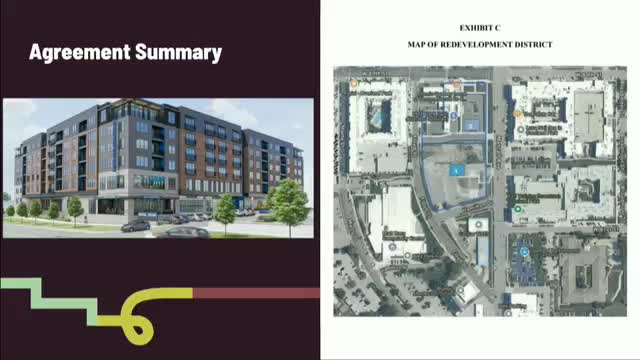
Project summary Hunt Midwest proposed a mixed-use project on a downtown Overland Park site that would include 226 multifamily units, roughly 5,000 square feet of commercial space and structured parking (about 350 stalls, with staff noting 58 stalls would be publicly available). The developer's total project budget was presented as approximately $87,800,000.
Requested incentives The developer sought a package of pay-as-you-go incentives: tax increment financing (TIF) for public-eligible costs, a 1% community improvement district (CID) for 22 years (requested cap $375,000), and an economic-development revenue bond (EDRB) to exempt sales tax on construction materials. The developer requested that the city consider a 100% capture of the TIF increment; staff's proposal reflected city policy and recommended 90%.
Four policy variances under debate Staff identified four principal policy variances where the developer asked for departures from the city's standard incentive approach and where the committee asked for further discussion: 1) TIF percentage: developer requested 100% of increment; staff said city policy uses 90% as the standard and recommended sticking with policy. Staff and the developer both described how a higher percentage affects the city's annual receipts (staff presented a rough example where the additional 10% equated to a modest annual city revenue difference compared with the value the mixed-use project brings overall). 2) Eligible soft costs/design fees: the developer sought reimbursement of certain A&E/design costs (about $220,000). Staff said design fees are eligible under law but that the city typically does not reimburse certain soft costs; they reduced the proposed TIF-eligible budget accordingly. 3) Land acquisition reimbursement: the developer requested roughly $1,295,000 (about 50% of a $2.6 million land cost) to be reimbursable; staff said city policy normally caps land-reimbursement at about 25% and proposed a lower reimbursable figure (near $650,000), leaving a delta to negotiate. 4) Attainable housing / IRR governance: staff included an attainable-housing provision similar to a prior downtown project (10% of units reserved at rents affordable to households at or below 60% of area median income, with rent-growth limits). The developer initially sought to remove the set-aside and instead offered a potential $750-per-unit one-time payment at certificate of occupancy (approximately $169,500 total) to support attainable-housing goals. Staff also emphasized the city's IRR (rate-of-return) cap mechanism: the city's policy limits a finished-project internal rate of return to 150% of the estimated IRR (staff framed that as roughly a 10% cap in this project), while the developer asked for a 16% cap; Hunt Midwest indicated it could accept a 15% cap if needed.
Other provisions The proposed agreement included a requirement that the project register for and secure a Green Globes certification (one Green Globe), and staff included enforcement language allowing TIF adjustments or cancellation if certification was not achieved.
Committee discussion and action Committee members and staff pressed for clarity on the four policy departures and compared prior downtown projects where staff and council had approved various mixes of reimbursements and incentive structures. Committee members expressed sympathy for the project's design ambition but said policy consistency mattered and that staff and developer should continue negotiating. The committee ultimately voted unanimously to direct staff to continue negotiations with Hunt Midwest, asking staff to try to reconcile the policy exceptions and return with revised terms.
Why it matters The project proposes dense, structured parking and downtown multifamily construction with potential long-term property-tax and sales-tax benefits for the city and region. Committee members weighed fiscal-policy precedent against the value of catalyzing a high-cost underground parking solution and new housing in the downtown core.
Next steps Staff will continue negotiating with Hunt Midwest on the four core policy points (TIF percentage, design-cost eligibility, land-reimbursement share and attainable-housing approach/IRR cap) and will return to the committee with a revised agreement or a clearer recommendation. The committee's direction preserves ongoing negotiation rather than approving incentive terms outright.