Get Full Government Meeting Transcripts, Videos, & Alerts Forever!
Get email alerts on the Renewable Energy Zoning topic
No spam. Unsubscribe anytime.
Lyon County adopts ordinance setting conditional-use standards for commercial solar, wind, geothermal and energy storage
Summary
After a second hearing and extended public comment, the Lyon County Board of Commissioners approved an ordinance amending Title 15 to add conditional-use standards, performance and decommissioning rules for commercial wind, geothermal, solar and energy storage systems. The vote was 4–1.
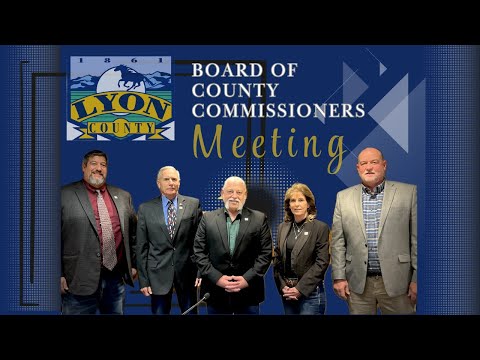
The Lyon County Board of Commissioners on June 18 approved an ordinance (Bill 25-02) adding conditional-use permit standards and performance rules for commercial wind, geothermal and solar generation and establishing standards for energy storage systems. The ordinance, which updates multiple sections of Lyon County Code Title 15, passed after a second hearing and extensive public comment, with the motion approved 4–1.
County Manager Andrew Haskin told the board the changes clarify that the planned unit development (PUD) process can be used to approve setbacks and other negotiated deviations from strict zoning rules, add fire-protection language if a local fire district will not serve a project, adopt definitions for solar and energy storage facilities, and create standards for decommissioning and reclamation. "This is a zoning ordinance, not a building code ordinance," Haskin said during the presentation. "With zoning, it's just as much about quality of life and maintaining the character of the communities as it is about the safety."
Why it matters: Haskin said Bureau of Land Management (BLM) filings and a recent BLM Western States Solar PEIS have significantly increased the amount of federal land available for solar projects near Lyon County, and the county previously has acted as a cooperating agency on large projects. Staff noted that, excluding projects not in the county or still "to be determined," BLM filings represent roughly 23,237 acres of proposed projects that could affect local roads, river access, visual character and transmission capacity. The ordinance gives the county clear permitting standards and a conditional-use path — including PUD — for mitigating site-specific impacts.
Key provisions and clarifications - PUD flexibility: Language expressly allows the Board of County Commissioners to approve setbacks or other deviations for projects that proceed through the planned unit development process, enabling case-by-case negotiation of siting and mitigation. - Fire protection: If a fire protection district declines to provide fire, inspection or emergency medical services to a project, the proponent must supply a plan for providing those services, the ordinance says. That applies only where a project is outside an existing fire district. - Definitions and accessory exemptions: The ordinance adds definitions for solar and energy storage systems and clarifies that accessory systems serving on-site primary users (for example, battery backup for a data center on the same parcel) are treated differently than utility-scale facilities distributed to the grid. - Setbacks and visibility: The ordinance inserts wording allowing setbacks to be addressed through PUD and permits reduced visibility restrictions where panels or storage are behind topographic features or buildings and not visible from public vantage points at or below the highest occupied floor. - Geothermal and wells: The county retained and clarified language requiring applicants to provide data and conceptual aquifer models and kept a 3,000-foot setback from private wells and a 3,000-foot standard (replacing a prior one-half-mile metric) from municipal wells; ag wells were added to protections as well. - Traffic and roads: The conditional-use framework requires road maintenance agreements and two separate traffic studies — one for high-volume construction impacts and one for operational traffic — and the applicant typically bears the cost of outside consulting if required. - Decommissioning and reclamation: Projects must include reclamation and decommissioning plans regardless of projected life span; staff noted those plans will differ if a facility expects a 100-year life versus 10–20 years.
Public comment reflected sharp differences in emphasis. Labor representatives, including Steve Boy Barra and Michael Brady of Laborers Local 169, spoke in favor of the ordinance and cited job creation, wages, pensions and benefits: "We are in support... This means jobs," a union representative told commissioners. Local civic and business leaders — from the Boys & Girls Club to area residents — generally urged the board to find balance, emphasizing jobs and tax revenue but also urging strong local controls on siting, road impacts and water. Several residents and agricultural interests warned about loss of farmland, groundwater sales and visual impacts; one long-time resident urged commissioners to avoid allowing solar on productive farm ground. Developers and industry representatives including Ash Woods (Dopia Power), a speaker from EDF Power Solutions, and Andy McKenna of NextEra Energy Resources urged the board either to reduce setbacks or to table the item for additional industry engagement.
Several commenters raised battery-safety concerns after high-profile incidents elsewhere; Andrew Haskin and an industry speaker noted that battery safety overlaps with fire code and NFPA standards and that PUD review allows site-specific mitigation.
Board action: After discussion, the board approved the ordinance as presented with staff recommended changes. The roll call at the time of adoption recorded one dissenting vote (Commissioner Jacobson), with the motion passing 4–1.
Next steps and implementation: Staff said conditional-use permits and PUD applications will be evaluated under the new standards and that any construction approvals will require complete civil and decommissioning plans and appropriate agreements (including road maintenance). Haskin noted the county will continue to monitor transmission and permitting activity on adjacent federal lands and work with project proponents and fire districts where required.
Speakers quoted or cited in this article spoke during the renewable-energy item on the June 18, 2025 agenda and in the public comment period that followed that item. Direct quotes are attributed to speakers listed in the transcript.