Get Full Government Meeting Transcripts, Videos, & Alerts Forever!
Get email alerts on the Payroll Reporting topic
No spam. Unsubscribe anytime.
TRS tells school employers to report summer payrolls in Gemini; DB contributions due by July 10
Summary
Teachers' Retirement System staff told school employers during a training that districts must report summer payroll schedules in the Gemini portal and that defined-benefit contributions for the fiscal year must be submitted by July 10 under the Illinois Pension Code.
Teachers' Retirement System staff told school employers during a training that districts must report summer payroll schedules in the Gemini portal and follow accrual reporting rules that assign earnings to the fiscal year when the work was performed.
Kim, an Employer Services team member at the Teachers' Retirement System (TRS), said the fiscal year runs July 1 through June 30 and that "the pay date on your payroll schedule should always be the date that the employees are actually paid by the employer." Kim said the Illinois Pension Code requires that "all contributions for the fiscal year ... are due by July 10," so Gemini pay-period reports for that fiscal year must be uploaded, submitted and paid by July 10 to avoid potential penalties.
The TRS presenters stressed that earnings must be reported on an accrual basis — when the work was performed, not when the paycheck was issued. Kim used a summer-school example to illustrate the rule: when a member is paid $2,000 on July 15 for work that ran June 23–July 3, employers must prorate the $2,000 by days worked (in that example, $1,333 for the six June days reportable in fiscal year 2024-25 and the remainder for 2025-26).
Kim also explained TRS staff will audit and, if needed, go back four years to correct prior reporting; there are no penalties for discovering reporting errors, but TRS will charge the contributions that should have been paid at the earlier time. Employers can upload reports after July 10 but may receive a penalty.
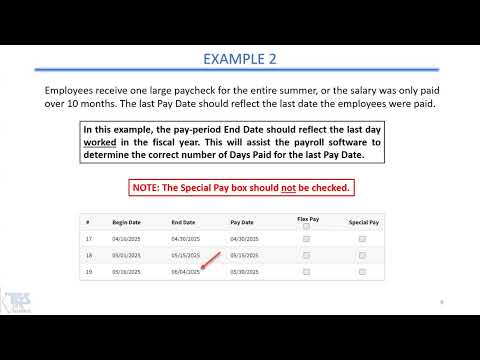
On technical rules for Gemini entries, Kim said payroll schedules must list the pay-period begin and end dates and the actual pay date. Employers cannot upload a pay-period report that spans multiple fiscal years; districts must submit separate reports for each fiscal year. She noted common payroll patterns (paying 9-month teachers over 12 months, single large summer checks, five consecutive pay dates, or five identical pay dates) and explained when to check the portal's "special pay" box (only when multiple paychecks share the exact same pay date).
Kim described editing constraints: a payroll-schedule row cannot be edited or deleted if a report using that exact begin/end dates has already been uploaded. She said employers can add rows or edit rows for schedules that have not been used on uploaded reports, and that Gemini will show fatal errors that must be corrected before saving.
Kim also explained the portal's "deferred" field for individual member records: mark deferred="yes" when a pay date falls in the summer but the pay covers no days between the begin and end date (indicating pay for prior work); if the pay includes days in June, mark deferred="no." She cautioned districts to verify payroll-software defaults at July 1 because some systems automatically switch fiscal years on that date and can cause widespread errors.
Angie, a deferred-compensation team member at TRS, reviewed timing for Supplemental Savings Plan (SSP) / defined-contribution reporting and remittance. Angie said SSP contributions "should be reported on your district's DC report as close to the employee's payday as possible" and that contributions submitted in Gemini before 2 p.m. will go to Voya the same day; submissions after 2 p.m. go the next business day.
Angie gave examples for DC reporting: if a district issues multiple summer pay dates, submit SSP remittances on each pay date; if a district issues one large summer check, remit once when checks are issued; if a pay date is unused but remains on the payroll schedule, TRS will expect a contribution and may issue a delinquent-contribution notice.
She explained when to implement employee SSP elections or changes: if a payroll is already closed, implement the change at the next available pay date (for example, the first pay date of the new school year); if pay periods are pending but not closed, implement the change on the first pay period whose begin date is on or after the contribution effective date. Angie summarized deferral application rules: flat-dollar deferrals should be taken from scheduled pay periods and not from special pays or stipends; percentage deferrals should apply to all pays, including special pays and stipends.
Both presenters said TRS will require separate payroll schedules for the job categories of teacher and administrator in FY 2025-26 and recommended separate schedules for subs and extra-duty pay if payment lags differ. TRS staff said they will offer multiple annual-certification trainings in June, July and August and invited employers to follow up with questions.