Get Full Government Meeting Transcripts, Videos, & Alerts Forever!
Get email alerts on the Corrections Budget topic
No spam. Unsubscribe anytime.
Virgin Islands Bureau of Corrections seeks $37.7 million for staff, medical and facilities upgrades
Summary
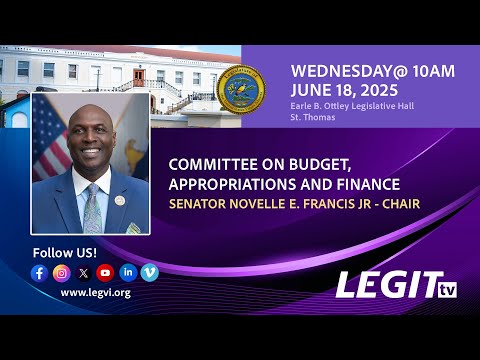
Bureau of Corrections Director Winnie Testamock asked the legislature’s Committee on Budget, Appropriations and Finance on June 18 for approval of a $37.7 million fiscal 2026 operating budget to pay personnel, expand medical and mental‑health services and fund capital projects including a planned Swan Annex correctional facility.
Bureau of Corrections Director Winnie Testamock asked the legislature’s Committee on Budget, Appropriations and Finance on June 18 for approval of a $37,700,000 fiscal 2026 operating budget to pay personnel, expand medical and mental‑health services and fund capital projects including a planned Swan Annex correctional facility.
Testamock told the committee the request represents a 4.4 percent increase over the current year and that personnel and benefits account for nearly 59 percent of the total. “The fiscal year 2026 budget is more than a series of line items and percentages. It is a journey of strategy, unwavering commitment, and a clear vision for a safer, more rehabilitative correctional system,” Testamock said.
Why this matters: The bureau manages both local and off‑island custody and has two active long‑running consent decrees. Lawmakers pressed bureau leaders on overtime, vendor payments and the high per‑day cost of housing detainees locally versus off island — figures bureau leaders said drive part of the budget request and long‑term planning needs.
Key facts and figures - Governor’s FY2026 request for the Bureau of Corrections: $37,700,000 (4.4% increase). - Budgeted positions for FY2026: 222; filled: 158; vacancies reported during hearing: 61 (management later said 18 vacancies on record and 10 PRFs in the pipeline). - Payroll projection for FY2026: about $15.5 million (41.3% of budget). - Fringe benefits projected: $6.5 million (17.4% of budget). - Local inmate population (as of 06/16/2025): 191 on island (111 at John A. Bell Correctional Facility on St. Croix; 80 at Alexander Farrelly Criminal Justice Complex on St. Thomas); another 160 housed off island – 21 in Florida, 32 in Virginia and 107 in Mississippi. - Estimated daily cost: about $321 per day to house an inmate locally vs. $103 per day off island (bureau estimate provided during testimony). - Vendor backlog: bureau reported 67 outstanding vendor payments totaling about $2.5 million “in various stages of the ERP payment process.”
Programs, performance and legal context Testamock described staffing, training and reentry programs the bureau says have reduced rearrest rates for a tracked cohort to roughly 11 percent over three years — a figure the bureau contrasted with a national recidivism statistic cited during testimony. She outlined ongoing education and vocational programs (Penn Foster high‑school diplomas, a Transforming Lives Academy in partnership with the University of the Virgin Islands, virtual reality training), inmate work crews supporting government agencies, and an equine therapy program. She said about 42 inmates were enrolled in education programs as of June 16, 2025, and 68 participated in work programs.
The bureau remains subject to two active federal consent decrees — one for John A. Bell on St. Croix and one for the Criminal Justice Complex on St. Thomas — and Testamock said the territory and U.S. Department of Justice jointly filed a motion in April 2025 seeking removal of the medical‑care provisions from the long‑running consent decree at John A. Bell; that motion had not been granted as of the hearing.
Spending pressure points raised by lawmakers Lawmakers questioned the bureau about a number of high‑cost items and operational risks: high overtime (overtime for FY2024 was about $4.9 million; FY2025 year‑to‑date was about $2.9 million as of June 16), vendor payment delays, the cost and oversight of off‑island housing and transportation for inmates with medical or security needs, and the $1,000,000 annual contract the bureau has with Butler Snow LLC for assistance related to consent decree work. The bureau said $2.1 million in FY2026 is budgeted to pay court‑appointed monitors and subject‑matter experts mandated under the consent‑decree frameworks; that total includes the Butler Snow contract (the bureau described the firm as retained jointly with DOJ and operating under DOJ supervision).
Capital projects and infrastructure Testamock outlined capital priorities: finalizing the Swan Annex site and launching a public‑private partnership (P3) procurement to expand capacity (the bureau said it has $25 million in funding identified, not sufficient to fully build a new facility); installing new fire alarm and suppression work scopes; upgrading perimeter lighting; installing generators (900 kW at John A. Bell; 500 kW at CJC); and completing a modular morgue for St. Croix. The bureau said it is developing an RFP for a P3 and working with the Office of Disaster Recovery on design elements for the Swan Annex.
Staffing and recruitment Lawmakers pressed the bureau on recruitment, training metrics and vacancy levels. Testamock said the bureau has used job fairs, radio campaigns and other outreach but that applicants often do not pass tests or background checks; she said 26 recruits had joined since 2019 and that as of February 2025 there were 20 applications and 14 eligible to test. The bureau reported it has implemented negotiated salary increases and retroactive payments for represented employees and described classification counts (about 163 classified positions; 59 unclassified).
Inmate healthcare and mental health The bureau budget proposal includes expanded funding for medical and mental‑health services. Testamock said roughly 40 percent of inmates receive some form of mental‑health treatment and that the system has been a primary provider of behavioral health services in the territory. She presented local versus off‑island medical spending and identified rising medication and off‑island emergency transfer costs as drivers of spending. The bureau also described oversight trips to contracted off‑island facilities.
What lawmakers asked for next Senators asked for more detailed documentation: updated vendor payment listings, a breakdown of medical expenditures by facility and vendor (Snyder Regional, Wang Lui and others were named in testimony), vacancy and PRF lists, and a clearer line‑by‑line tie of post‑audit numbers to the bureau’s executive‑budget book. The chair directed additional follow‑ups and asked for clarifications on discrepancies between the post‑audit report and the bureau’s testimony.
Where things stand The bureau requested that the legislature approve the FY2026 request. The agency emphasized that many operating costs are personnel driven and that investments in staffing, medical and reentry programming are intended to improve public safety and reduce long‑term costs through lowered recidivism. Lawmakers signaled support for some initiatives but demanded more granular financial and procurement documentation before final appropriation decisions.
Ending The bureau left the hearing with an obligation to provide several requested financial breakdowns and vendor lists; senators said they would continue follow‑up questions in committee. The hearing covered staffing, the consent decrees, medical cost drivers, and capital projects that will be considered during the budget review process.