Get Full Government Meeting Transcripts, Videos, & Alerts Forever!
Get email alerts on the Public Safety Complex Financing topic
No spam. Unsubscribe anytime.
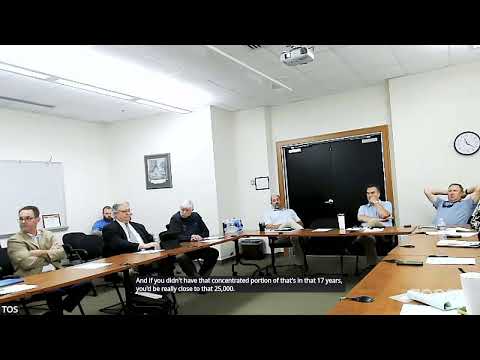
Council reviews plan to finance $62 million public safety complex; advisers recommend installment-purchase revenue bonds and formation of nonprofit issuer
Summary
Town advisers presented a financing plan for an estimated $62 million police, fire, court and fleet complex that would rely on roughly $44.5 million in bond proceeds and a mix of local revenues; advisers recommended installment-purchase revenue bonds issued by a nonprofit conduit and outlined a calendar for approvals, bond pricing and closing.
Town advisers outlined a plan to finance a proposed $62,000,000 public safety complex that would consolidate police headquarters, a municipal court, a fire department headquarters, a fleet/kennel facility and associated parking.
David (financial adviser) and Theo (bond counsel) recommended using an installment-purchase revenue bond structure issued by a single-purpose nonprofit corporation, saying it preserves the town’s 8% general-obligation debt capacity and permits annual payments by appropriation from any legally available funds. The advisers described a proposed funding package that would move roughly $44,500,000 in new bond proceeds toward the project, supplemented by about $2,000,000 of the town’s unassigned general fund balance, $10,000,000 of remaining 2022 limited-obligation bond proceeds from the Midtown TIF, and an estimated $5,500,000 from potential land sales.
"Installment purchase revenue bonds...do not count against the town's 8% debt limit," David, the town's financial adviser, said. "Payments can be made from any legally available source of funds, or a combination of funds, including millage, if you wanted to do that." Theo, the town's bond counsel, explained the conduit approach and said the nonprofit corporation would be formed under the South Carolina Nonprofit Corporation Act and act only on behalf of the town for this project.
Why it matters: the proposed structure lets the town borrow the majority of the project cost without using up general-obligation capacity that would otherwise require a referendum or be limited to 8% of assessed value. Advisers cautioned that some revenue sources — notably impact fees — are more volatile than hospitality or TIF revenues, and that the town must budget annual installment payments by appropriation each fiscal year.
Scope and timing: advisers described the complex as approximately 90,000 square feet across multiple buildings (three-story police/court component, two-story fire headquarters, plus fleet/kennel), with an 18-month construction estimate. Under the advisers’ schedule the town would close the financing in mid-December, with bond pricing targeted for November 20; first debt service budget impacts fall in fiscal 2027, with the first payments estimated at about $2.8 million for fiscal 2027. The bonds are being sized on a 30-year amortization, with typical prepayment language allowing refinancing or prepayment without penalty after year 10.
Repayment plan: advisers identified a mix of revenue streams to support the roughly $44.5 million of borrowing: - Local accommodations tax (the town-controlled portion): roughly $425,000 per year could support about $6.5 million of debt. - Hospitality tax: an estimated $220,000 per year of identified capacity could support about $3.2 million of debt. - Impact fees: projected receipts tied to police, fire and court growth were estimated at about $1.3 million per year that could support roughly $20 million of borrowing; advisers warned this stream is the most variable. - Midtown Tax Increment Financing (TIF) incremental revenues: advisers’ model projects available incremental tax revenues that could support roughly $15 million of borrowing, but noted a timing shortfall in fiscal 2028 tied to a developer’s revised schedule.
Advisers emphasized flexibility built into the installment-purchase structure: the town would appropriate annual payments during budget cycles and could change the mix of revenue sources year to year if one stream underperforms. David said the structure typically yields a credit rating about one notch below the town’s general-obligation rating and carries an interest-cost premium of roughly 0.25–0.35% versus GO bonds, reflecting the added steps and the conduit issuer.
Questions and concerns: council members asked whether the town could use other TIF districts, how prepayment and refinancing would work, and whether the plan would force cuts to existing programs. Council members and staff discussed that the hospitality tax has historically grown and that existing hospitality bonds mature in about 10 years, freeing capacity. Multiple speakers cautioned that impact fees are the principal wildcard in long-term projections and that, in a worst-case scenario, the town could increase property tax (mills) to cover a shortfall.
Next steps: advisers recommended forming the nonprofit corporation within about two months, identifying three to five directors (generally citizens), and scheduling two readings of the required ordinance (target dates discussed: September 11 and October 9). Advisers also outlined a likely financing calendar: corporation formation by August, pricing in November (target November 20) and closing in mid-December. Bond counsel recommended the council consider a July resolution authorizing staff to retain bond counsel, financial adviser and an underwriter to begin work on documents; no formal council vote authorizing the bond issuance was recorded at the special meeting.
Quotes from advisers and staff are drawn from the meeting transcript: David, financial adviser, described the proposed repayment flexibility and the structure; Theo, bond counsel, described the nonprofit conduit, director roles and legal guardrails; Rhonda Moore, finance director, participated in sizing revenue estimates.