Get Full Government Meeting Transcripts, Videos, & Alerts Forever!
Get email alerts on the Transportation Funding topic
No spam. Unsubscribe anytime.
South Salt Lake begins study of transportation utility fee; council delays decision for further notice and review
Summary
City consultants presented a transportation utility fee proposal including axle-weight adjustments, a 10-year capital need estimate and sample charges; the council voted to move the matter to unfinished business and to notify affected businesses before further action.
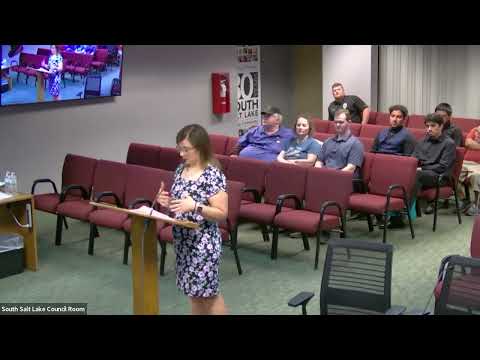
Consultants briefed the South Salt Lake City Council on June 11 about a proposed transportation utility fee that would fund roadways, trails and street lights. After discussion and questions about methodology and exclusions, the council voted to move the item to unfinished business for further notice and review.
Consultant Cody (presenting for the city) summarized the methodology used to calculate the fee: identify operating and capital costs for transportation infrastructure, calculate a revenue requirement, and allocate the requirement across equivalent residential units (ERUs) adjusted for vehicle axle weight. He cited a 10-year capital need of about $68,800,000 (in present-day dollars) and said the proposal was designed to produce approximately $7,000,000 in annual revenue under one scenario, using a total community equivalent of roughly 208,000 ERUs.
Cody explained the recommended rate structure uses four user categories—residential, office, retail/commercial and industrial—with multipliers to account for heavier axle loads on industrial users. He said one ERU equates to 9 typical residential trips per day and that the draft per-ERU charge in the presentation would be $2.79. Using average building sizes in the city, the consultant presented sample monthly charges: a typical office (13,000 sq ft) at about $143.87 per month, retail at about $216 per month, and industrial examples near $517 per month. Cody noted those sample figures assume axle-weight adjustments that other local ordinances shown in his comparison did not use.
Council members asked practical questions about implementation and fairness. Several council members supported excluding residential customers from a charge and discussed whether places of worship should be excluded; Cody noted draft state legislation (House Bill 454) that would have provided guidance had it passed and that, historically, the Utah Supreme Court has found municipalities have authority to implement such fees when they are tied to demand for service.
Council and staff discussed enforcement and practical concerns about heavy trucks using neighborhood streets and sidewalks; staff suggested police could address illegal overnight semi parking and noted that government entities (for example transit agencies or county-owned properties) would be charged based on their classification unless the council elected otherwise.
Council member Clarissa moved to move the item under new business to unfinished business for additional outreach and notice to affected businesses; the motion was seconded by Nick and approved by the council. Staff said they will notify businesses (for example, on July 3 billing) before taking any ordinance action so businesses may comment at a future meeting.
No ordinance or final rate was adopted at the June 11 meeting; the presentation and council direction created next steps: additional outreach to affected businesses, further review of exclusions (residential, places of worship) and return to council as unfinished business.