Get Full Government Meeting Transcripts, Videos, & Alerts Forever!
Get email alerts on the Housing Development topic
No spam. Unsubscribe anytime.
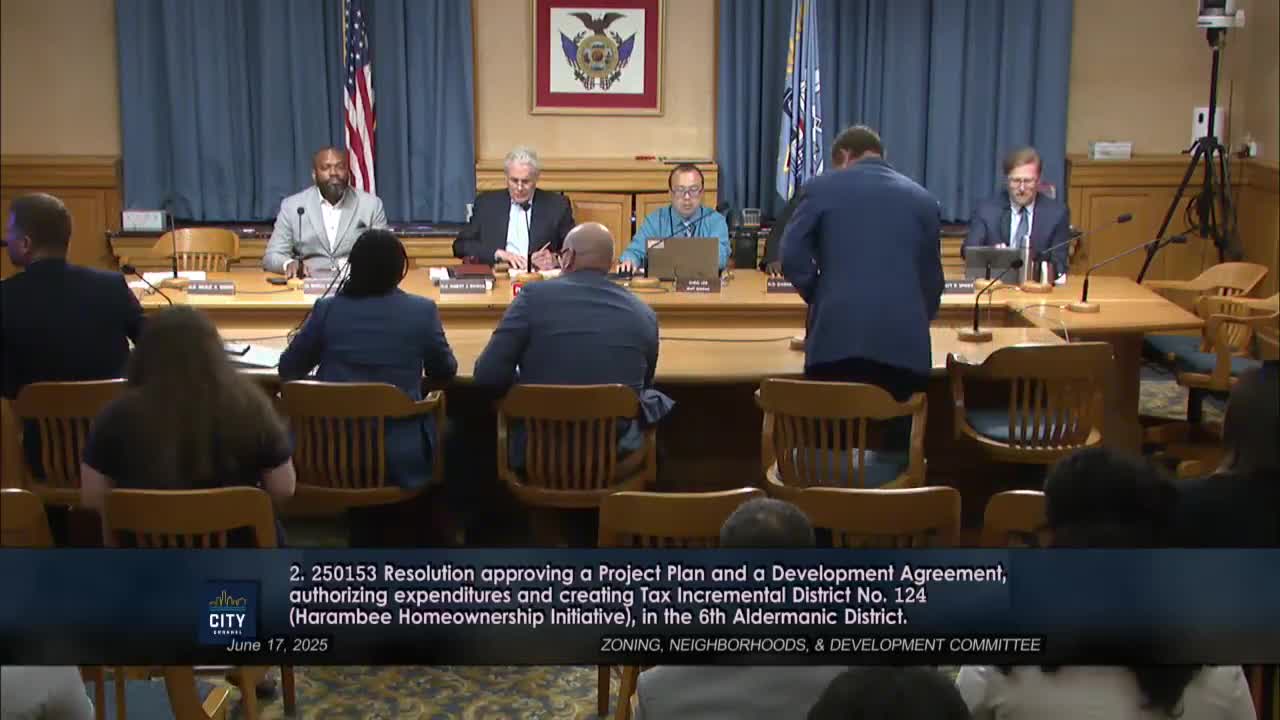
Committee advances TID 124 ‘Harambee Homeownership Initiative,’ clearing way for 59 infill owner‑occupied homes
Summary
The committee recommended creation of Tax Incremental District 124 for the Harambee Homeownership Initiative to support construction of 59 new single‑family homes on vacant city lots, to be developed by Envision Growth and Milwaukee Habitat for Humanity with coordination and gap financing from the Community Development Alliance.
The committee recommended approval of a coordinated package to create Tax Incremental Financing District 124 for the Harambee Homeownership Initiative, a targeted infill and homeownership program on Milwaukee’s North Side.
What the plan includes: The proposed TID boundary would enclose about 193 parcels (described by staff) and direct up to $2.85 million of TID reimbursement to two developers: Envision Growth (proposed allocation about $840,000) to build eight starter homes for early childhood education workers and Milwaukee Habitat for Humanity (proposed allocation just over $2 million) to construct another 51 single‑family houses. Project proponents estimated a total development cost of roughly $17.5 million for all 59 homes and an estimated timeline that would complete the Envision Growth homes by end of 2026 and the Habitat homes by end of 2029.
Delivery structure and financing: The Community Development Alliance (CDA) described a developer‑financed TID structure in which CDA raises philanthropic and debt funds to fill gaps and assumes certain fundraising risk. CDA said it will borrow roughly half of a $2.8 million target and expects to recycle repaid funds for future affordable housing. Project presenters emphasized conservative TID boundary design to limit market‑risk exposure.
Equity, contracting and workforce conditions: Committee members pressed staff and project partners on how the TID interacts with requirements under the city’s Moore Ordinance (SBE/RPP/SVE and RPP apprenticeship rules). Presenters said some ‘best‑efforts’ provisions would apply — notably on RPP/SBE goals — and that Habitat’s nonprofit construction model (volunteer labor, donated materials) was part of the rationale for the funding split. CDA and Habitat described recruitment and workforce partnerships (WRTP/BIG STEP) and contractor pipeline work to expand opportunities for local and underrepresented contractors.
Debate highlights: Aldermen asked whether the city had publicly advertised the parcels for wider developer competition; staff said the eight Envision Growth homes were selected through a prior RFP process three years earlier while Habitat’s role followed long‑standing city practice of offering nonprofit housing groups opportunities for scattered vacant lots. Members also questioned whether splitting the TID allocation across two contracts was a mechanism to avoid triggering certain thresholds in the city’s RPP/SBE rules; DCD staff said the structure reflects two developers with separate contracts and the city’s ability to accept ‘best efforts’ approaches in developer‑financed TIDs.
Committee action: The project sponsor and developers presented; Alderman Cogs moved for the recommendation and committee members voted to advance the TID and associated resolutions with no objection on the motion to recommend adoption.
Why it matters: The TID is intended to convert multiple city‑owned vacant lots into affordable homeownership units and to build capacity for emerging developers; it also raises policy questions about how city workforce and contracting goals are applied and enforced across developer‑financed TIDs.
Ending: DCD and CDA said they will continue reporting on contractor outreach, SBE and RPP implementation as the project moves into procurement and construction.