Get Full Government Meeting Transcripts, Videos, & Alerts Forever!
Get email alerts on the Transit Oriented Development topic
No spam. Unsubscribe anytime.
Miami planning board backs new Transit Station Neighborhood District after heated debate, 6-3
Summary
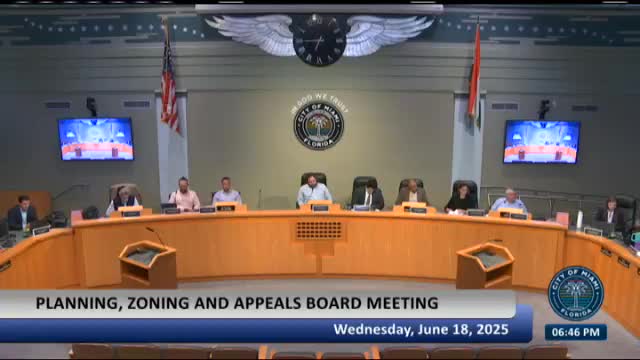
The Miami Planning, Zoning and Appeals Board on Thursday recommended approval of a new Transit Station Neighborhood District program intended to encourage transit-oriented development (TOD) near fixed-rail stations, voting 6-3 after adding conditions that cap taller development between a half-mile and one mile from stations and require the general program to be processed by exception.
The Miami Planning, Zoning and Appeals Board on Thursday recommended approval of a new Transit Station Neighborhood District program intended to encourage transit-oriented development (TOD) near fixed-rail stations, voting 6-3 after adding conditions that cap taller development between a half-mile and one mile from stations and require the general program to be processed by exception.
The recommendation, tied to changes to the city’s Miami 21 zoning ordinance, would establish two participation tiers — a general district and an enhanced district — with mandatory public benefits such as pedestrian and mobility improvements and minimum affordable or workforce housing commitments. Board members, staff and dozens of public commenters debated the program’s geographic reach, required affordable-housing levels and protections for existing neighborhood form.
Supporters told the board the district is intended to promote compact, walkable, mixed-use development within walking and biking distance of fixed-rail service and to align the city’s rules with its recent comprehensive-plan updates. Opponents — including residents from Coconut Grove, Little River and other neighborhoods — warned that the program’s one-mile radius and bonus height could allow high-rise projects to abut low-rise neighborhoods, intensify displacement pressures and bring traffic and parking impacts.
Planning staff described the program as two-tiered. The general district would be processed by warrant (the board amended that to be processed by exception in its recommendation) and allow properties with underlying zoning of T4, T5, T6 or D1 to build up to the T6-12-O standards if they proffer required public benefits. The enhanced district would require a master plan, apply to projects that master-plan at least 3 acres, and require larger public benefits — including a guaranteed 20% of units as affordable or workforce housing across the master-plan area, enhanced landscaping and either construction of, or a substantial contribution to, a fixed-rail station or station improvement (staff estimated a station improvement would be on the order of $35–$40 million).
Planning staff said the general program would require a minimum 10% of units be affordable or workforce housing and that increased public benefits would be required for height bonuses above 12 stories. Staff also told the board the city’s proposed TOD nodes still must be approved by the state as a comprehensive-plan amendment and that the rules apply only to land that both has the TOD node future-land-use designation and meets other program requirements.
Public comment was extensive and often critical. “We think this is a really well-intentioned idea to increase the density. Wonderful,” said Mel Meinhardt of 3075 Virginia Street, but he urged exemptions for special districts and stronger affordability requirements. “Putting these large structures, especially the enhanced ones in a T4 abutting a T3 — that’s putting a 250-foot building next to a townhouse,” Meinhardt said. Arsen Gritsenko of Coconut Grove said new high-rise development near the Metrorail would not address local affordability: “We don’t have a condo shortage in Coconut Grove. These aren’t going to be affordable housing units,” he said.
Others urged the board to tighten geographic limits and increase the city’s affordable-housing proffers. Danielle Villock told the board that allowing taller buildings to radiate in multiple corridors would create “a polycentric high-rise core” and recommended limiting the program to T6 zoning or above and restricting TOD influence to a half-mile radius rather than a mile.
Board members pressed staff on who could apply, program safeguards for historic and conservation districts, and the trade-offs with the county’s Rapid Transit Zone (RTZ) program. Planning staff said historic-district design guidelines, conservation-district requirements and historic-preservation review would continue to apply to projects that opt into the Transit Station Neighborhood District; the program does not exempt applicants from those standards. Staff also said the city had intentionally aligned some affordable-housing thresholds with county rules (the county’s RTZ program requires 12.5% set-aside at a higher AMI in some circumstances) and that the city’s general program uses 10% at a maximum 100% AMI while the enhanced program sets 20% at the same AMI, with higher proffers required for additional height.
Board members proposed and approved a recommendation that the general district be processed by exception and that properties using the general district between a half-mile and one mile of a fixed-rail station be limited to a T6-8 development standard. The board approved the overall recommendation on a 6–3 vote: Mario Bailey, Andres R. Lopez, Arthur Parasoft, Paul Main, Manuel Vidillo and Adam Gersten voted yes; Joseph Carroll, Paula DeCarolis and Javier A. Lopez voted no.
Planning staff told the board they would track applications and suggested that if the exception processing requirement produced an unwieldy administrative burden, it could be revisited after a period of implementation. Staff also said only properties that have the TOD node land-use designation can opt in; the proposed nodes were being considered for state review as part of the city’s comprehensive-plan amendment process.
The board tabled further action on the program until it completed the rest of its agenda and then returned to vote. Several board members urged more outreach and time to refine affordable-housing targets and other conditions before the proposal goes to the City Commission for first reading.
If City Commission adopts the ordinance, projects would still need to satisfy other city and state approvals; staff emphasized that nothing in the program removes historic-preservation review, conservation-district design standards or required setbacks that protect lower-intensity neighborhoods.
—
Speakers (attributed quotes in this article): Planning staff (presenter), Planning Department (role: staff presenter) Catherine Engleton, Planning Department Mel Meinhardt, resident (3075 Virginia Street) Arsen Gritsenko, resident (Coconut Grove) Andy Parish, resident (3940 Main Highway) Danielle Villock, resident (3044 Orange Street) Ed Cruz, resident (2831 South Bayshore) Anna Wenger, resident (3553 Palmetto Avenue) Board members referenced in vote: Mario Bailey (board member), Andres R. Lopez (board member), Arthur Parasoft (board member), Paul Main (board member), Manuel Vidillo (board member), Adam Gersten (board member), Joseph Carroll (board member), Paula DeCarolis (board member), Javier A. Lopez (board member)
—
Authorities referenced: [ {"type":"ordinance","name":"Ordinance No. 13,114 (City of Miami zoning ordinance)","referenced_by":["transit-station-neighborhood-district"]},{"type":"other","name":"Miami 21 (city form-based zoning code)","referenced_by":["transit-station-neighborhood-district"]},{"type":"policy","name":"Miami Comprehensive Plan","referenced_by":["transit-station-neighborhood-district"]},{"type":"other","name":"Miami-Dade County Rapid Transit Zone (RTZ) program","referenced_by":["transit-station-neighborhood-district"]},{"type":"statute","name":"Florida Statute section 286.0115","referenced_by":["transit-station-neighborhood-district"]} ]
Clarifying details extracted from discussion: [ {"category":"affordability requirement","detail":"General program requires 10% affordable/workforce housing at up to 100% AMI (as proposed by staff)","value":"10%","source_speaker":"Planning staff (presenter)"},{"category":"affordability requirement","detail":"Enhanced program requires 20% affordable/workforce housing at up to 100% AMI across the master-planned area","value":"20%","source_speaker":"Planning staff (presenter)"},{"category":"minimum master plan area","detail":"Enhanced program requires 3 acres minimum for master plan applications","value":3,"units":"acres","source_speaker":"Planning staff (presenter)"},{"category":"station investment estimate","detail":"Station construction or substantial station improvement estimated at roughly $35,000,000–$40,000,000","value":35000000,"units":"USD","source_speaker":"Planning staff (presenter)"},{"category":"public benefits","detail":"Pedestrian/mobility connections, enhanced landscaping, public park/open space, mobility amenities, workforce small business support are required benefits for enhanced program","source_speaker":"Planning staff (presenter)"} ]
Community relevance: {"geographies":["Little River","Coconut Grove","Wynwood","Edgewater","Brickell","Vizcaya","Coral Way","Little Haiti","Overtown"],"funding_sources":["city funds","developer proffers","park trust fund"],"impact_groups":["renters","lower-income households","residents in T3/T4 zones","small businesses"]}
Meeting context: {"engagement_level":{"speakers_count":25,"duration_minutes":240,"items_count":1},"implementation_risk":"medium","history":[{"date":"prior meeting","note":"Program and TOD nodes previously discussed and partially adopted as a comprehensive-plan amendment first reading"}]}