Get Full Government Meeting Transcripts, Videos, & Alerts Forever!
Get email alerts on the Municipal Finance topic
No spam. Unsubscribe anytime.
Redding council adopts updated Master Fee Schedule after hours of questions on inspections and utility fees
Summary
Council approved a revised Master Fee Schedule after public hearing and extended discussion about inspection-based charges for water heaters, sprinklers and fire-related permits, plus new recreational and airport fees. Council members and residents pressed staff for methodological detail on several large increases.
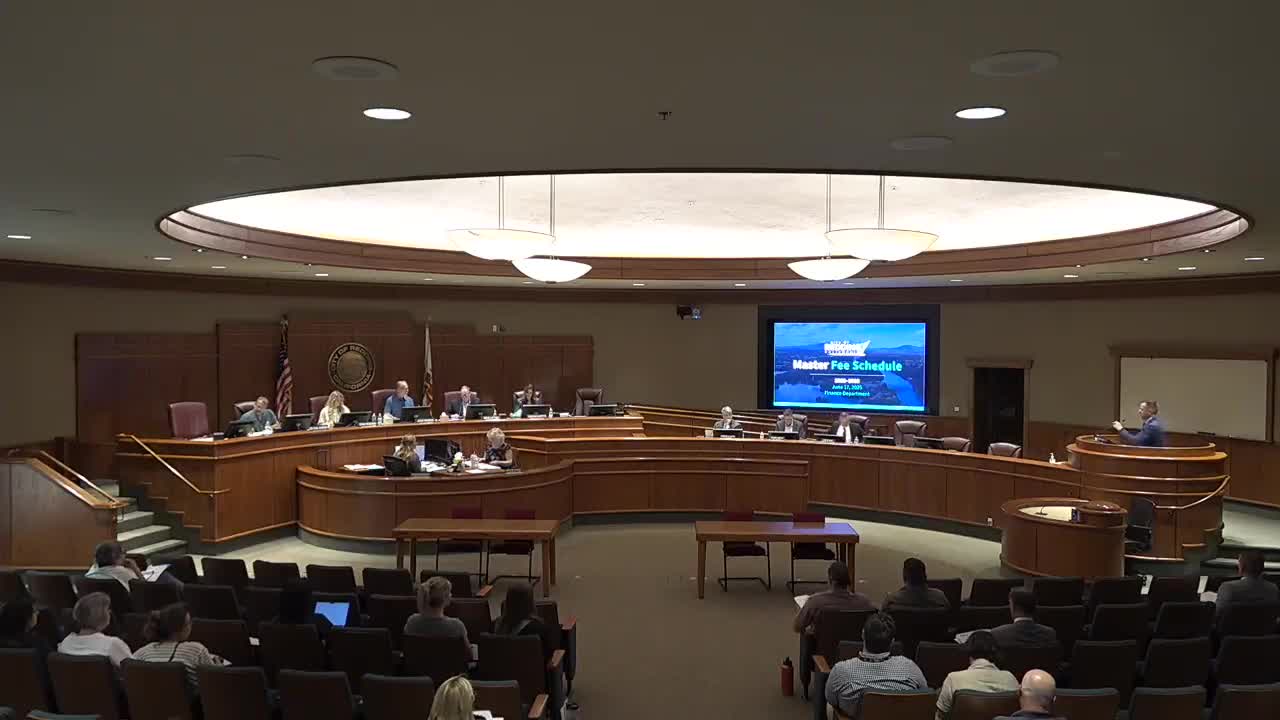
The Redding City Council adopted a revised Master Fee Schedule following a public hearing and extended council questions about how some fees were calculated.
City finance and development staff presented the 12-page schedule and described the methodology used to align fees with estimated staff time and cost recovery. The updated schedule adds new charges (for example, field-preparation for baseball/softball and pickleball court user fees), consolidates some event and parking fees, and adjusts multiple inspection and permitting fees citywide, including building, fire, airport and public-works charges.
City Budget and Finance Director Greg Robinette and Development Services staff told council they reviewed department-by-department cost studies before proposing changes. The presentation emphasized that many fees still recover less than full cost and that staff used Consumer Price Index (CPI) or Construction Cost Index (CCI) escalators for many line items. Where staff used a different method, they highlighted those rows for council review and said they employed time-and-motion estimates to compute staff hours.
Council members pressed staff on specific large increases. Several questioned the decision to align commercial and residential water-heater and HVAC replacement fees, which raised some residential charges to match commercial fees; staff replied that the typical inspections and field time were similar for standard residential and commercial tank water heaters and that the fee was derived from estimated staff time and average inspection frequencies. Fire-related fees increased in places because staff said multiple site visits (pre-piping, pressure testing and final inspection) were standard for some sprinkler and underground fire-service work.
Council members also asked about building fees tied to photovoltaic systems, fire plan reviews, massage-parlor permits, airport terminal rents and long-term parking, and public-works solid-waste lock/padlock fees. Staff said some fees were removed as obsolete (for example, an Aquatic Center card replacement fee), while others were modernized or consolidated to streamline administration.
Public comment included a request for clearer public explanations of large fee increases. Council members asked staff to provide detailed methodology and supporting data for the most significant increases and to consider the impact on residents, small businesses and the general fund if full cost recovery is not achievable.
Council voted to adopt the updated Master Fee Schedule after discussion and questions from multiple members. Staff said departments would be available to answer follow-up questions and that fees using the non-CPI/CCI methodology would be reviewed annually for reasonableness.
The council also noted that some of the increases were phased in (for example, fire inspection fee increases staggered over three years) to limit community impact.
Looking ahead, staff said departments will continue to refine fee language and that council could request additional adjustments if the underlying costing data indicate the need.