Get Full Government Meeting Transcripts, Videos, & Alerts Forever!
Get email alerts on the County Budget topic
No spam. Unsubscribe anytime.
Clay County budget workshop lays out options to close $17M gap, sets timeline for July decisions
Summary
County staff presented two budget scenarios that would reduce or preserve sheriff funding and outlined a timeline that requires action on reserves, ongoing projects and a possible utility tax before July.
Clay County officials presented two budget scenarios June 17 that together aim to close roughly a $17 million gap between projected spending and the county’s reserve targets as the Board of County Commissioners prepares to set a maximum millage rate this summer.
The county’s budget staff, presenting at a workshop, told commissioners the county’s goal is to hold general-fund reserves at 16.7% of revenues — enough to operate about two months while property-tax receipts arrive — and to keep other ad valorem–funded accounts at roughly 5% to 10% reserves. Troy (budget staff) said the county is currently about $17 million short of the 16.7% target under the proposed operating plan.
Why it matters: county staff said the gap would force choices that affect public safety, capital projects and day-to-day operations. The budget office emphasized the tradeoffs between holding reserves for emergencies and funding one‑time or continuing projects, and warned that continued growth in public-safety spending (fire rescue and the sheriff’s office) is outpacing projected ad valorem revenue growth.
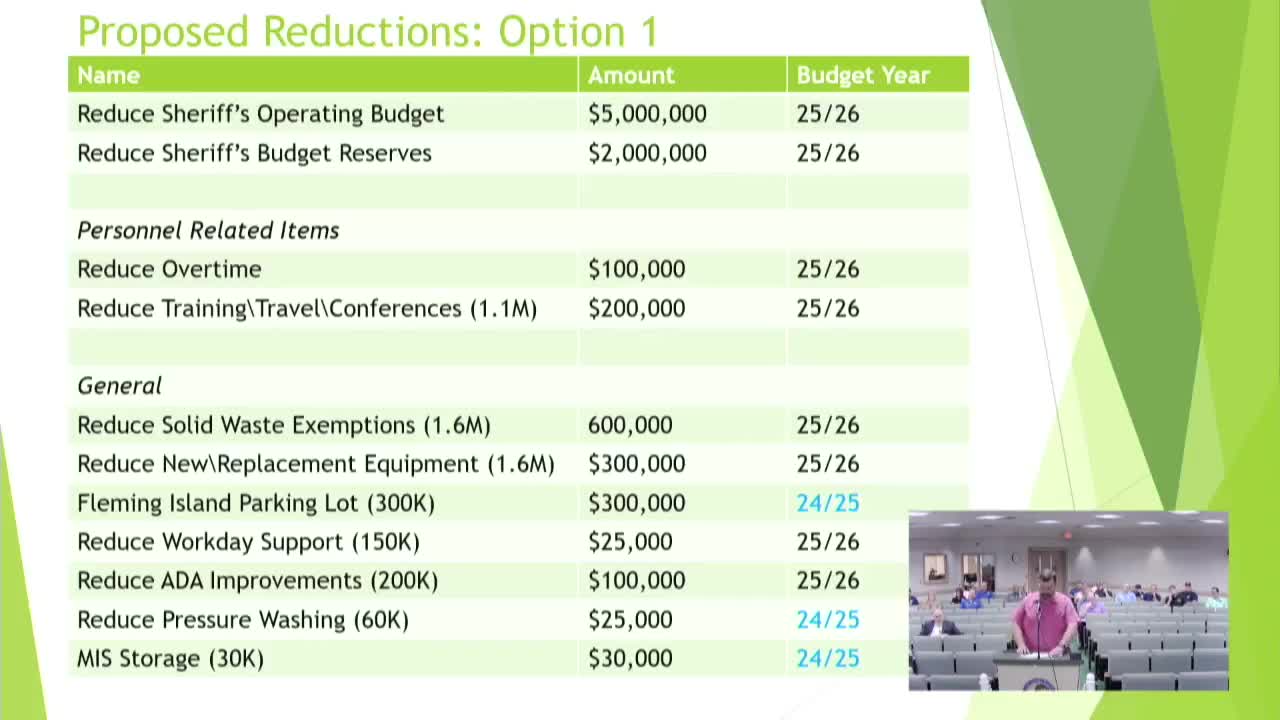
Key numbers and options laid out - Property-appraiser estimate: staff reported a revised taxable-value estimate of 6.6% for the coming year, higher than an earlier 5% assumption but below what would be required to erase the shortfall. - Reserves: target of 16.7% for the general fund; 5% target for most ad valorem–funded funds. - Option 1 (reduction approach): reduce sheriff operating budget by about $5 million and draw $2 million from sheriff reserves (bringing county-wide trimming actions across departments). Staff estimated this option would cut roughly $9.2 million from the Board of County Commissioner (BCC)-related budget and bring the county toward the needed balance. - Option 2 (protect sheriff funding): restore sheriff funding and identify other cuts, including eliminating 15 vacant county positions, trimming the proposed 3% county-wide salary adjustment to 1%, and further cuts to capital projects; staff said Option 2 would require roughly $14.1 million in BCC-related cuts plus about $2.5 million in sheriff reserve reductions.
Staff emphasized two near-term constraints: some projects in the current fiscal year are already under purchase orders or in bid processes (those require board action to cancel and return funds to reserves), and the board must set maximum millage by July 22 under the county’s schedule. Troy asked commissioners to provide direction at upcoming meetings so staff can return with greater detail.
What commissioners asked for and next steps Commissioners asked staff for (1) a project-level accounting showing remaining balances for every current-year and next-year project, (2) vetted options for the solid-waste veterans exemption (several options and price points were discussed), and (3) a joint sheriff/county staff reconciliation of health‑insurance vacancy calculations (staff said solving that difference could reduce the budget pressure by roughly $1.5–$3 million). Staff committed to return with those items at the next meetings: a CIP/CIE update on June 24, a proposed-budget workshop on July 8, and maximum-millage setting on July 22.
Ending County staff and department heads said they will continue to refine the options and return to the board with precise project-level numbers. Commissioners said they will provide lists of “do/don’t” projects and priorities before the next meeting so staff can produce a balanced recommendation in time to set millage and address current-year appropriations.