Get Full Government Meeting Transcripts, Videos, & Alerts Forever!
Get email alerts on the Land Use Zoning topic
No spam. Unsubscribe anytime.
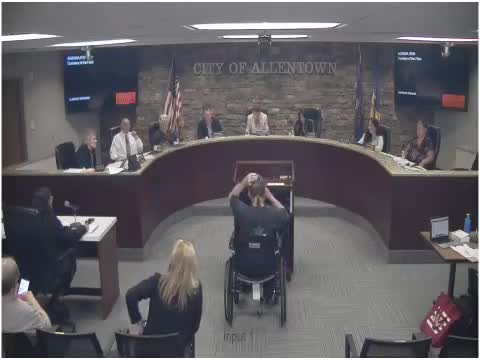
Allentown council amends zoning definition to allow community centers to serve all ages; vote passes
Summary
The Allentown City Council voted to amend Chapter 660 of the zoning code (Bill 16) to change the definition of "community center," removing a restriction that limited dining services to senior citizens. Council and residents debated neighborhood impacts and zoning protections before the measure passed.
The Allentown City Council on Wednesday approved Bill 16, a zoning-code amendment to Chapter 660 that changes the definition of "community center" to remove a restriction limiting food service to senior citizens.
The change makes it explicit that community centers may provide meals to people of any age; council members and staff emphasized that the amendment is a definition change and does not alter existing special-exception procedures for uses in residential zoning districts.
The amendment drew a mix of public comment. Michael Schwer, a resident who submitted a speaking card, said the issue is "where they should be allowed to be fed and where what changes should be able to happen in our communities," and urged council to protect single-family neighborhoods from intensive uses. "We need your help," he said. Schwer also noted concerns about illegal conversions and nuisance activity in nearby blocks.
Council members debated the balance between expanding access to food and protecting neighborhoods. Councilwoman Gerlach asked whether the health department and zoning officers would still regulate food service; City zoning staffer Gomez said food-service operations would be subject to health inspections and that, in residential zoning districts, community centers would remain a special-exception use. "Procedurally on our end, we do a public notice," Gomez said, describing the zoning hearing board process and the standard that the board shall not approve a special exception if it would create a traffic or public-safety hazard or negatively affect the character of a residential neighborhood.
Other council members said the change would not allow community centers to open unchecked in single-family areas. One council member noted that in commercial and industrial districts the rules differ, while in residential districts the special-exception process — with public notice and a hearing before the zoning hearing board — remains in place.
Council President Hammond called the roll on Bill 16 after public comment and discussion. Several council members declared their votes in favor during the roll call, with one council member recorded as voting no. Following the roll call, the president stated that a yes vote meant the bill would pass.
Supporters of the amendment argued that allowing community centers to feed anyone who needs a meal strengthens neighborhoods and connects people to services; a council member recalled eating at church basements and said community centers "add vitality" and "add a sense of community to a neighborhood." Opponents and some neighborhood speakers warned the change could enable new, more intensive uses and urged vigilance from zoning and health officials.
The council and city staff repeatedly emphasized that the bill changes only the definition and does not remove the special-exception review or public-notice requirements for uses in residential zoning districts.
The council approved Bill 16 in a roll-call vote. The bill's amended definition will take effect according to the city's adoption procedures; parties interested in opposing an individual use must raise objections through the existing zoning-hearing process.
Votes and next steps: City staff said that an applicant seeking to establish a community center in a residential district must still file with the zoning officer and, if initially denied as a special-exception application, may appeal to the zoning hearing board, which will hold a public hearing and consider neighborhood testimony and the code's standards.
Community reaction: Speakers at the meeting asked the council to balance access to food with neighborhood quality-of-life concerns. Council members asked staff to ensure neighborhoods receive notice of any applications and reiterated that health inspections and the zoning-hearing process are triggers for enforcement when unpermitted activity is alleged.