Get Full Government Meeting Transcripts, Videos, & Alerts Forever!
Get email alerts on the Staffing And Overcrowding topic
No spam. Unsubscribe anytime.
DOC seeks more officers as overcrowding strains staff; senators press for recruitment, parity and electronic monitoring
Summary
DOC told senators June 17 the system is overcrowded (about 936 inmates across two facilities) and that the agency has about 181 corrections officers and aims to reach 200 by December 2025; DOC said ideal staffing would be about 350 officers under its manning model.
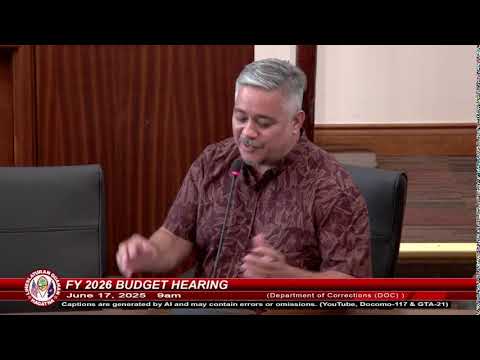
At the June 17 hearing on Bill 44‑38 COR, Department of Corrections officials and senators focused on overcrowding, staffing shortfalls and the operational consequences for inmate and officer safety.
DOC reported combined inmate/detainee counts of roughly 936 — about 713 at Mangilao and 223 at Hagåtña — and said each facility is over design capacity (DOC estimated roughly 130–160 inmates over capacity in each facility). Director Fred E. Bordalli Jr. said recruitment efforts have brought the corrections force to about 181 officers with a departmental target of 200 officers by December 2025. He also said that, using a National Institute of Corrections staffing analysis, a fully manned operation would require approximately 350 officers to staff all posts and shifts according to DOC's preferred manning model.
Senators raised operational ratios from DOC testimony: in some housing posts one officer supervises dozens of inmates and in certain posts the on‑duty ratio can be as extreme as one officer to 70 inmates, depending on housing unit and security classification. Major Anton explained ratios vary by post and housing assignment; DOC said ratio improvements would depend on sustained recruitment and additional funding.
Lawmakers and DOC discussed several recruitment and retention strategies: the administration has approved a 25% differential for some public‑safety positions, and DOC asked the committee to consider parity in uniform stipends (DOC noted a $250 allowance for DOC staff versus $500 for some other agencies). Senators encouraged DOC to request the funds it needs rather than understate shortfalls.
On alternatives to incarceration and population management, DOC described interest in electronic monitoring, more robust pretrial supervision, and a parole reserve program modeled on reserve marshal or corrections reserve programs; senators and DOC agreed these would require both rule changes and funding.
Senators also questioned how the budget will address contraband and misconduct. Director Bordalli and Major Anton said staffing increases, better camera coverage and targeted intelligence and classification (segregation committee, caseworkers, and a threat‑intelligence unit) are part of the plan. Bordalli estimated the condition of facilities on a 1–10 scale as a 4 and said improved staffing and equipment would mitigate many risks.
The committee requested DOC to provide documentation on recruitment, retention initiatives, current sick‑call volumes, and a timeline for reaching staffing targets. No formal vote was taken.