Get Full Government Meeting Transcripts, Videos, & Alerts Forever!
Get email alerts on the Inmate Medical Care topic
No spam. Unsubscribe anytime.
DOC: inmate medical costs driving shortfalls; hospital invoices and MOUs cited
Summary
Department of Corrections leaders told the legislature that inmate medical and behavioral health care are the largest drivers of DOC costs, that GMHA staff assigned to DOC cost roughly $4 million annually, and that DOC owed GMHA about $5 million for inpatient care as of 9/30/2023.
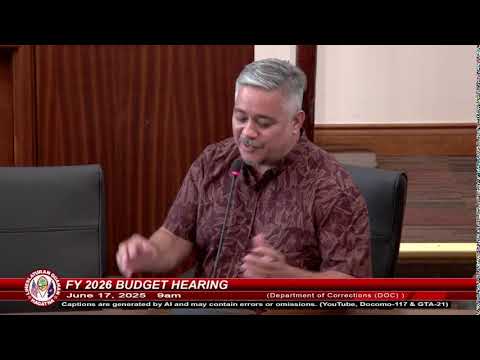
At a June 17 public hearing on Bill 44‑38 COR, Department of Corrections Director Fred E. Bordalli Jr. told the Committee on Finance and Government Operations that inmate medical care is the agency's highest recurring cost and a primary source of budget shortfalls.
"The highest cost incurred by the Department of Corrections are inmate medical expenses," Bordalli said, noting DOC coordinates medical and behavioral health services through a tri‑party memorandum of understanding (MOU) with Guam Memorial Hospital Authority (GMHA) and Guam Behavioral Health and Wellness. Bordalli told senators the DOC clinic receives nursing triage daily and that one physician is on site 40 hours per week.
Major Anton and DOC administrative staff said GMHA provides on‑site medical staff under an MOU and that DOC reimburses GMHA for staff and some supplies. DOC estimated the cost of assigned GMHA staff at roughly $4,000,000 per year. Later in the hearing Major Anton disclosed that inpatient bills owed to Guam Memorial Hospital for DOC‑referred hospitalizations, including prior‑year invoices, totaled about $5,000,000 as of the most recent accounting.
Director Bordalli and staff outlined steps they are exploring to contain costs: identifying inmates' existing health insurance coverage at intake (including Medicare when applicable), pursuing potential Medicaid eligibility where appropriate, and considering legislative options such as inmate co‑payments for nonemergency services (they noted such policies have faced legal challenges in other jurisdictions). Senators requested that DOC provide the committee with weekly sick‑call and clinic usage numbers; Bordalli and staff said they would return with that data.
DOC also said Guam Behavioral Health and Wellness provides behavioral health services under the tri‑MOU and that that agency currently does not charge DOC for its staff assigned to DOC facilities. Senators pressed DOC for additional detail on outstanding hospital debts and whether the 2026 budget request would include funds to retire prior obligations; DOC said some prior‑year obligations exist and that the department is working with BBMR and the governor's office on possible transfers and resolutions.
No formal action was taken; the committee left the record open for written testimony.