Get Full Government Meeting Transcripts, Videos, & Alerts Forever!
Get email alerts on the Prison Construction topic
No spam. Unsubscribe anytime.
DOC budget hearing: A&E procurement for new prison terminated; agency, lawmakers push phased design
Summary
At a June 17, 2025 public hearing on Bill 44‑38 COR, Guam Department of Corrections officials said negotiations for architecture and engineering (A&E) services for a new prison were terminated after a $16 million proposal and that the agency favors a phased design using the legislature's $5 million set‑aside.
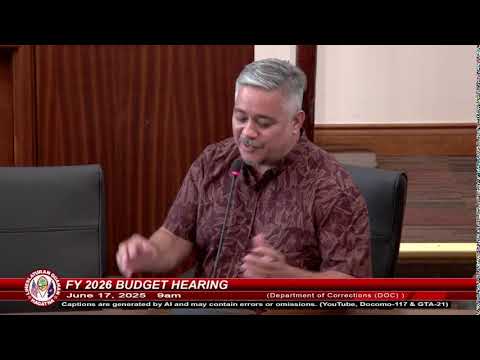
The Committee on Finance and Government Operations held a public hearing June 17 on Bill 44‑38 COR, the governor's FY2026 appropriations bill, and Department of Corrections Director Fred E. Bordalli Jr. told senators the department must restart planning for a new prison after negotiations for A&E services were terminated.
Director Bordalli said a design proposal came back at about $16 million for the architect and engineering work, a figure the department did not have available to commit when negotiations began. "We were just advised by the DPW to terminate negotiations, and we'll probably have to restart all over again," Bordalli said. Major Anton (DOC administrative division) told senators the $16 million reflected a full-phase design estimate and that the department and its partners had tried to negotiate alternatives, including phasing the work and using $5 million per year to advance design in stages.
Why it matters: The department and many senators said a staged approach would make the best use of the existing set‑aside in the prison modernization account while producing tangible design deliverables. Major Anton described the DOC master plan as a long, 80‑year planning document intended to map eventual build‑out of multiple phases; he and other witnesses said a shorter, living plan with 5–10 year updates would be more practical for design and procurement.
Senators pressed for a phased procurement so the legislature's $5 million appropriation can be committed and produce usable design products. Major Anton said a three‑phase approach would likely produce a final design in about three years even if full funding were available up front: "Even if we had the 15,000,000 or 16,000,000 right now, according to the architect, it will still take them about 3 years even if all the money is put into a bank to do it." Chairman Chris Duenas and other members encouraged the department to reissue a more narrowly scoped RFP limited to an initial phase to secure demonstrable progress.
Discussion at the hearing also touched on the distinction between space for sentenced prisoners and pretrial detainees. Bordalli said the department and judiciary had discussed locating a detention facility closer to the courts to reduce transports and security costs; he said other jurisdictions keep sentenced populations separate from pretrial detainees. Senators and the director agreed any relocation or reclassification would require further, formal planning with the judiciary and DPW.
What happens next: The department said it will return to DPW and other partners to refile a procurement that uses a phased approach; the committee left the record open for seven days for written testimony on Bill 44‑38 COR. There was no formal vote at the hearing.