Get Full Government Meeting Transcripts, Videos, & Alerts Forever!
Get email alerts on the School Safety Board topic
No spam. Unsubscribe anytime.
Committee trims school safety advisory board to improve quorum; House Bill 42 sent to floor with due pass
Summary
Representative Ted Hill told the Idaho House Committee on Education he is proposing to reduce the statutory size of the School Safety and Security Advisory Board to solve chronic quorum problems and make the advisory body more effective.
Representative Ted Hill presented House Bill 42 to the House Committee on Education, proposing to reduce and reconfigure the School Safety and Security Advisory Board to address chronic quorum problems and make the advisory panel more functional.
Hill told the committee the existing board, established in Idaho code, had 13 members and ‘‘has been problematic’’ because it often could not achieve a quorum. He said the bill aims to keep a broad set of stakeholders engaged while narrowing voting membership so the board can meet and make recommendations. "We'd like to maintain the broad spectrum of stakeholder representation," Hill said. "You need to talk to the FBI, law enforcement, whatever. Whatever the school threats are."
Matthew Reiber, Strategy and Planning Officer for the State Board of Education, told the committee the board’s invitation list would remain broad and that non-voting experts would continue to be invited to meetings. "We still want the experts in the room," Reiber said. "One thing we've really seen is we want to strike that balance between an effective board that can get a quorum, make decisions, and be effective, as well as a board with the proper expertise."
Quinn Perry, deputy director of the Idaho School Boards Association, testified in opposition to the bill as printed, saying ISBA and the Idaho Association of School Administrators wanted at least one statutorily guaranteed seat for a school official. "We do just wanna be on record that we have some concerns about striking the official affirmative part of having school officials," Perry said. She said ISBA would seek to supply committed local board members to serve if the statute required it.
Sheriff Chris Gertz (identified in testimony as representing local sheriffs) said he was concerned the bill would remove an official law enforcement seat. "We feel that there needs to be a law enforcement person on this committee officially there," Gertz said, adding that the sheriffs' organizations had not taken a formal position as of the hearing.
Committee members debated trade-offs between representation and the ability to reach a quorum. Representative Mathias and others warned that reducing the board could raise the proportion of voting members who were not daily school practitioners and that some statutory decisions elsewhere depend on this board’s recommendations. Representative Garner noted that adding two seats back would still leave a smaller board (an eight-member voting body) that could reach quorum more easily.
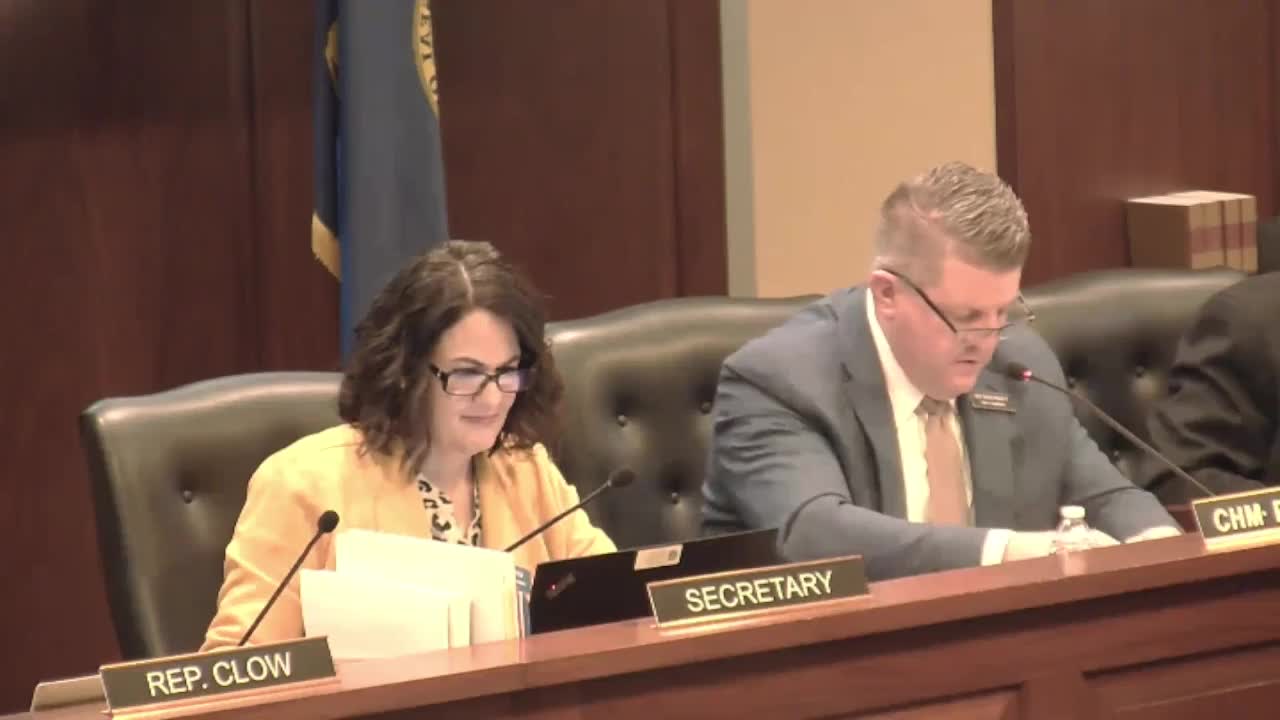
Representative Clow offered a substitute motion to send House Bill 42 to the floor with a due-pass recommendation. The committee conducted a roll-call vote on the substitute motion. The clerk recorded the following votes as read into the record during roll call: Chairman Pickett — Aye; Representative Hawkins — Aye; Representative Lance Clow — Aye; Representative Mendy — Aye; Representative Wischnewski — Aye; Representative Garner — No; Representative Nielsen — Aye; Representative Harris — Aye; Representative Marmon — Aye; Representative Tanner — No; Representative Mathias — No. The committee chair announced the motion passed "by a vote of 8 to 4." House Bill 42 will be sent to the House floor with a due-pass recommendation.
The transcript contains committee discussion about ensuring invited experts (FBI, state police, local law enforcement, school administrators) remain able to attend meetings even if they are not voting members; committee members requested clearer communication about past attendance and appointments. Representative Tanner and others asked whether appointing bodies could commit to designating members who would be able to regularly attend.