Get Full Government Meeting Transcripts, Videos, & Alerts Forever!
Get email alerts on the Utility Usage Tax topic
No spam. Unsubscribe anytime.
Committee sends utility usage-tax bill to the floor aiming to replace property valuation disputes
Summary
House Bill 329 would replace property tax on centrally assessed utilities with a usage-based tax (kilowatt-hour or therm) designed to produce roughly the same statewide revenue and avoid valuation litigation under the federal 4R Act; the committee approved a due-pass recommendation to the floor.
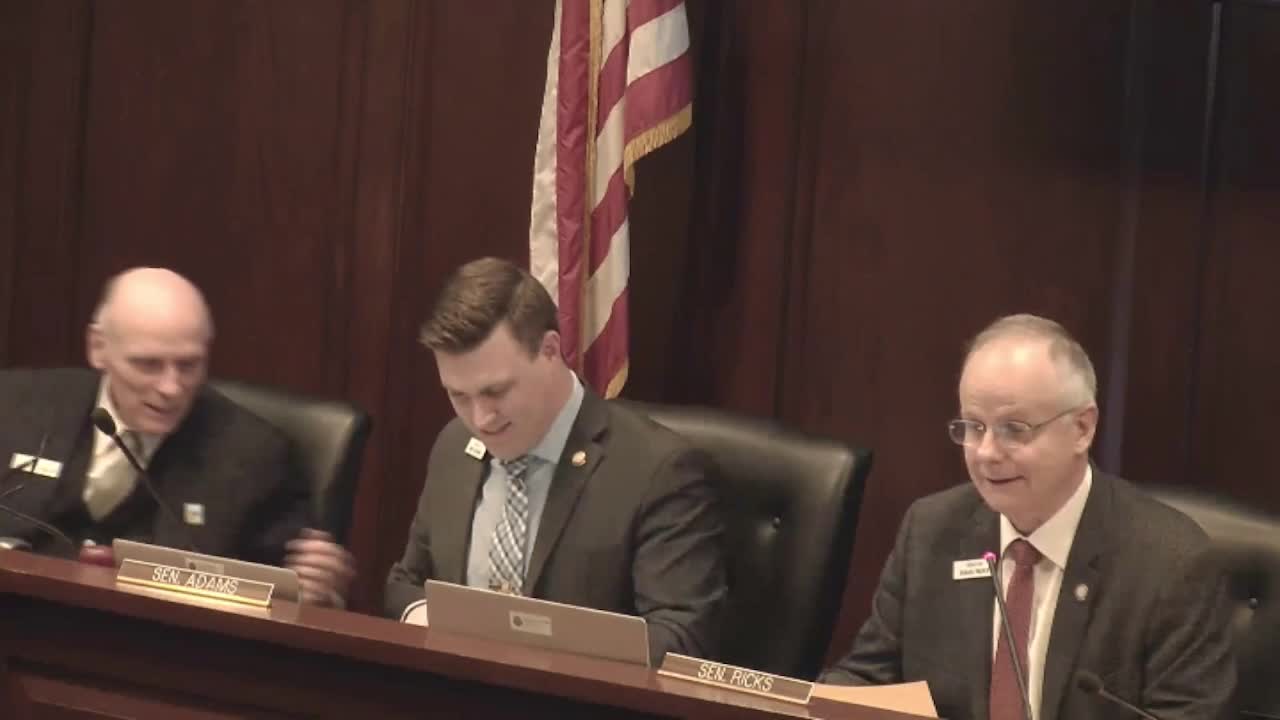
The Senate Local Government and Taxation Committee on voice vote sent House Bill 329 to the Senate floor with a due-pass recommendation after the sponsor described the bill as a negotiated replacement tax intended to avoid litigation over utility property valuations.
Representative Jeff Ehlers, District 21 (Meridian), told the committee the measure responds to court rulings that applied the federal Railroad Revitalization and Regulatory Reform Act of 1976 (the “4R Act”) to centrally assessed utility property. That litigation, he said, reduced the property valuations used in local property tax calculations and shifted tax burdens to other taxpayers. “So what it does is it’s basically a replacement tax,” Ehlers said. “Instead of property tax for these centrally assessed properties … it’s a usage tax. For electrical utilities, it’s a kilowatt hour tax, and for the gas companies it’s a therm tax.”
Ehlers said the rates in the bill were calculated from historical usage data submitted to the Public Utilities Commission and aimed to be revenue-neutral statewide, with an estimated total of about $23 million distributed across taxing districts under the proposed mechanism. He said stakeholders, including utilities and the Association of Counties, participated in drafting the compromise.
Senator Adams asked how confident sponsors were that the new tax would be revenue-neutral. Ehlers said historical averages guided the rate calculation but use can fluctuate year to year and property tax litigation had already reduced assessed values. “We can’t predict in 2026 what the actual usage would be,” he said, but added the bill includes a five-year review provision so future legislatures can revisit the approach.
Senator Berndt moved to send the bill to the floor with a due pass recommendation; Senator Anthony seconded. The committee approved the motion by voice vote. The committee record shows the bill carries support from utilities and county officials who participated in the negotiations.
The bill would re-allocate the same total dollars across taxing districts using a usage-based calculation and apportions those dollars among local taxing districts to minimize distribution changes. Testimony noted variability in usage and potential future adjustments but framed the measure as a way to avoid ongoing appraisal litigation under federal law.