Get Full Government Meeting Transcripts, Videos, & Alerts Forever!
Get email alerts on the Vocational Rehabilitation Audit topic
No spam. Unsubscribe anytime.
Legislative auditors flag internal‑control failures at Idaho Vocational Rehabilitation; federal reallocation, contractor costs and supplements under review
Summary
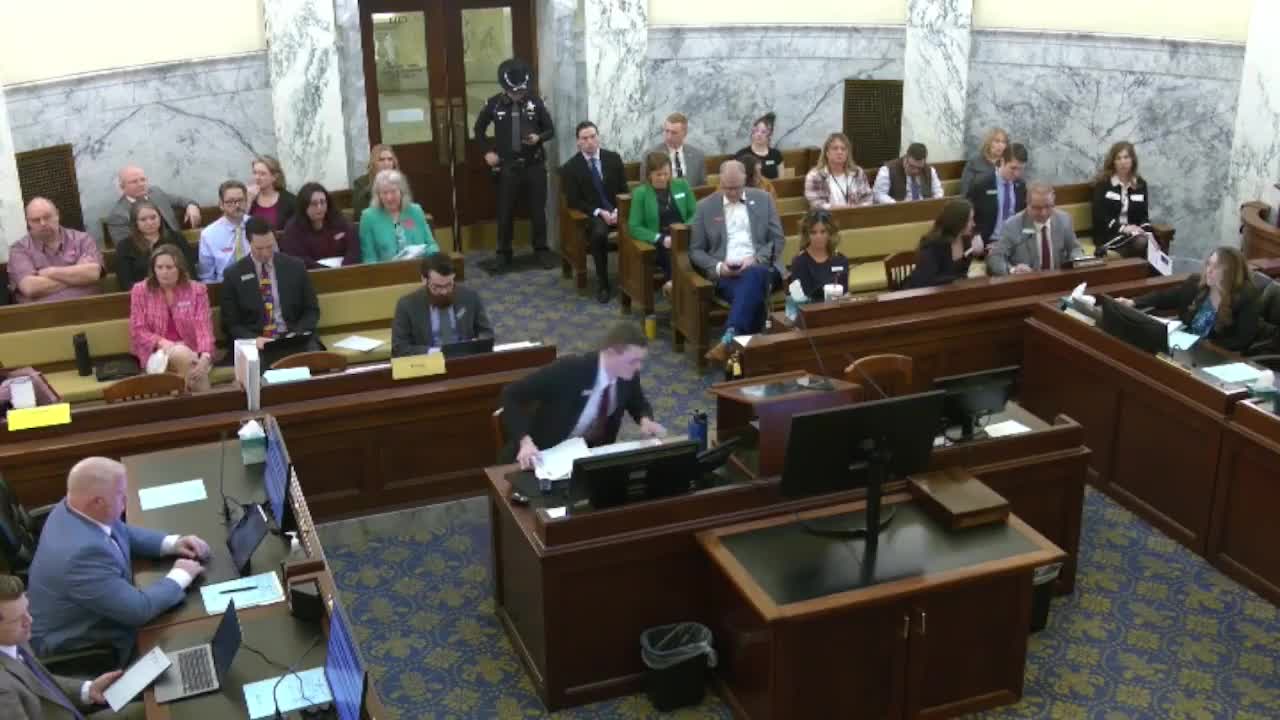
Legislative auditors and agency leaders told the Joint Finance‑Appropriations Committee on Feb. 24 that the Idaho Division of Vocational Rehabilitation failed to implement procurement and accounting controls, prompting a federal high‑risk designation, a $10 million federal reallocation, an expanded consultant contract and state supplemental funding requests.
Legislative auditors told the Joint Finance‑Appropriations Committee on Feb. 24 that the Idaho Division of Vocational Rehabilitation (IDVR) failed to maintain controls ensuring compliance with appropriation laws and federal grant reporting. The finding accompanies a governor‑recognized $10 million federal reallotment, a high‑risk designation by the Rehabilitation Services Administration (RSA), a multi‑million‑dollar consultant contract, and supplemental state funding requests to match federal money.
April Renfro of the Legislative Services Office audits division summarized the office’s Jan. 13, 2025 accountability report. “We issued one finding: the division did not establish procedures and control activities to ensure compliance with appropriation laws applicable to fiscal year 2024,” she told the committee. The auditors recommended procedures to monitor expenditures committed in individual plans for employment (IPEs) and further recommended the division and the Legislature address rising costs and participation.
Brooke Dupree, the legislative budget analyst, explained the fiscal facts: RSA reallocated approximately $10 million in federal Rehabilitation Services Administration funds to Idaho late in federal FY2024; the governor recognized that noncognizable adjustment in September. Dupree said the federal grant requires a state match (about 21.3% of federal spending in the grant formula the analyst cited), and IDVR requested a $2.7 million one‑time general‑fund supplemental to meet the state match for that $10 million. The governor’s recommendation included that $2.7 million request plus an additional $1.7 million one‑time general‑fund request that Dupree described as an estimate for client services that the federal partner might deem ineligible after review.
Renfro said RSA designated the division a “high‑risk grantee” under 2 CFR 200.208 and imposed specific conditions, then required a corrective action plan (CAP). IDVR submitted a CAP on June 17, 2024, but auditors found it lacked measurable steps and timelines. RSA subsequently performed fiscal monitoring and identified three main concerns: weak internal controls, insufficient financial management systems and inaccurate federal financial reporting. The federal monitoring prompted IDVR to hire a private contractor to assist with forensic accounting, reporting and process redesign.
The division signed an initial professional services contract on Aug. 12, 2024, for $499,999 to assist with mapping business processes, period‑of‑performance control analysis, forensic accounting and grants‑management documentation. The agency later amended the contract in November, increasing total contracted support by $1.9 million and extending the engagement through Dec. 2025 — bringing the total contract value to about $2.4 million. Renfro reported that about $900,000 had been paid to the contractor as of the Feb. 24 hearing and noted all contractor payments so far had been charged to the federal grant (which will require state match for the grant as a whole).
IDVR Interim Director Judy Taylor said the contractor was selected under a time‑sensitive single‑source exemption that the division justified to the state purchasing office because the consultant had rare technical experience reprogramming the division’s case‑management system to report charges to the correct federal period of performance. Taylor said the initial work to fix period‑of‑performance issues was largely completed by Sept. 30, 2024, but that subsequent draw requests revealed documentation, invoice and contract problems that required deeper forensic review and remediation.
Taylor warned the committee the division had been close to defaulting on bills without the federal reallocation and contractor help. “We realized running our numbers that we were going to run out of appropriation in early September. By October, we would have been defaulting on our bills and by December we wouldn’t have been able to meet payroll,” she said. Taylor and Renfro said RSA placed additional conditions on the agency and could pursue further enforcement actions if corrective steps are not completed; those remedies can include requiring reimbursement of federal funds or other sanctions.
Audit and agency figures presented to the committee included: roughly 1,950 qualified applicants on an IDVR waitlist and 2,735 active clients; a federal grant that commonly requires a 21.3% state match on expenditures; an earlier transfer of extended employment services out of IDVR to the Department of Health and Welfare that reduced the division’s state appropriation in prior years; and a spike in commitments and unliquidated obligations in FY2023–FY2024 that outpaced appropriations.
Renfro also flagged procurement concerns. The audits office said the corrective action plan did not require a contractor and questioned whether the single‑source procurement exemption and the large contract amendment (quadrupling the initial contract cost within months) were justified given the division’s strained fiscal position. She noted the contractor is based out of state.
Committee members asked whether the federal partners had specified expected remedies or dollar amounts. Renfro said the federal response will determine whether questioned costs must be returned and that RSA may reduce or waive identified amounts depending on mitigating factors. She said the Legislative Services Office will include the matter in the State’s single‑audit work for 2024 and expects that process — and RSA’s eventual determination — to produce a clearer dollar figure, but no final amount was known at the hearing.
Dupree and Taylor said IDVR had submitted draw requests that suffered high disallowance rates on Pre‑Employment Transition Services (Pre‑ETS) reimbursement requests. Taylor said the first large draw had a high “breakage” rate and that IDVR estimated the $1.7 million supplemental request as the expected shortfall for services that may be found unallowable. Taylor also said the forensic audit will review activity back to 2019 for maintenance‑of‑effort purposes and to support any required restatements.
Renfro said RSA’s specific conditions already require enhanced reporting and monitoring; additional enforcement remedies remain available if the CAP is insufficient. The committee did not act on the supplemental requests during the hearing; those items remain decision points for members to consider in subsequent budget deliberations.