Get Full Government Meeting Transcripts, Videos, & Alerts Forever!
Get email alerts on the Elections topic
No spam. Unsubscribe anytime.
Senate committee advances constitutional amendment to require photo ID for voting after heated hearing
Summary
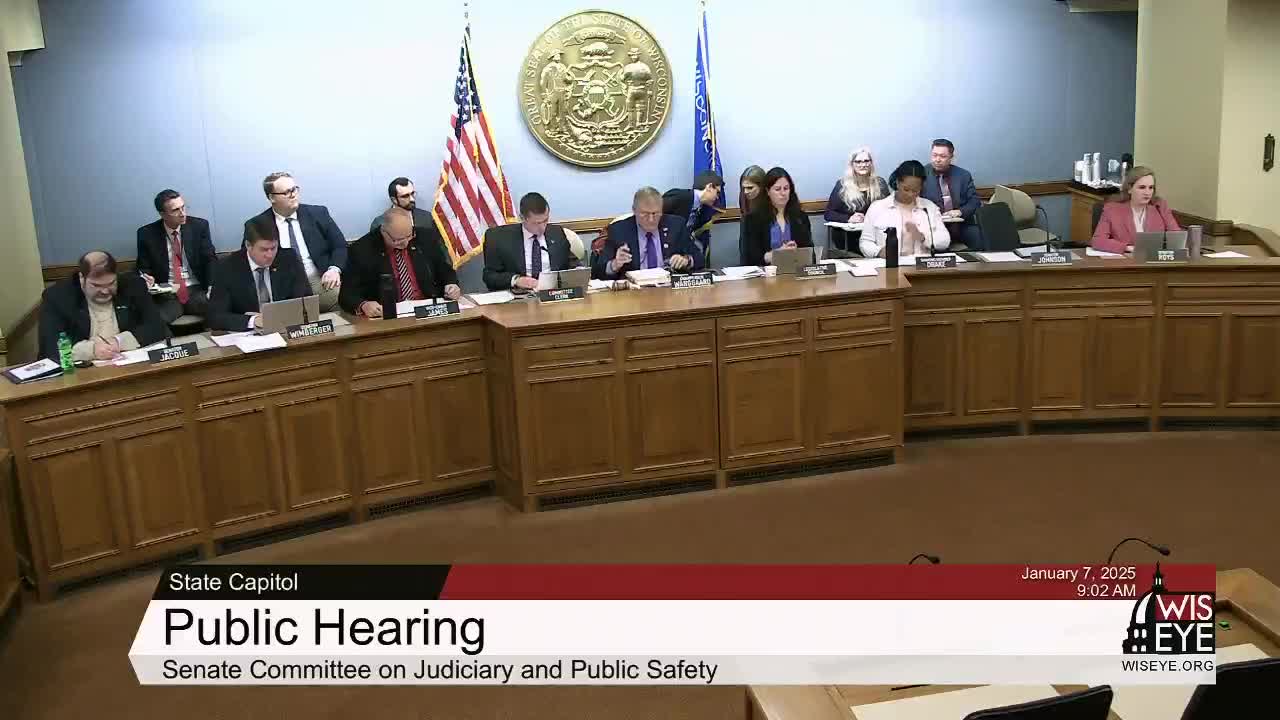
A Senate committee voted to advance Senate Joint Resolution 2 on second consideration after a contentious public hearing and an executive-session vote that split the panel 5-3.
A Senate committee voted to advance Senate Joint Resolution 2 on second consideration after a contentious public hearing and an executive-session vote that split the panel 5-3.
SJR 2 would add a photo-identification requirement to the Wisconsin Constitution and direct the Legislature to provide for provisional ballots that would be counted only if a voter later presents a valid ID. The committee approved the resolution in executive session; the motion was seconded on the record and the committee recorded five members voting “aye” and three members voting “no.”
Why it matters
Supporters said the amendment would lock an existing statutory voter-ID requirement into the state constitution to prevent future court decisions from removing it. Opponents — including disability advocates, voting-rights groups and civic organizations — told the committee the change would cement barriers that disproportionately affect seniors, people with disabilities, students, low-income voters and communities of color.
What happened at the hearing
Vice Chair Senator James presided over the hearing and the panel allowed a series of prepared witnesses to speak for and against SJR 2. The League of Women Voters of Wisconsin, represented by Deborah Kronmiller, urged the committee to reject the amendment. “An expensive law that does not solve a problem but keeps eligible citizens from voting is a net loss for democracy,” Kronmiller said in her prepared remarks, describing studies and estimates of the cost and administrative burdens created by the statutory voter-ID regime.
Civil-society witnesses repeated similar concerns. Sam Lebold, state director for All Voting Is Local Action, told the committee, “It is alarming that 1 day after the solemn anniversary, we are here discussing a measure that would further undermine access to the ballot, a corner stone of our democracy.” Bianca Shaw, a campaign manager for the same organization, and Nick Ramos of the Wisconsin Democracy Campaign warned the amendment would enshrine barriers and could depress turnout among already underrepresented groups.
Disability Rights Wisconsin’s public policy manager, Lisa Hassenstab, told the committee the state’s transportation and documentation systems leave many voters with disabilities at a disadvantage: “The CDC indicates 26% of adults have some type of disability,” she said, and many lack reliable access to DMV locations, accessible vehicles or the underlying documents the DMV requires.
Legislative counsel summarized the effect of the proposed constitutional language and clarified how provisional ballots would work if the amendment were adopted: “The proposed constitutional amendment does require that provisional balloting be available. However, you would still have to return and present a valid voter ID in order for that provisional ballot to be counted,” counsel said, and noted voters may present the ID at the polling place during hours or at the clerk’s office by a statutory deadline.
Supporters’ arguments
Authors and supporters told the committee the amendment only codifies existing statutory law and argued it would preserve voter confidence. Sponsors emphasized the measure would not change which documents count as valid ID under statute and that the constitutional route makes repeal more difficult; supporters said that is important because of recent and ongoing litigation over previously settled laws. Supporters also noted that state-issued identification for voting is available at no direct charge from the DMV and that the amendment allows the Legislature to create statutory exceptions.
Opposition and concerns
Opponents and testifying organizations raised several practical and equity concerns: the cost and time to obtain underlying documents (for example, out‑of‑state birth certificates), limited DMV hours and locations in rural areas, accessibility problems at some DMV centers, and the additional burden on voters who would need to return after Election Day to have a provisional ballot counted. Multiple witnesses and committee members also cited studies and post‑enactment analyses they said show the law has had a disproportionate effect on certain populations.
Committee action and next steps
The committee moved SJR 2 to passage in executive session. The motion was seconded on the record; recorded votes and names were read aloud by the clerk. The committee recorded five “aye” votes and three “no” votes. (The measure now proceeds to the full Senate and, if passed by a second legislature in a subsequent session, would go to a statewide referendum.)
The resolution’s backers told the committee they are pursuing the timing needed to place the question on an upcoming spring ballot; opponents said the Legislature should focus instead on measures that expand access to the ballot and on other policy priorities.
What the amendment would require if ratified
- The Wisconsin Constitution would explicitly require voters to present photographic identification (types of acceptable ID remain subject to statute). - The Legislature must provide for provisional ballots; under counsel’s summary these ballots would be counted only after the voter presents valid ID, within the time prescribed by statute. - Constitutional amendments require passage in two successive legislatures and ratification by statewide vote.
Closing note
The committee hearing drew a broad slate of civic‑society witnesses and debate that highlighted competing concerns about election integrity and access. The full Senate will take up the measure next; if it again passes in a subsequent legislative session, SJR 2 would appear on a statewide ballot for voters to decide.