Get Full Government Meeting Transcripts, Videos, & Alerts Forever!
Get email alerts on the Student Transportation Software topic
No spam. Unsubscribe anytime.
Statewide student‑transportation routing software proposed as optional tool; purchase contingent on legislation, officials say
Summary
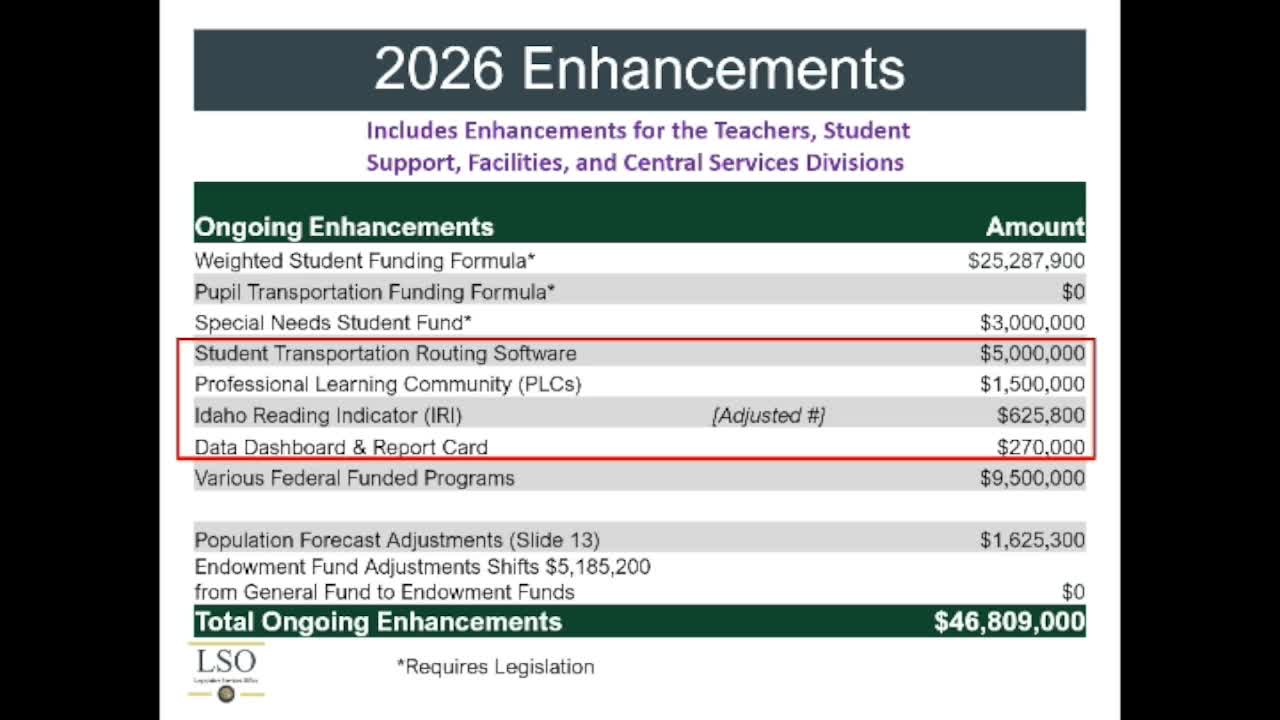
Legislative and Department of Education officials told the Joint Finance‑Appropriations Committee they want to make statewide routing software available to districts as an optional contract to improve route efficiency, but that acquisition depends on legislative action and no request‑for‑proposal is yet final.
BOISE — Idaho education officials and analysts told the Joint Finance‑Appropriations Committee on March 4 that a proposed statewide student‑transportation routing software contract would be optional for school districts and charters and is intended to reduce reported miles and improve route accuracy.
State Superintendent Debbie Critchfield and Gideon Toleman, a department finance official, described the proposal as an optional statewide contract that smaller districts may not currently be able to afford. "A lot of districts and charters don't have any routing software at this point, and particularly for our smaller districts and charters it's cost prohibitive," Toleman said. He and the superintendent said the goal is accurate reporting of miles and ridership and more efficient routes that could save state dollars over time.
Key points: Committee analysts flagged that the routing‑software request is contingent on legislative action tied to the budget; the department has not issued an RFP or completed procurement. Superintendent Critchfield described the acquisition as "contingent upon legislative action with the budget," and the department told members they had examined available products but had not finalized procurement.
What was not decided: Committee members asked how many districts already use routing software and how many could benefit; department officials did not have a statewide inventory on hand and said they would supply numbers on current usage and potential take‑up. No dollar amount for a statewide contract was shown during the committee discussion; members asked for a cost estimate and a count of districts currently using routing software.
Context: Committee members were also briefed elsewhere in the hearing on the transportation funding formula and a separate statutory transportation funding bill that staff said was scheduled for consideration at a later hearing. The routing‑software request was presented under central services and described as an optional tool districts could adopt to improve mileage reporting and route accuracy.
Next steps: The department agreed to follow up with committee staff on (1) how many districts and charters currently use routing software, (2) how many could potentially adopt statewide software under an optional contract, and (3) estimated procurement and implementation costs.