Get Full Government Meeting Transcripts, Videos, & Alerts Forever!
Get email alerts on the Public Health Budget topic
No spam. Unsubscribe anytime.
Joint Finance hears Public Health Services budget, data modernization and program restorations
Summary
Department of Health and Welfare officials told the Joint Finance-Appropriations Committee the Division of Public Health Services requests restorations of previously reduced ongoing programs, one-time ARPA-funded projects for data modernization and a $500,000 rural physician incentive addition in its 2026 budget request.
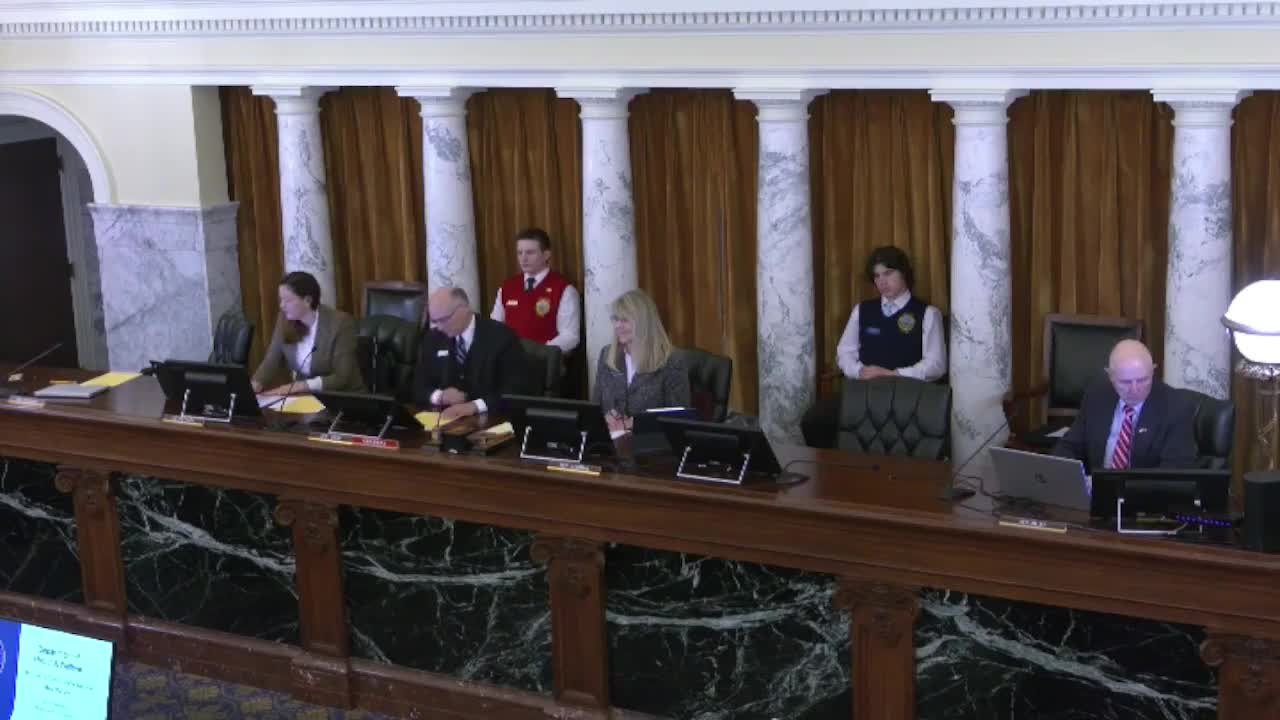
At a Joint Finance-Appropriations Committee hearing Monday in Boise, state health officials outlined the Department of Health and Welfare’s Division of Public Health Services budget request for fiscal 2026, asking the committee to restore a number of ongoing programs, approve one-time enhancements largely tied to ARPA and federal grants, and fund targeted incentives for rural physician recruitment.
The request matters because the Division of Public Health Services oversees immunizations, communicable-disease response, laboratory services, suicide-prevention programming and other statewide preventive programs that affect vaccine access, data reporting and public-health workforce capacity across Idaho.
Division staff described the agency as five programs managed through contracts with local public health districts and community providers. Keith Bybee, division manager of budget policy analysis, briefed the committee on the structure and numbers in the request. He said the division had 256.52 established full-time-equivalent positions and four vacancies as of Aug. 31, 2024, and that the 2025 appropriation was about $164.02 million.
Director Alex Adams, who led the department’s presentation, said the 2026 request reflects a structural correction after several years of one-time federal funds. “I would characterize it as a healthy exercise,” Adams said, describing a roughly 6% year-over-year reduction in the division’s budget in the governor’s recommendation compared with the prior year. He said the reduction stemmed in part from reclassifying some previously ongoing programs as one-time appropriations and other base adjustments.
Committee members were shown a set of one-time enhancement requests on Slide 266 of the legislative budget book that include several data modernization efforts. The department said the agency’s one-time requests total $8,752,500 and are largely federal or ARPA carryover funds; the governor recommended those items. Staff described Data Modernization II, epidemiology and laboratory capacity grants, a vital statistics modernization of birth and stillbirth registration, and a WIC (Women, Infants and Children) systems upgrade among the items tied to federal grant sources.
Among the one-time and ongoing items discussed were:
- Communicable disease prevention grant: a year‑4 federal grant request of $2,041,800 one-time to support 4.4 limited‑service positions (department slide text). - Ongoing program restorations: the agency requested $20,846,300 ongoing to restore programs moved to one-time status; the governor recommended $21,464,500, including $500,000 for a rural physician incentive program. - Suicide prevention: a requested restoration of $1,807,700 from the general fund and $195,000 in federal funds for the statewide suicide‑prevention program established by the legislature in 2016. - Drug overdose prevention: a restoration request of $2,820,200 and four full‑time equivalent positions for the Drug Overdose Prevention Program. - Refugee health screening: restoration of 1.5 FTE and $991,000 ongoing for refugee arrival health screenings in Boise and Twin Falls. - Alzheimer’s and dementia programming: a $275,200 ongoing request to coordinate a statewide Alzheimer’s and related dementias alliance. - Fit and Fall Proof: $140,000 ongoing to support the community‑led fall‑prevention exercise program for older adults. - Immunization assessment and vital records: the division asked for $2.5 million ongoing from dedicated immunization assessment funds to support the Idaho immunization program; slides also referenced a $22.5 million figure tied to the immunization assessment fund without further explanation in the hearing. The bureau of vital records requested $150,000 ongoing from dedicated funds to support timely processing of birth, marriage and death records. - Home visiting: $725,900 ongoing in federal funds to expand home visiting services for at‑risk parents in counties identified by a needs assessment.
Division Administrator Elke Shaw Tullock described retention rates for the rural physician loan‑repayment program tied to the department’s health workforce initiatives. “We have a very high retention rate. Almost 91% of the providers that receive these loan repayments stay in the state and practice in the state,” she said.
Committee members asked about the department’s decisions to remove certain items from base budgets in recent years and whether some programs would be better housed in other agencies. Director Adams said the department is open to transfers where appropriate and noted efforts to narrow the agency’s focus to core responsibilities. Several lawmakers raised concerns about pass‑through grants and programs the department administers but does not directly manage, citing Project ECHO as an example of a program some legislatures treat as a pass‑through.
Adams and staff reiterated that some requests and restorations are contingent on federal grant availability and prior legislative actions. He also said the department had dissolved the Bureau of Equity and removed roughly 30 policies during recent budgeting work.
The committee did not take final action during the hearing; members were encouraged to follow up with analysts for line‑by‑line questions. Staff advised legislators to contact the agency’s budget analyst for further detail on IT modernization work and federal grant accounting.
The presentation and committee questions underscored two recurring themes: the department’s push to modernize data systems used for vital records and public‑health surveillance, and the legislature’s attention to which functions are run as ongoing state obligations versus one‑time, federally funded projects.
Committee work on the public health budget continued through follow‑up conversations and analyst briefings after the hearing.