Get Full Government Meeting Transcripts, Videos, & Alerts Forever!
Get email alerts on the Community Corrections Reentry topic
No spam. Unsubscribe anytime.
Idaho requests more probation/parole staff, Pocatello reentry center funding and pilot for medications for opioid use disorder
Summary
The Community Corrections Division asked for annualized funding for newly added staff at the Pocatello Community Reentry Center, five additional parole officers in two districts, expanded drug testing and a pilot to begin medications for opioid use disorder for incarcerated people before community reentry.
The Joint Finance Preparations Committee heard requests Tuesday for additional staffing and programmatic expansion in Idaho’s Community Corrections Division, including annualizing recently added Pocatello Community Reentry Center positions, more parole officers for Districts 3 and 4 and a pilot to provide medications for opioid use disorder (MOUD) to incarcerated individuals prior to release.
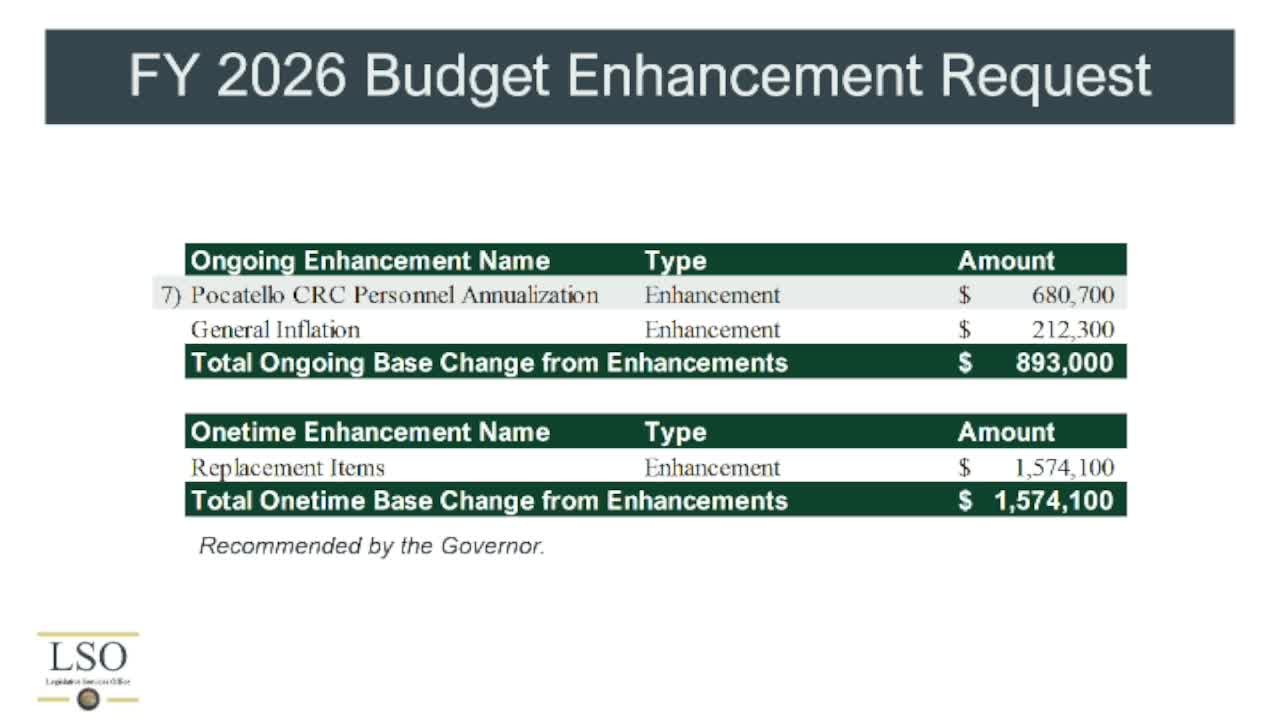
Noah Peterson, a budget and policy analyst with the Legislative Services Office, told the committee the Community Corrections Division has 511.35 FTP and that recent enhancements included 20 FTP related to reentry operations and 17 of those posts had six months of funding provided in the prior appropriation. “The Pocatello CRC personnel annualization is the amount needed to fund ongoing the additional 6 months of personnel costs for those 17 positions,” Peterson said, listing an annualized personnel cost of $680,700 for those positions if approved.
The division also highlighted a $721,200 ongoing increase for expanded drug testing (including fentanyl testing) and a $750,000 request for transitional housing and reentry supports. Peterson noted a $522,900 appropriation had earlier been made to raise starting pay for parole officers by $0.85, and the division requests six additional parole officer FTP and $616,500 ongoing for Districts 3 and 4.
Peterson said the agency also requested two FTP and $580,400 for a pilot to provide MOUD while people are incarcerated, with the FTP serving as case managers to coordinate post‑release community treatment.
All items presented for Community Corrections were recommended by the governor, Peterson said. Committee members did not act on the requests in the hearing but asked for follow‑up details about caseloads, outcome measures and how the MOUD pilot would be structured and evaluated.