Get Full Government Meeting Transcripts, Videos, & Alerts Forever!
Get email alerts on the Prison Security Transport topic
No spam. Unsubscribe anytime.
After transport ambush, Idaho prison system seeks surveillance upgrades and expanded transport team
Summary
Following a spring ambush during a return transport, Idaho corrections proposed digital mail scanning, drone detection, phone‑call transcription and a 12‑position expansion to the transport bureau to reduce risk and take pressure off facility staff. Lawmakers questioned staffing math and requested implementation data.
The Idaho Department of Correction told the Joint Finance Preparations Committee on Feb. 4 that a high‑risk ambush of facility staff during a medical transport last spring prompted several supplemental and ongoing budget requests to harden security, deploy new surveillance tools and create specialized transport capacity.
Noah Peterson, budget and policy analyst with the Legislative Services Office, said the requests are designed to “address vulnerabilities that were discovered within the agency” after the incident in which three IDOC staff were shot while escorting an inmate to an emergency medical facility.
The agency’s proposals include a package the presentation described as “advanced surveillance technology” that would digitize inmate mail, add drone‑detection systems and implement a phone‑call transcription/analysis platform (referred to in the presentation as LEO intelligence software). Peterson said the digital mail scanning would route physical mail to an off‑site unit where it would be opened, scanned and delivered to residents electronically; the initiative would also fund a standalone illicit‑substance test unit.
The department requested $795,000 in one‑time funds to begin implementation in fiscal 2025, and $2,397,000 ongoing in fiscal 2026 to maintain the full suite: roughly $1,011,000 for mail scanning, $385,500 for drone detection and $1,000,000 for phone transcription and analysis.
Peterson said the department handled about 4,000,000 phone calls totaling roughly 49,000,000 minutes in 2023, which is the input volume the transcription software would process.
In addition, the department proposed a supplemental to expand the statewide Transport Bureau so it could handle emergency medical transports; the request included funding for 12 full‑time positions, seven equipped vehicles (six SUVs and a wheelchair van) and related equipment. Peterson explained the bureau currently handles scheduled, non‑emergent transport but does not typically execute emergency medical transports — those are staffed by facility personnel assigned other duties.
Director Josh Tewalt told lawmakers the Transport Bureau expansion is intended to create a resource for high‑risk emergency transports rather than supplant every local response. He described the operational reality in a high‑security facility: when emergency response teams are activated, posts must be covered, overtime spikes and trained staff are pulled from other duties. “We generated 20,000 hours of overtime at ISCC; we generated 14,000 hours of overtime at IMSI,” Tewalt said, adding that providing the same advanced training to every line officer at every facility would require an even larger staffing increase.
Tewalt said the goal of adding 12 FTP to the Transport Bureau was to cover relief factors and specialized skill requirements without “double digit” staff increases at each high‑security facility. Senator Cook asked why the request did not offset existing posts; Peterson said the agency would be better positioned to address reallocation questions, and that overtime hours were a key driver.
The agency also requested a federal body‑worn camera grant pilot for three sites (Idaho Maximum Security Institution, a District 3 probation and parole office, and the IDOC special investigations unit). The year‑one request is primarily federal funds; the agency will need state match dollars in 2026 and 2027 if the pilot proceeds.
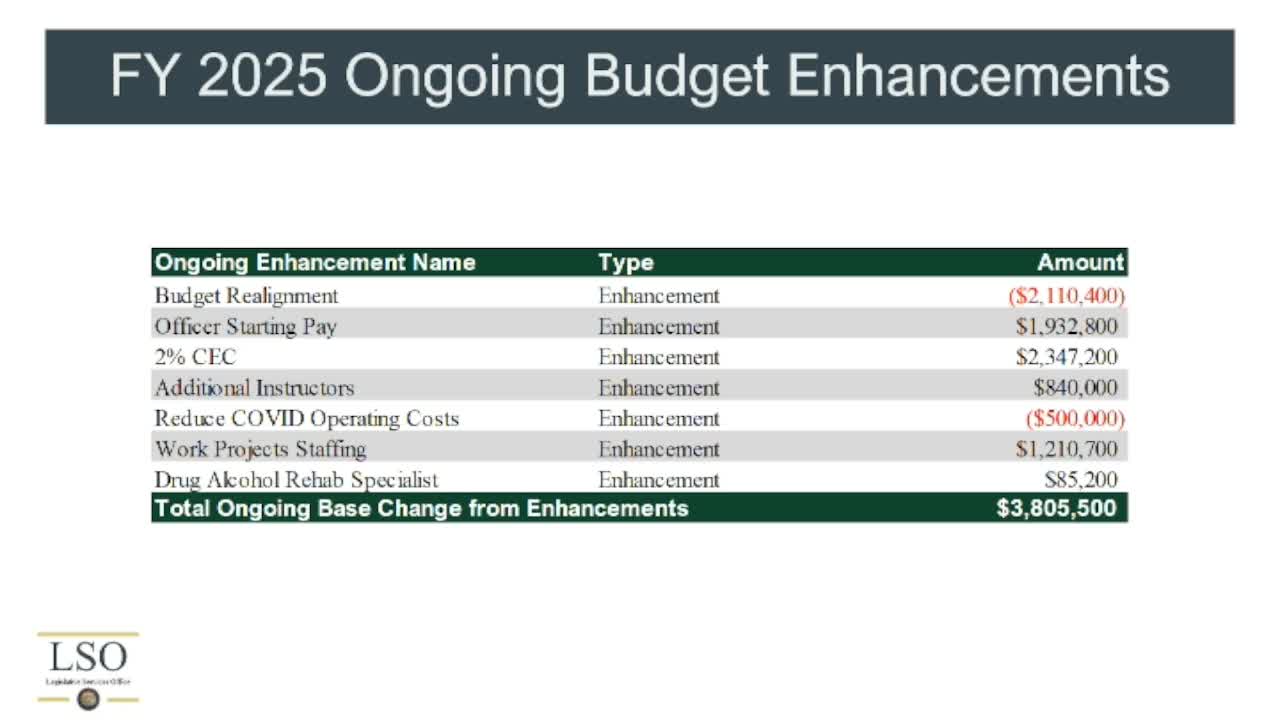
Other items in the packet included $83,200 ongoing for a skid‑steer (later clarified by the governor’s office as a preference for contracting snow removal at St. Anthony’s Work Camp at $30,000 ongoing instead of purchasing the equipment), $5.7 million one‑time for vehicle and equipment replacement across facilities and smaller line items for equipment and supplies.
Lawmakers pressed the department for written updates on GPS monitoring pilots and asked for clearer cost comparisons and staffing analyses before approving permanent staffing changes. No votes were taken during the presentation.