Get Full Government Meeting Transcripts, Videos, & Alerts Forever!
Get email alerts on the Corrections Technology topic
No spam. Unsubscribe anytime.
Idaho corrections seeks ongoing funding for Recidiviz tools, inmate transparency platforms
Summary
The Idaho Department of Correction on Tuesday requested ongoing funding for Recidiviz case‑management tools and several transparency subscriptions, saying the systems streamline casework for probation, parole and prison case managers and that philanthropic matching has offset earlier costs.
The Idaho Department of Correction on Tuesday asked the Joint Finance Preparations Committee to approve ongoing funding for several technology and transparency tools, including an extension of its partnership with the nonprofit Recidiviz and subscriptions that provide detainees with digital access to court materials.
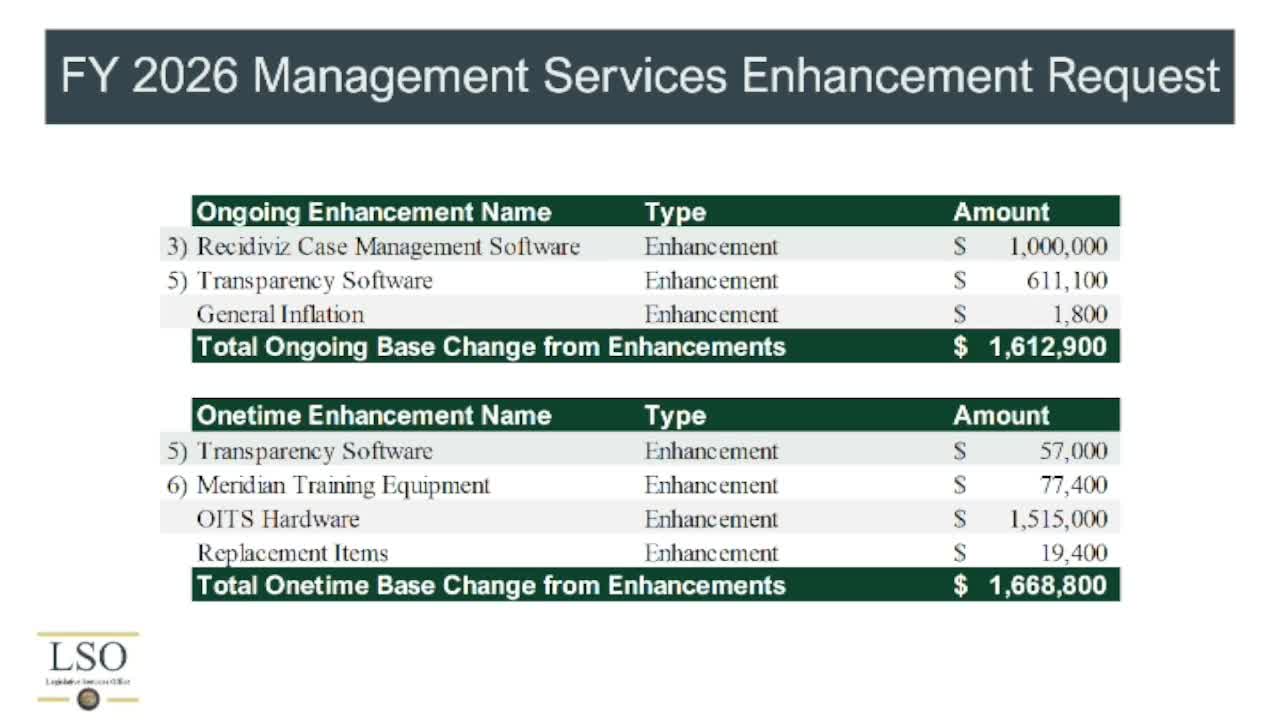
At a committee presentation, Noah Peterson, budget and policy analyst with the Legislative Services Office, reviewed the Department’s Management Services Division requests and said the division recently received a general‑fund appropriation to continue case‑management software work begun with federal and philanthropic dollars. “The management services gained an appropriation of $910,000 from the general fund for recidivism case management software,” Peterson said, directing members to slides in the committee packet.
Director Josh Tewalt told the panel Recidiviz is “probably the most transformative partnership we’ve entered” during his tenure. He described Recidiviz as a nonprofit technology partner that aggregates disparate corrections data, creates dashboards and automations and has been used in Idaho probation and parole to triage caseloads and surface officer‑level outcomes. “They create overlays… and automate a lot of processes that take a lot of staff time,” Tewalt said. He said the work in probation and parole will be extended to prison case managers to speed classification and track pro‑social behavior in more real time.
Tewalt said prior appropriations for work with Recidiviz totaled about $1.5 million and were “mostly appropriated from federal funds,” and he added the nonprofit leverages private philanthropic matching so “for every dollar we spend, they match with private foundation money.” Committee members asked for outcome data and dashboards used internally; Tewalt and Peterson said the agency could provide visualizations and that Peterson would work with the agency to gather hard data on return on investment.
The department also requested ongoing subscriptions and one‑time implementation funds for several transparency and access tools. Peterson listed a $668,100 request overall for “transparency software” that included: - GovQA public‑records software: $58,700 ongoing (manages ~6,000 public‑records requests annually), - LexisNexis subscription: $69,700 ongoing (digital access to case law for residents), - “Access to courts” (ATC) database: $90,000 total ($33,000 ongoing; $57,000 one‑time implementation), and - $250,000 ongoing for continued customization and upgrading of the agency’s offender management system (Atlas).
The department also requested $77,400 one‑time for training mannequins and a “light duty” training vehicle; $1,515,000 for IT replacement items (laptops, desktops and other hardware) recommended by the Office of Information Technology Services; and a one‑time $85,000 appropriation to pilot a special assistant U.S. Attorney position in North Idaho focused on drug trafficking, mirroring similar positions in other regions.
Committee members expressed interest in seeing outcome metrics and raised questions about contract terms, data control and the risk of creating ongoing general‑fund obligations after initial federal funding. Representative Tanner and Senator Cook asked for sample dashboards and cost comparisons with other products; Tewalt said Recidiviz’s model differs from commercial off‑the‑shelf systems because it minimizes new data entry by staff and focuses on surfacing existing data from legacy systems. “We control the data,” Tewalt told lawmakers, and he said data‑sharing agreements and protections are in place.
Peterson noted that past Recidiviz appropriations were largely one‑time funds to build tools, and the department’s current request would shift some of that into ongoing support for continuous development and broader deployment in prisons.
The committee did not take a vote during the presentation. Lawmakers asked the department to provide more detailed outcome metrics, cost comparisons with alternatives and written updates on other items (such as an ongoing GPS pilot).