Get Full Government Meeting Transcripts, Videos, & Alerts Forever!
Get email alerts on the Public Health Budget topic
No spam. Unsubscribe anytime.
JFAC approves Public Health Services enhancements, directs multiple department studies
Summary
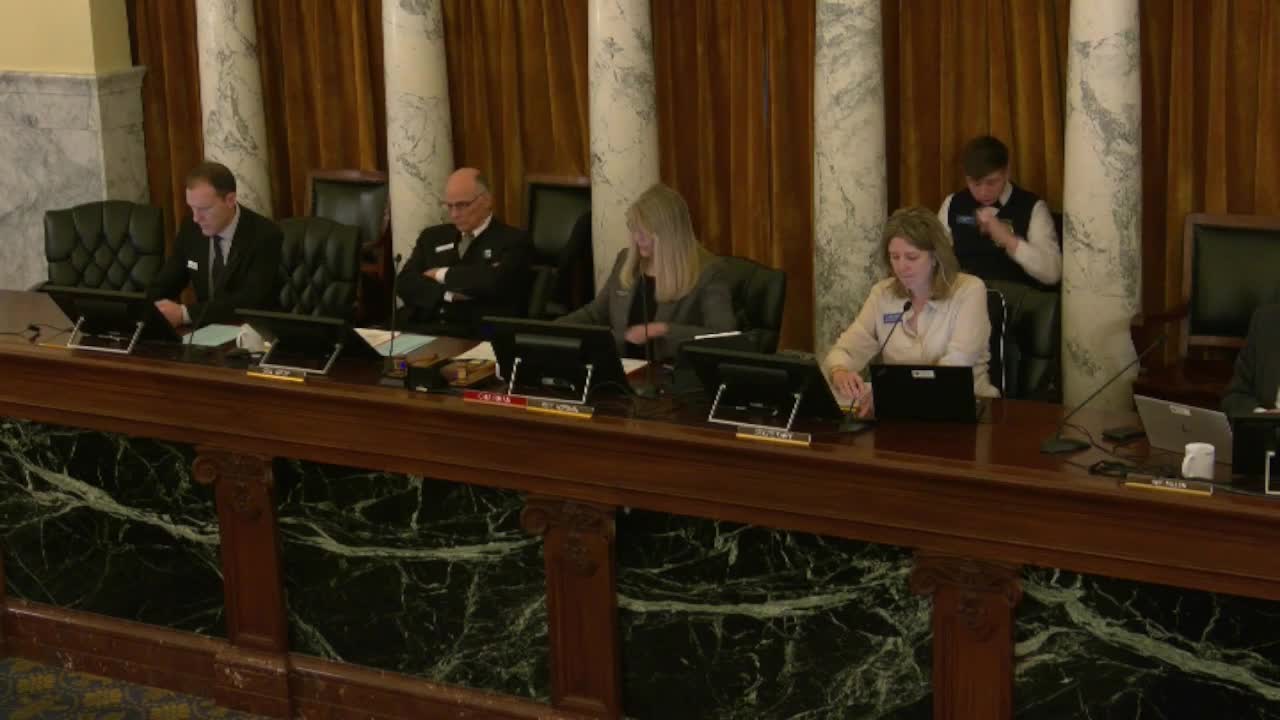
The Joint Finance-Appropriations Committee approved an FY2026 enhancement package for the Department of Health and Welfare’s Division of Public Health Services and approved several language items directing the department to study program transitions and potential billing issues.
The Joint Finance-Appropriations Committee voted March 12 to approve an FY2026 enhancement package for the Department of Health and Welfare’s Division of Public Health Services and to adopt a set of directive language asking the department to study several program transitions and billing practices.
The committee approved a substitute motion to add four full-time equivalent positions and increase appropriations to support program restorations, ARPA multi-year programs, communicable disease prevention work, an immunization assessment fund request, and other public-health programs. The committee’s composite action carried a due-pass recommendation by recorded vote: 14 ayes, 4 nays, 2 absent/excused across both chambers.
The enhancements bundle included funding elements for the Office of Accreditation and Planning, Suicide Prevention, Drug Overdose Prevention, Refugee Health Screening, an Alzheimer’s and dementia program, the Fit and Fall Proof program, WIC and related block-grant programs, and one-time ARPA-funded items. The package also included a request to grow the immunization assessment fund by $2.5 million in dedicated funds to expand free childhood immunizations and a governor’s initiative for a $500,000 general-fund rural physician incentive program.
“Idaho ranks fiftieth of 50 states in active physicians per capita,” Representative Furness said during debate, urging support for incentives and noting retention statistics presented to the committee. Alex Williamson, budget policy analyst at the Legislative Services Office, summarized the department’s requests and explained that several items are restoration requests and that some ARPA grants are in the middle of multi-year award periods.
In addition to the appropriation action, the committee placed several language requirements and directed studies in the department’s budget language. Those include: - Notification requirements when the department applies or reapplies for federal grants, continuing a requirement added last session. - A review of transitioning clinical-service pass-through grants from the seven local public-health districts to federally qualified health centers and other safety-net providers, and a review to identify and plan to eliminate instances of double billing between federal grants and Medicaid. - Analyses of potential transitions of specific programs: drug overdose prevention to the Office of Drug Policy; Alzheimer’s and related-dementia GRAMA functions to the Commission on Aging; and the Fit and Fall Proof program to the Commission on Aging. - Cost–benefit studies on potentially moving the 988 crisis-line contract to an alternative vendor and on bringing the state cancer data registry work in-house rather than using a contracted vendor.
Senator Wintrow objected to unanimous consent on some language items, saying the volume and specificity “creep into policy” and that selective application of such language to one agency could be inconsistent. After discussion the committee voted on the contested language and adopted the direction for reporting and studies.
The committee discussion repeatedly distinguished reporting requests from policy changes. “We are not setting policy here. We are asking for a report on existing policy and potential double billing services,” the committee chair said during debate on the grant-notification language.
What’s next: The department must prepare the reports and analyses called for in the budget language and return them as required by the committee’s directions; the appropriations will proceed through the usual bill trail and conference steps.
Sources: Committee transcript, Joint Finance-Appropriations Committee, March 12, 2025.