Get Full Government Meeting Transcripts, Videos, & Alerts Forever!
Get email alerts on the Elections topic
No spam. Unsubscribe anytime.
U.S. Election Assistance Commission outlines HAVA support, testing and training for Idaho elections
Summary
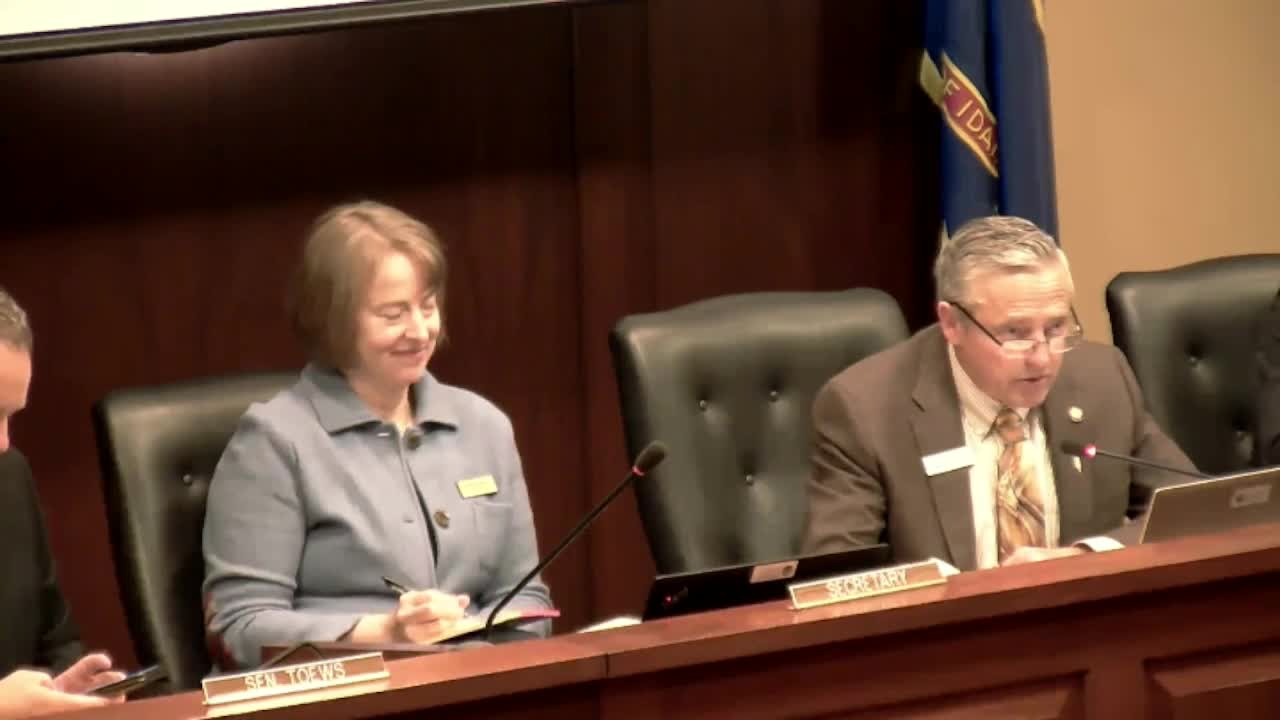
Don Palmer, vice chair of the U.S. Election Assistance Commission, told the Idaho Senate State Affairs Committee that the federal commission’s core mission is to support states and local election officials through testing, standards development and grants created by the Help America Vote Act.
Don Palmer, vice chair of the U.S. Election Assistance Commission, told the Idaho Senate State Affairs Committee that the federal commission’s core mission is to support states and local election officials through testing, standards development and grants created by the Help America Vote Act.
“In a nutshell, it’s a small federal agency that was created by Congress after the 2000 election,” Palmer said, summarizing HAVA’s origin and the EAC’s role in testing and setting voluntary standards for voting systems.
Palmer told the committee the EAC runs a testing-and-certification program for voting equipment, operates advisory boards made up of state and local election officials, and distributes federal HAVA funds for equipment, cybersecurity and accessibility programs. He said the EAC adopted Voluntary Voting System Guidelines (VVSG) 2.0 about a year ago and is in transition from the older standards; several systems were under federal testing at the time of his presentation.
Why it matters: federal testing, grants and guidance shape what machines and supporting technology counties can deploy. Palmer said Congress originally appropriated roughly $3 billion after HAVA passed and that annual HAVA-related grants have varied; nationwide HAVA funding peaked in 2020 and had declined in subsequent years. He said Idaho received about $8.8 million in recent HAVA allocations and that CARES Act funding provided an additional infusion of roughly $400 million nationally during the pandemic.
Palmer described several technical and oversight tools intended to preserve election integrity. Those include accredited independent labs that evaluate manufacturers’ systems, a field-services program for post-deployment anomaly reports and “hash verification” to detect differences between lab-approved software and fielded versions. He also said the EAC has broadened its work beyond tabulators to cover election-supporting technology such as electronic poll books and voter registration systems.
Idaho officials and the EAC also discussed training, data reporting and poll-worker recruitment. Phil McGrane, Idaho secretary of state, said Idaho hosts county clerks and other local officials for professional education and that the Idaho National Laboratory has performed cybersecurity testing on equipment used in the state. McGrane introduced Palmer and thanked the EAC for support.
Palmer noted the EAC’s monthly reporting and post‑election data collection, saying the agency compiles categories including turnout modes, registration and technology use and that the reports are provided to Congress. He also said the EAC offers free training modules and resources for clerks and their staff.
On follow-up questions, Palmer described the commission’s involvement after the 2020 cycle and the steps the EAC has taken since then, including additional penetration testing and a vulnerability-disclosure program. “We now do additional penetration testing of all of our voting systems,” Palmer said, describing efforts to test known vulnerabilities before manufacturers can bring systems to market for state review.
Several committee members pressed Palmer on what Idaho can do to improve election administration. Palmer said the most effective improvements are “fundamentals” — more staff and resources to carry out duties such as list maintenance, accessibility, cybersecurity and training. “The most fundamental thing to do to improve elections is to increase that foundation upon which they work,” he said.
The committee members expressed appreciation for the work of Idaho’s secretary of state and county clerks. No formal action was taken; Palmer appeared at the committee’s invitation to brief members and answer questions.
The committee recessed to the remainder of its agenda after the presentation.