Get Full Government Meeting Transcripts, Videos, & Alerts Forever!
Get email alerts on the Land Use Code Cleanup topic
No spam. Unsubscribe anytime.
City Council adopts broad land-use code cleanup, allows hospital height exception and narrows some late edits
Summary
Boulder City Council on June 12 approved Ordinance 86 97, a package of technical land-use code corrections and clarifications that also allows hospitals in the public zone to seek a three‑story/55‑foot height modification; the ordinance passed 7–1 after amendments on energy rules for ADUs, duplex setbacks and contractor language.
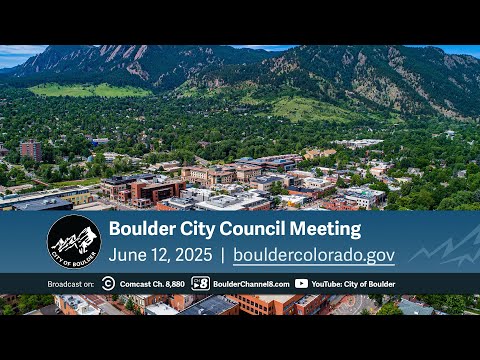
Boulder City Council on Thursday adopted Ordinance 86 97, a comprehensive code-cleanup package amending Titles 4, 9 and 10 of the Boulder Revised Code (BRC 1981). The ordinance, a second reading continued from June 5, passed on a 7–1 roll-call vote after council approved staff-recommended changes and a set of council amendments.
The changes are intended to correct errors and typographical citations, clarify definitions and standards, update graphics, and remove some development restrictions to provide flexibility in project design and administration. “This is ordinance 86 97, the code cleanup,” Planning staffer Jeff Solomonson told council during a presentation that summarized the package.
Council members and the public focused discussion on several substantive items that staff characterized as clarifications or administrative cleanups: the treatment of accessory dwelling units (ADUs) under the city’s energy-efficiency “smart regs,” rules for duplexes and setback treatment on nonconforming lots, removal of a 750‑foot separation requirement for certain residential care facilities, and a proposed allowance for hospitals and associated medical offices in the public zoning district to request a height modification for three‑story buildings up to a 55‑foot limit.
Boulder Community Health representatives described operational needs motivating the hospital language. “The height modification would be applied to a planned three‑story extension,” said Rob Bissers, identified in testimony as the hospital CEO, adding the hospital seeks additional emergency‑department beds, operating rooms and perioperative space. Daryl Brown, associate vice president of strategy and business development for Boulder Community Health, asked council to support the staff-recommended change so hospital floor‑to‑floor heights that accommodate mechanical and ventilation needs can be requested through the existing site‑review process.
Staff explained other notable edits included clarifying which dwelling types remain allowed in industrial service (IS) districts, aligning impervious/permeable surface terminology within the form‑based code, consolidating minor subdivision language so dividing a single lot into two is administratively clearer, and removing a separate survey requirement for certain minor development procedures. Staff also said they removed the 750‑foot separation requirement for congregate custodial and residential care facilities because it proved highly restrictive and state law imposes no analogous separation for those uses.
On ADUs and smart regs, staff proposed removing the existing exception for attached accessory dwelling units—an exception that had relied on owner occupancy—and instead bring those properties into compliance with smart regs by the end of the calendar year. During the hearing Councilmember Lauren Folkerts proposed an amendment to strike staff’s proposed exemption change in Appendix C so that attached ADUs within existing structures would remain exempt from smart regs in this ordinance round; the final approved motion included council amendments on ADUs and other items.
Council debate also returned repeatedly to the insertion of the word “generally” into site‑review language governing consistency with subcommunity and area plans. Staff and the city attorney framed that change as restoring longstanding practice—allowing decision‑makers to weigh competing plan policies on a site‑specific basis—rather than establishing a new standard. Planning staff noted that state statutes and the Boulder Valley Comprehensive Plan use similar language in land‑use contexts.
Members of the planning board and an individual planning‑board member who testified urged more caution on some items. Laura Kaplan, a planning‑board member speaking for herself, told council she viewed certain proposals (notably the elevated courtyard/open‑space language and the “generally consistent” phrasing) as substantive rather than strictly clerical and recommended fuller public engagement on those changes.
Council action: Councilmember Lauren Folkerts moved approval of Ordinance 86 97 with amendments that (1) keep the ADU exemption in Appendix C (so existing attached ADUs are not amended in this ordinance), (2) remove the new duplex setback language in Section 9.8.3.8.a.2.a so conversions on nonconforming lots are not made more difficult, and (3) postpone staff’s proposed new contractor‑licensing enforcement language (the provision addressing unlicensed contractors for short‑ and long‑term rentals) for future consideration and enforcement analysis. The final roll call recorded seven votes in favor and one against; Councilmember Taisha Adams cast the lone no vote. The ordinance as amended was approved 7–1.
What changed and next steps: The ordinance packages routine corrections and clarifications—staff said the last comprehensive cleanup was 2024—and also includes a staff recommendation (adopted by council) allowing hospitals and medical offices in the public zone to request a height modification during site review to accommodate functional floor heights (three stories, up to 55 feet). Staff told council they will return with additional, more substantive code changes if broader policy revisions are warranted. For several items (contractor licensing language and some courtyard/open‑space wording) council asked staff to bring refined language at a later date with additional analysis or stakeholder input.
Votes at a glance: Ordinance 86 97 (code cleanup) — Passed 7–1 (motion adopted as amended). “Ordinance 86 97 is hereby amended and approved with a vote of 7 to 1,” the council clerk announced after roll call.
The council concluded the public‑hearing portion of the agenda after the vote and moved on to unrelated matters.
Ending note: The ordinance is a second‑reading adoption of a package of largely technical amendments; however, council and public comment focused the debate on a small set of items with substantive policy implications (hospital height, ADU energy rules, duplex setbacks and contractor licensing). Staff will follow up on the items council asked to revisit and will return with additional language or analysis where requested.