Lifetime Citizen Portal Access — AI Briefings, Alerts & Unlimited Follows
Fairfax County presents interim findings from economic mobility pilot; research to continue through 2026
Loading...
Summary
Fairfax County’s Health and Human Services Committee on Tuesday reviewed preliminary results from an 18‑month economic mobility pilot that gave 180 households $750 per month, showing early improvements in bill paying, debt reduction and community participation while highlighting persistent barriers such as childcare, housing and credential recognition.
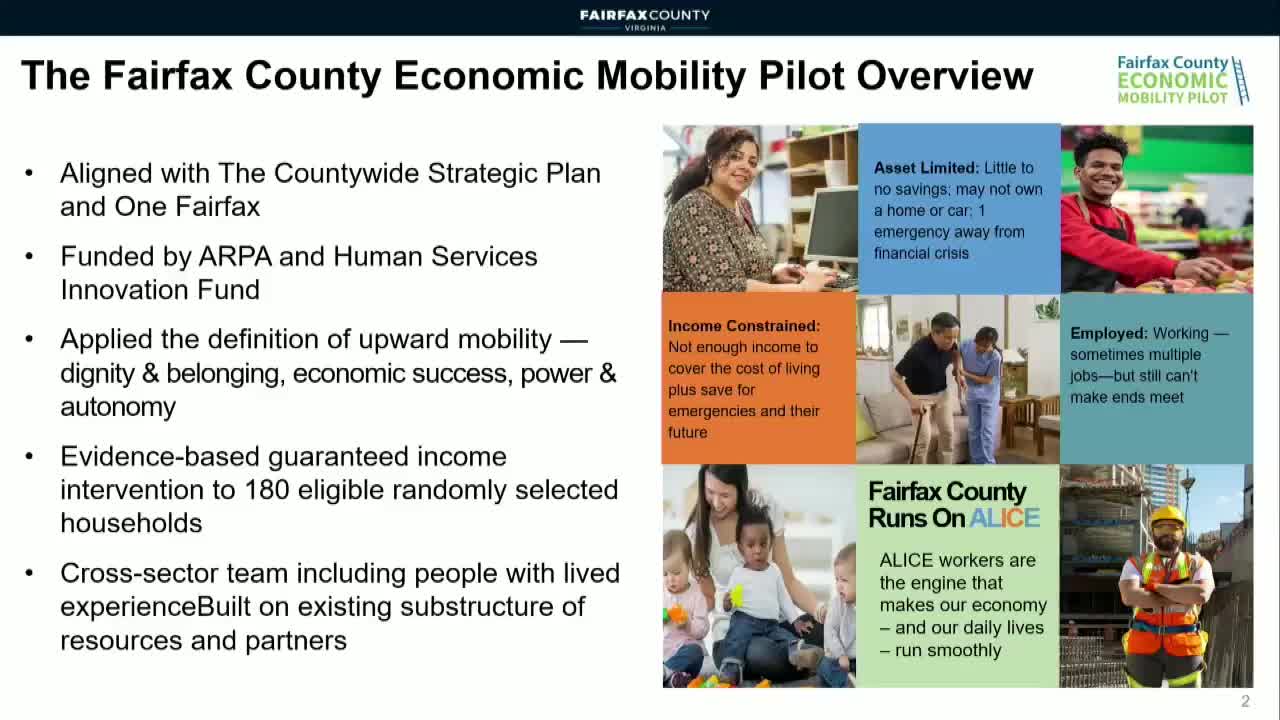
Fairfax County’s Health and Human Services Committee on Tuesday received preliminary findings from the county’s economic mobility pilot, a project launched in October 2023 that provided 180 randomly selected households with $750 per month for 18 months and wraparound supports funded through ARPA and the Human Services Innovation Fund.
The presentation, led by Chief Equity Officer Toni Zollicoffer and reviewed by United Way and George Mason University researchers, showed early positive outcomes — improved bill payment, reduced debt, modest savings and increases in mental and physical well‑being for many participants — while underscoring persistent structural barriers such as high childcare and housing costs, limits on credential recognition for immigrants, and inadequate wages.
County and partner speakers said the pilot targeted ALICE households — Asset Limited, Income Constrained, Employed — a United Way term for residents who earn too much to qualify for many public benefits but not enough to cover basic living costs. Scott Mengebier of United Way NCA told the committee that official poverty measures identify about 23,000 Fairfax households in poverty, and that an additional 102,000 households meet the ALICE definition, “bringing nearly a third of Fairfax County’s population” — which he described as about 125,000 households — into a zone of financial hardship.
Researchers from George Mason’s Center for Social Science Research described the study’s scope and early findings. Amy Best said the research team prioritized participant voices through three waves of surveys and in‑depth interviews and that a final, comprehensive report is scheduled for January 2026. Co‑researcher Elise Dorelli said the 2026 report will be “Fairfax‑centric,” situating how families used the funds in the context of other county and federal supports and producing specific, locally relevant recommendations to inform policy.
George Mason presented examples and early impacts from mid‑pilot data. Research staff said participants frequently used the unconditional cash to pay bills and reduce debt, begin modest savings, access medical and dental care they had deferred, and invest in children’s activities (swim lessons, sports) that staff said increased participant sense of belonging. One participant described the payment as “oxygen for me,” according to the presentation.
Researchers and county staff noted signs that the payments supported mobility investments: coursework toward credentials, completion of tech certificates, increased use of county financial empowerment resources and steps toward college savings accounts. At the same time, baseline data showed high precarity: researchers reported 82 percent of wave‑1 respondents said wages were inadequate to cover basic needs much or some of the time, and that by wave 2 the share reporting insufficient wages remained largely unchanged.
Department of Family Services Director Michael Beckett said the department sees guaranteed‑income models as an upstream strategy for preventing family stress and associated harms. Beckett described operational changes already implemented from lessons learned in the pilot — for example, using the pilot’s payment platform to issue a debit card for youth who could not access bank accounts, replacing unsafe cash disbursements.
Neighborhood and Community Services Director Lloyd Tucker and NCS staff described programmatic shifts informed by the pilot: reexamining fee determinations for county programs, expanding the concept of “economic mobility partners” to provide coaching and service navigation, and planning to spread financial empowerment services beyond a single site to additional reengagement and workforce centers.
Presenters emphasized that gains varied across participants. Immigrant participants frequently faced lost credential recognition and stalled career advancement; childcare costs remained a major barrier, especially for single‑parent households; housing costs continued to be a dominant expense. Scott Mengebier highlighted an ALICE household survival budget example used in the research: a family of four with two working adults and two children in daycare faced costs the presentation calculated at about $122,256 annually for 2023, while average area household income in the slide deck was shown near $86,000, leaving a monthly gap the presenters described as “over $3,000.”
Committee members asked whether the final George Mason report will include concrete, implementable recommendations and how the evaluation will account for federal and state supports. Elise Dorelli said the team will analyze the pilot “in context” with other programs and networks — federal, state and local — and aims to offer specific recommendations tied to county systems. County staff and presenters said the pilot has already informed service delivery and that staff will return with recommended next steps, including developing a cross‑sector coalition and an awareness campaign; the team plans a follow‑up update to the committee in spring 2026.
The researchers and county staff cautioned that the findings are preliminary and that the final report will synthesize all three waves. Presenters said the pilot’s unrestricted cash payments and wraparound supports produced early improvements in financial stability and participant well‑being but did not eliminate deep systemic constraints that require policy and cross‑sector responses.
Next steps described to the committee included continued data collection and analysis, convening cross‑sector stakeholders to address credentialing, childcare and underemployment, and returning to the committee with recommended actions in spring 2026. The George Mason final report remains on schedule for January 2026.