Get Full Government Meeting Transcripts, Videos, & Alerts Forever!
Get email alerts on the Data Centers topic
No spam. Unsubscribe anytime.
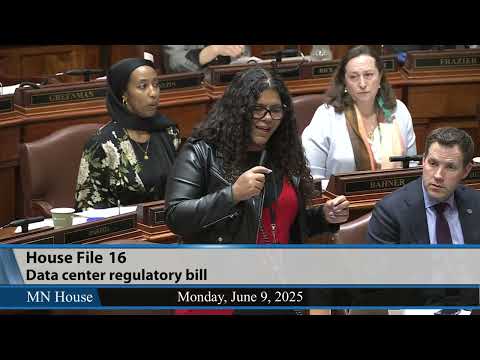
Minn. House passes House File 16, a data-center tax and oversight package
Summary
The Minnesota House of Representatives passed House File 16, a data-center tax and oversight package, after suspending rules to give the bill an immediate final reading and voting 85–43 for final passage.
The Minnesota House of Representatives passed House File 16, a bill relating to data centers, after members suspended the House rules to give the bill its final reading and place it on final passage.
Representative Niska of Anoka moved to suspend the rules under Article IV, Section 19 of the Minnesota Constitution so the House could consider House File 16 immediately; the motion prevailed. The clerk later announced, “There being 85 ayes and 43 nays, the bill is passed and its title is agreed to,” after a roll call that included remote votes such as Olsen voting yes.
Representative Davids, the bill’s author and the member from Fillmore, said the measure reflects a negotiated agreement and described its main provisions: it creates a “very large” customer subclass for data centers, requires data centers that use more than 100,000,000 gallons of water per year to provide pre-application information to the Department of Natural Resources, creates a fee on qualified large-scale data centers that will be deposited into the energy and conservation account, and extends an existing sales-tax exemption to 35 years. “This data center bill establishes very large customer class or subclass … it requires data centers that use over 100,000,000 gallons of water per year to supply pre application information to the DNR,” Davids said.
Supporters described economic and workforce benefits. Representative Davids and other proponents said the bill will drive job creation in construction and technical fields; Davids called it “a very, very important jobs bill.” Representative Weiner of Todd urged passage on competitiveness grounds, saying Minnesota risks losing projects to neighboring states unless tax and regulatory frameworks are updated. Representative Quam of Olmsted argued Minnesota’s cooler climate and clean-energy efforts make the state attractive to data-center builders and said she would “vote green” while urging continued technical conversations.
Opponents raised concerns about public cost and environmental impacts. Representative Hollins of Ramsey said she opposed tax breaks for very large tech firms and called the bill “fiscally irresponsible,” arguing that tax incentives shift costs onto residents. Hollins said, “I am anti tax breaks for billionaires … It is fiscally irresponsible for us to be providing tax breaks to people who could otherwise pay these bills.” Several members, including Representative Acum of Hennepin, said the bill makes progress on protections but does not fully achieve environmental and community safeguards; Acum said the measure advances ratepayer protections and establishes a community benefit program intended to help low-income Minnesotans with weatherization and energy efficiency.
Other discussion noted specific technical and local concerns. Representative Meckland of Sherburn described local impacts where a previously contemplated project had withdrawn, noting a $5,000,000 fee most data centers would eventually pay under build-out plans and saying some communities faced budget holes when anticipated developments did not proceed. Members also raised issues about backup generation at large facilities, water availability and early coordination with the Department of Natural Resources, and whether large data centers could require more energy than entire cities.
The measure received endorsements from building trades and the Chamber of Commerce, according to members speaking for the bill. Several supporters and opponents said further work remains; Representative Acum said she would continue to press for more thorough environmental review and host-community input and that data centers would remain a topic in the 2026 session.
Votes at a glance: the House suspended rules to take up House File 16 (motion moved by Representative Niska of Anoka; outcome: motion prevailed) and then passed House File 16 on final passage by roll call, 85 ayes, 43 nays.