Get Full Government Meeting Transcripts, Videos, & Alerts Forever!
Get email alerts on the Housing Code Enforcement topic
No spam. Unsubscribe anytime.
Council committee advances tenant relocation fund, holds two larger tenant-protection bills for more work
Summary
Philadelphia’s City Council housing committee voted to advance an anti-displacement/relocation fund ordinance (Bill 250331) after a committee amendment, while holding two companion bills on proactive inspections and expanded tenant protections for further negotiation with administration officials and stakeholders.
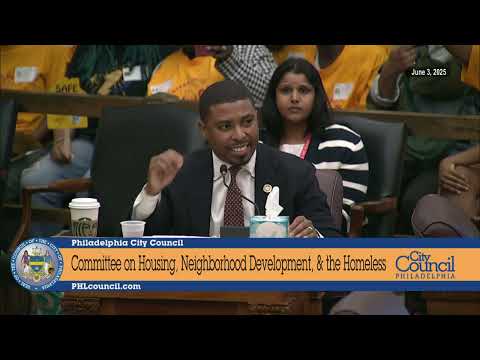
Philadelphia’s City Council committee on Housing, Neighborhood Development and the Homeless on June 3 advanced a bill to create an anti-displacement (relocation) fund for tenants displaced when buildings are closed due to unsafe conditions and held two companion bills that would expand tenant protections and authorize a proactive rental‑inspection program.
The committee approved an amendment and then voted to report Bill 250331 — the anti-displacement fund and related notice requirements — favorably out of committee and asked the full Council to consider the measure at its next session. Committee leaders and the bill sponsor said the vote was intended to preserve immediate assistance for displaced tenants while giving staff and departments more time to work through operational and legal concerns on the larger package.
Why it matters: committee members, city agencies and tenant advocates framed the hearing as a response to persistent housing code failures that advocates and clinicians tied to health harms. Dozens of tenants and health professionals testified about mold, pests, sewage backups and other hazards. Dr. Tyra Bryant‑Stevens, chief health equity officer at Children’s Hospital of Philadelphia, told the committee “housing is health,” citing a city mapping of L&I code violations that correlated with higher childhood asthma ER visits and hospitalizations.
Administration and operational concerns: Department of Licenses and Inspections (L&I) representatives and other agencies said they support the bills’ goals but flagged operational limitations and potential unintended consequences that require more time to fix in the text and to resource for implementation. Sarah Adhamo, described in testimony as the department’s zoning and legislation director, said the administration “strongly supports the spirit of this bill” but asked that language and implementation timing be revised because recent amendments had not been fully tested against L&I’s licensing and case‑management systems. Bridget Collins Greenwald, L&I commissioner, said the department is developing a proactive inspection plan and estimated it could produce a plan by the end of the summer but that system updates (the city’s Eclipse web UI queue) and regulatory changes will take longer.
Planning and enforcement tradeoffs: John Monlach, first deputy and chief of staff at the Department of Planning and Development, raised concerns about using violations as a sustainable revenue source for a relocation fund. He said cease‑operations orders sometimes result from disasters beyond an owner’s control (fires, water‑main breaks), and a new separate “cease operations” violation could discourage some landlords from remaining in the rental market. The administration asked that the committee hold the two bills with broader operational impact while moving the relocation fund forward.
Public testimony and evidence: more than 70 people signed up to speak. Tenants described long waits for repairs, infestations and medical harm; several testified to hospitalizations and chronic illness they attributed to housing conditions. Melissa Montz said she was hospitalized with pneumonia after living in a unit with pests and sewage issues: “I woke up unable to breathe. I went to the hospital and ended up in the hospital for nine days with pneumonia,” she said. Tenant organizers and health and legal advocates urged passage of the full package as a set of complementary reforms: proactive inspections, tenant anti‑harassment protections, right to organize and relocation assistance.
Housing providers and management groups urged a more targeted approach. The Pennsylvania Apartment Association and local landlord groups warned that broad, mandatory inspections and new licensing or suspension rules could increase costs, be difficult to operationalize under current L&I capacity, and — they said — unintentionally drive small landlords out of the market. Several witnesses representing landlord associations and owner networks offered to continue negotiating amendments.
Committee outcome and next steps: committee leadership and the bill sponsor, Councilmember Nicholas O’Rourke, announced a consensus to move Bill 250331 (the anti‑displacement/relocation fund) forward with the committee amendment approved on the floor. The committee agreed to hold Bill 250329 (right to repairs / proactive inspection authorization) and Bill 250330 (tenant protections including good‑cause nonrenewal, anti‑harassment and organizing protections) for further work with the administration. Members said they also will communicate support for the sponsor’s budget request — a proposed $10 million for L&I capacity and for relocation resources — as part of ongoing budget negotiations.
What to expect: the committee asked city departments to return with operational details within weeks: staffing and inspection metrics, counts of chronic offenders, and timelines for necessary software changes. L&I said major front‑end changes to Eclipse are in a queue and may not be fully implemented until 2027 unless the city reprioritizes enhancements. The sponsor, Councilmember O’Rourke, and committee members indicated they will continue working through the summer on language and funding so the broader package can return in a form the administration can implement.
Ending: with the relocation fund advanced, the committee signaled city leaders intend to pair short‑term tenant relief with a longer process to strengthen enforcement and preventive inspections. Advocates urged the Council to attach sufficient budget funding when the fuller package returns to committee so implementation does not stall.