Get Full Government Meeting Transcripts, Videos, & Alerts Forever!
Get email alerts on the Strategic Plan topic
No spam. Unsubscribe anytime.
Rapid City Area Schools presents year‑end strategic plan report; facilities score jumps, student survey top‑box responses rise
Summary
District staff delivered an end-of-year strategic plan update at a board study session, reporting gains on facility measures and student-survey top‑box items while noting areas—attendance, volunteer tracking and some academic measures—where next-year metric and operational changes are planned.
The Rapid City Area School District 51-4 presented its end-of-year strategic plan update at a board study session, highlighting mixed progress across five pillars—communication, community, staff, facilities and students—and outlining next steps for metrics and implementation.
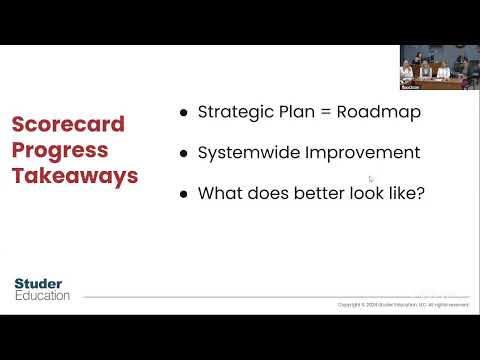
District leaders said the year focused on system alignment and establishing repeatable feedback loops. Superintendent Dr. Strasser framed the presentation as a multi-year effort and said the district is "about progress, we're about learning, adjusting, and continuing to move forward." The report summarized scorecard metrics, short-cycle actions, bright spots, barriers and planned follow-up steps for each pillar.
Key takeaways
Facilities: The district reported a notable gain on its facilities performance index—moving from a baseline of about 53 to a current average in the high 50s (reported as about 58.5–59.5). Staff said the district concentrated on high-impact, lower-cost ‘‘low-hanging fruit’’ projects this year and completed an impact project plan tied to the facilities master plan. District staff cautioned that construction-market volatility and urban-growth patterns could affect future timelines and costs.
Students: The student pillar included academics, behavior, attendance and special services. Two student-survey measures—students who say "I like going to school" and "I feel like I belong"—rose 5.18% and 7.25%, respectively, measured as top-box responses. Attendance (the state report-card attendance rate) held near the baseline (listed at roughly 81%) and was marked yellow, in part because the district said it had redesigned attendance tracking and would use this year as a new operational baseline after implementing an OCR-related voluntary agreement. Behavior incident reporting rose year over year; district leaders said the increase reflected more consistent and standardized reporting across buildings rather than a clear jump in underlying misconduct, and they described new "behavior academies" and an MTSS approach to address student needs.
Academics: The district reported mixed interim-assessment results. Kindergarten and grade K–1 achievement (Acuity/Acadience measures) showed high year-over-year gains from low starting baselines but did not meet an originally set proficiency target because the cohort started lower. NWEA MAP results for grades 2–8 showed growth that exceeded the prior year in math and ELA (about +3% math, +2% ELA) though short of the district's goal. PreACT participation and results met or exceeded the year target; ACT results slipped slightly. The district also reported increased Advanced Placement activity (a 17% year-over-year increase in AP tests administered) and 615 industry/occupational certifications earned by students.
Staffing and human resources: The staff pillar showed an 82% retention rate (goal 83%). Officials said the raw number of job applicants was a problematic metric (it can fall as retention increases) and will be replaced with more meaningful measures such as number of open positions and time to fill them. The district also rolled out a staff transfer portal and began a regular "rounding" practice—brief, frequent check-ins between managers and staff—as part of retention and engagement efforts.
Communication and community: District communications launched a new website and a staff/parent newsletter; staff reported nearly 1,444 app downloads for the district mobile app and increased social‑media followers (from roughly 17,643 to about 19,406). A parent-survey question about pride in their child's school met its goal (baseline 3.96, goal 4.06). Officials said volunteer tracking and outreach processes still need refinement: the district has a database of volunteers but lacks a consistent mechanism to match volunteers with building-level opportunities or to measure volunteer frequency and hours.
Next steps and board discussion
District staff said they will refine metrics in places where measurement no longer fits the work (for example, replacing an applicant-count goal with time-to-fill and unfilled-positions metrics) and continue to build committees—parent, staff and community—to solicit targeted feedback. Several board members praised the work and asked for more detail at follow-up meetings on items such as the behavior academies and the transfer portal. Superintendent Strasser and the pillar leads emphasized the district will continue short-cycle improvement work, re-examine metrics over the summer and return with recommendations to the board.
Ending
Board members thanked staff for the review and noted the plan will be used as an accountability roadmap. Staff reiterated the district's intent to keep adjusting metrics and to run additional short-cycle reviews as the new school year approaches.