Get Full Government Meeting Transcripts, Videos, & Alerts Forever!
Get email alerts on the Elections topic
No spam. Unsubscribe anytime.
Payson counsel briefs council on limits of using town resources during bond special election
Summary
Town legal staff reviewed Arizona law prohibiting use of public resources to influence elections after the council called a special bond election, outlining examples, exceptions, and potential penalties.
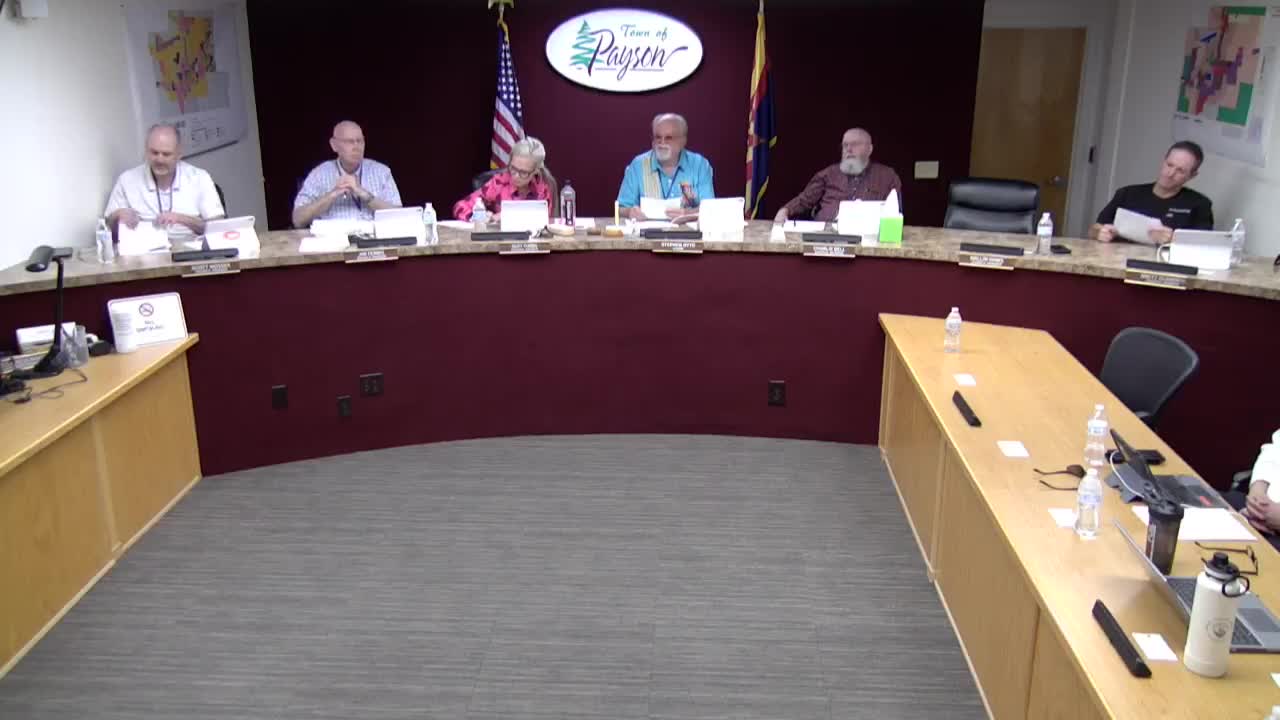
Town legal staff briefed the Payson Common Council on June 11 about the statutory prohibition on using public resources to influence elections, a presentation the council requested after it called a special election on June 3 to submit a bond question to voters.
The presenter, identified in the meeting as Christina, told the council that state law (cited in the presentation as ARS 9-5-100.14) prohibits a city or town from using its resources—monetary or otherwise—to influence the outcome of an election. "An ARS nine-five 100.14 says a city or town shall not... spend or use its resources including expenditures of monies, accounts, credit, facilities, vehicles, postage, telecommunications, computer hardware and software, web pages, personnel, equipment, materials, buildings, of the town for the purpose of influencing the outcomes of elections," Christina said during the presentation.
Christina explained the analysis is twofold: (1) determine whether a public resource is being used (town-paid employee time, town devices, town facilities, etc.), and (2) determine whether the use is intended to influence an election. She said items that can be "things of value" include staff time during work hours, town-issued devices, and even the use of a town employee's title or uniform in a political context. She distinguished elected officials from employees: elected officials cannot always separate their title from their person and therefore have fewer ways to disassociate their office from their political expression, while town employees must avoid using town resources or their job title in campaign activity.
The presentation listed authorized exceptions where the town may provide factual information: distribution of an informational pamphlet required under Title 35, reporting on official council actions (meeting minutes), routine factual communications from the town (for example, voter-registration or ballot-mailing information), government-sponsored forums or debates that are neutral and offer equal opportunity to all viewpoints, and rental of town facilities to private parties under regular policies.
Christina warned that violations are complaint-driven and may be investigated by the Arizona Attorney General or county attorney. She said penalties may include civil fines against individual violators; the presentation noted civil penalties can be up to $5,000 for individuals who knowingly violate the statute. She also said employment consequences could apply to town employees under personnel rules.
Why it matters: The council had approved a resolution on June 3 calling a special bond election (resolution cited in the meeting as 34 52). The guidance helps council members and staff understand what communications and activities are permissible during the special-election cycle and how to avoid using town resources to advocate for or against the measure.
Practical examples highlighted in the presentation - Town employee calling in to a radio program during work hours: using a public resource and therefore impermissible if used to influence the election; the same employee could speak on the radio about the bond on personal time and from non-town devices. - Elected official paying to place an argument in the informational pamphlet: permissible if the town does not pay for it; the official may use their title in the paid submission according to attorney-general guidance noted in the presentation. - Call to the public at a recorded council meeting: Christina advised caution because meetings are taxpayer-funded and recorded; callers who electioneer may be warned and asked to stop, and persistent electioneering could lead to enforcement.
Ending: Council members asked clarifying questions about where public-private lines fall (radio, social media, printed arguments) and were told to contact counsel ahead of time if they plan public activities so staff can review specific facts. Christina encouraged officials and staff to reach out with specific scenarios for a case-by-case analysis.