Get Full Government Meeting Transcripts, Videos, & Alerts Forever!
Get email alerts on the Act 73 Event Permits topic
No spam. Unsubscribe anytime.
Licensing staff briefs committee on state’s Act 73 changes for event venues; city to notify operators before 2026 deadline
Summary
Licensing staff warned owners of event spaces and unlicensed venues that 2023 Act 73 will require either a state no‑sale event permit or a municipal Class B liquor license beginning Jan. 1, 2026. The Licensing Division proposed outreach and minor code updates and the committee held the file open for follow‑up.
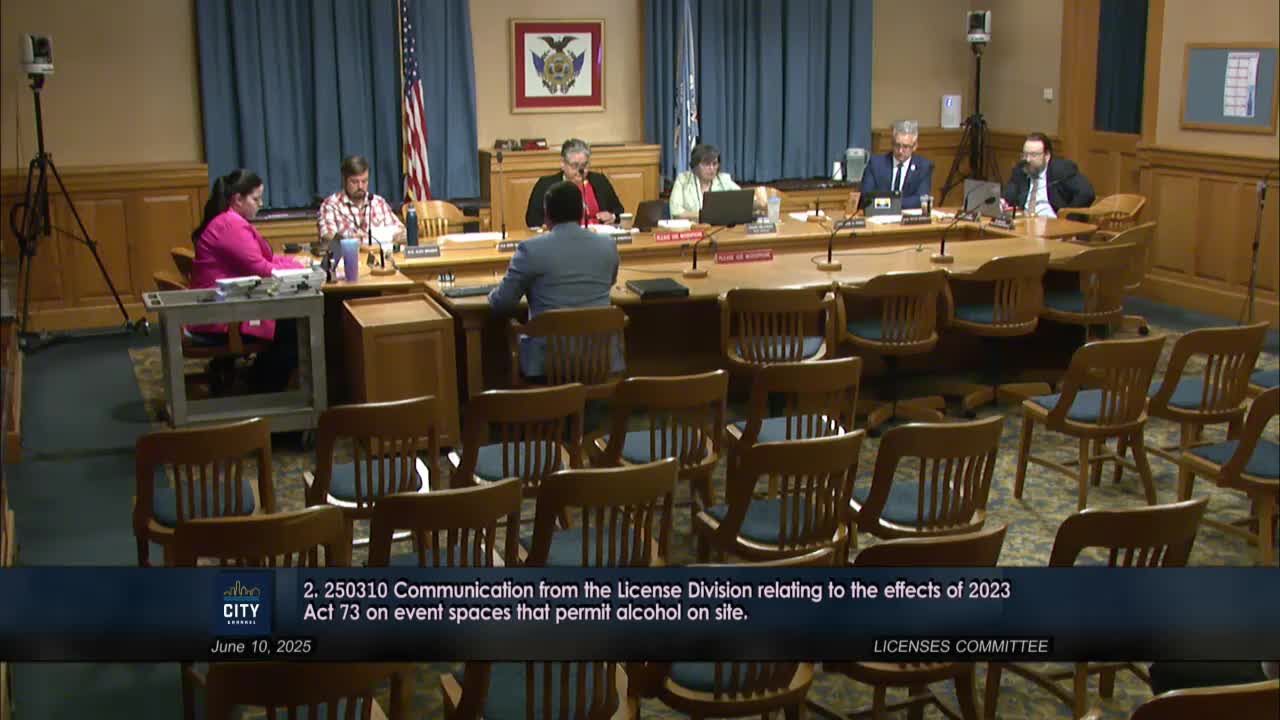
Licensing Division staff told the Licenses Committee on June 10 that state law changes under 2023 Act 73 will require privately owned event venues — often called “wedding barns” or rental event halls — to carry either a limited state no‑sale event permit or a municipal Class B tavern license beginning Jan. 1, 2026.
Jim Cooney, Licensing Division manager, briefed the committee (file 250310) on the high points of Act 73, which broadens the definition of “public place” to include venues that hold their spaces out for rent for events and social gatherings. Under the new law, privately owned venues that hold themselves out for rent can either:
- Apply for a state “no‑sale event” permit (commonly called a wedding barn/no‑sale event permit) that allows beer and wine at up to six one‑day events per calendar year and requires Class D bartender service when attendance exceeds 19; or - Apply locally for a municipal Class B tavern license, which would be reviewed under the city’s hearing process and allow the full range of spirits and on‑site sales but includes annual review and local public notification.
Cooney said the Department of Revenue will handle administration of the state no‑sale permits and that city staff are working to get clarity from DOR on how the state will publish and share permit lists; the city wants to avoid enforcement action against venues that hold a valid state permit. Licensing estimated there are roughly 50 Madison‑area or Milwaukee‑area businesses that rent event space but do not currently hold a municipal liquor license; some operators may choose the state limited permit and others may pursue a Class B license.
The committee discussed other technical questions: how event operators will be tracked, the number‑of‑events cap (six per calendar year for the state permit), whether bartenders are required for larger events, and whether municipalities can adopt parallel language in Chapter 108 to align with state statutory language. Cooney recommended early outreach because Class B municipal licensure typically takes 6–8 weeks from filing to hearing and approval and because DOR’s application material was not yet posted (licensing staff said DOR’s site expected to publish application materials in late 2025). Cooney also noted litigation exists that could affect the statewide timeline, but he said the Licensing Division wanted to start outreach to event operators now.
Action: Alderman Peter Bergellis moved to hold the communication open to the call of the chair for follow‑up, including additional information from the Department of Revenue about permit issuance and sharing lists. The committee approved the hold without objection.
Why it matters: Beginning Jan. 1, 2026, venues that advertise or rent space for events and allow alcohol will need clear authorization (either the limited state permit or local Class B) so municipalities can regulate sales and ensure compliance with state limits.
Follow‑up: Licensing staff will continue discussions with DOR to confirm when state applications will be available and how the state will share permit data with municipalities; staff also suggested a Code update to reference the new state permit and to consider aligning city PEP (public entertainment premises) language to match the statute.
Speakers - Jim Cooney — Licensing Division manager — presented the change and timeline. - Alderman Jocasta Samaripa — Committee chair — led questions and the committee conversation. - Alderman Peter Bergellis — moved the committee action to hold the file open.
Discussion vs decision - Discussion: City staff described Act 73’s requirements, likely affected venues, the DOR no‑sale event permit characteristics (beer/wine only, six events/year, no distilled spirits, Class D restriction for bartenders when attendance >19), and the municipal Class B path. - Direction: Staff to continue coordination with DOR and return with guidance for outreach; committee held the file open to the call of the chair.
Provenance (transcript excerpts) - topicintro: block_id:"s=342.21-e=351.01" local_start:0 local_end:88 evidence_excerpt:"We'll move on now to item 2, file number 250310, communication from the licensing division relating to the effects of 2023 act 73 on event spaces that permit alcohol on-site. Good morning, Jim Cooney." reason_code:"topicintro" - topfinish: block_id:"s=1413.105-e=1419.125" local_start:0 local_end:30 evidence_excerpt:"Sure. Maybe it was more information from DOR about how they'll share out the, information about the no sale of that permits issue." reason_code:"topicfinish"