Get Full Government Meeting Transcripts, Videos, & Alerts Forever!
Get email alerts on the Overdose Prevention topic
No spam. Unsubscribe anytime.
Austin and Travis County officials say opioid harms fell after $2 million federal grant, urge continued funding
Summary
City and county leaders credited a roughly $2 million federal grant and local programs with increased naloxone distribution, training and a reported drop in overdose deaths, while urging continued funding and expanded services including jail reentry supports.
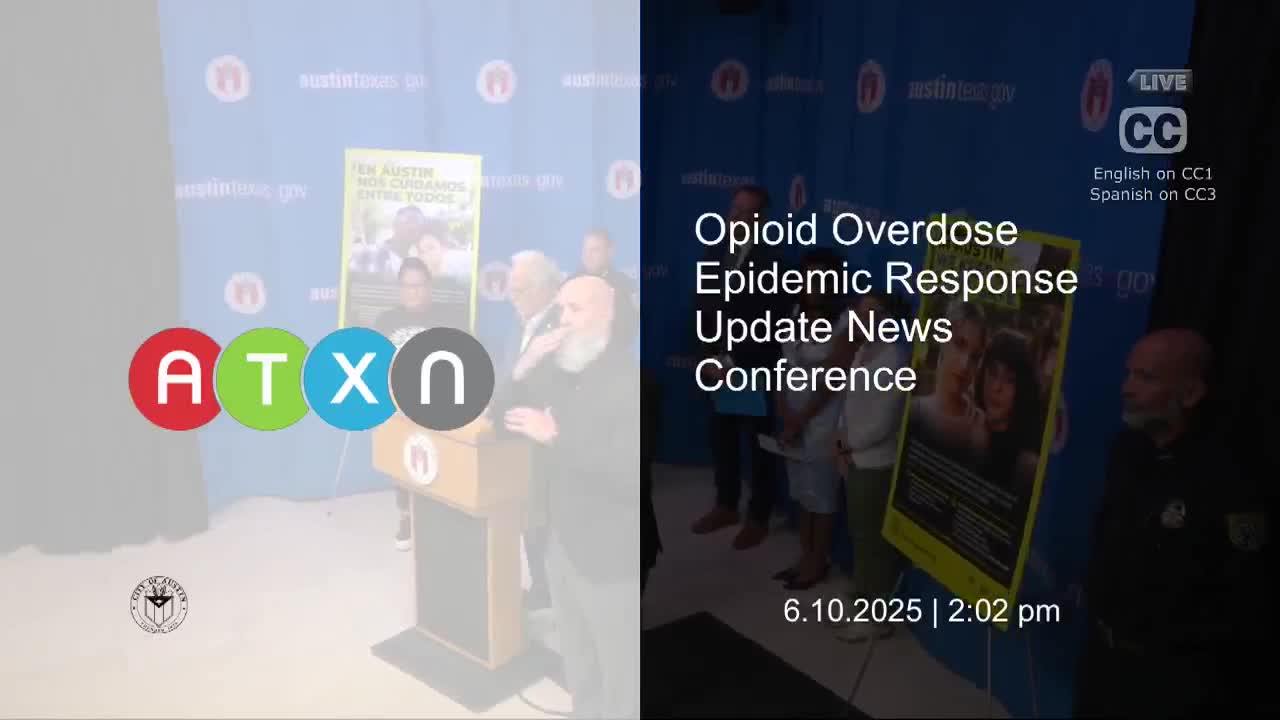
Mayor Kirk Watson and Travis County leaders on Tuesday described a year of expanded overdose-prevention work in Austin and Travis County they say was made possible by federal funding and local partnerships, and reported declines in opioid-related harms while urging continued investment.
City and county officials said a roughly $2 million federal grant secured with help from U.S. Rep. Lloyd Doggett funded expanded naloxone distribution, public education and training programs across Austin and Travis County. “Hoy el día de hoy estoy orgulloso de estar aquí con otros que lo hemos hecho,” Mayor Kirk Watson said, praising coordinated efforts by the city, Austin Public Health and county partners.
Officials said the grant helped scale a mix of services — including community naloxone distribution, public-awareness campaigns, trainings to recognize and respond to overdoses, and expanded outreach to justice-involved people — and pointed to measurable outputs. Austin Public Health Director Dr. Desmar Walks said the city and county have trained more than 11,000 people to recognize overdoses and administered or distributed more than 24,000 doses of naloxone through the program. “Hemos tratado más de 1000 personas y hemos reconocido y contestado por sobredosis,” she said.
Travis County Judge Andy Brown said county data show a drop in overdose deaths over the last year. “El condado de Travis tenemos el 22 por 100 de disminución … de 480 a 380,” Brown said, reporting the county’s decline in opioid-related fatalities as presented at the briefing. He also reported additional funding arriving in April (figures described during the meeting as about $1.4 million) to expand the county program.
Emergency-services leaders described expanded training and a goal of equipping first responders and community members. Robert Glent, identified at the briefing as a chief with the county’s medical services, said last year’s grant helped develop a public-training program to teach the public how to recognize an overdose and administer naloxone until medical responders arrive. “El programa fue muy bueno, pero tiene que crecer,” Glent said.
Speakers described public-awareness work that officials said produced large numbers of impressions and web traffic: Walks cited the city’s campaign as generating what the transcript reported as 56,000,000 impressions and more than 58,000 visits to a campaign page; officials framed the campaign as a tool to drive people to resources hosted on a dashboard at austintexas.gov/opioids.
Officials also described targeted outreach to people leaving jail and to unhoused residents. Brown said the county’s reentry and recovery work included more than 50 sessions with more than 600 participants and more than 400 referrals to housing and treatment services. Leaders said they are piloting a behavioral-health center focused on the intersection of justice involvement and addiction; officials said the pilot aims to provide coordinated care where people intersect with police and the jail system.
Throughout the briefing, speakers emphasized that naloxone (referred to in Spanish in the briefing as “nolaxing/Narcan”) saves lives but is one part of a broader continuum of care: distribute naloxone, connect people who survive overdoses with treatment and supports, and sustain prevention and recovery programs. Officials repeatedly urged continued federal and local funding to maintain and expand gains.
No formal votes or ordinance actions were recorded in the transcript; officials described program activity, funding sources, and planned expansions but reported no board or council decision during the event.
Looking ahead, officials said they will continue existing CDC-aligned protocols and training, pursue additional grant funding, and expand outreach and reentry services. Judge Brown and mayoral and public-health staff said they will keep advocating for policy and funding to support testing, naloxone distribution and treatment access.
Ending: City and county leaders framed the past year’s work as an early success they hope to sustain: officials credited federal grants, local funds and partnerships for expanding naloxone access and training and said recent data show declines in deaths, while urging continued support and new investments to expand treatment and reentry services.