Get Full Government Meeting Transcripts, Videos, & Alerts Forever!
Get email alerts on the Multifamily Text Amendment topic
No spam. Unsubscribe anytime.
Planning commission opens public hearing on text amendment to ease multifamily exception; continues item for legal review
Summary
The Orem City Planning Commission opened but did not close a public hearing on June 4 over a proposed text amendment to allow some single-family lots surrounded by multifamily development to be redeveloped as multifamily; the item was continued to the commission's first July meeting for legal review.
The Orem City Planning Commission on June 4 opened a public hearing on a staff-proposed text amendment to the special-exception rule for multifamily dwellings and then continued the item to the commission's first meeting in July for additional legal review.
What was proposed: The amendment would revise the city's special-exception provision (section 22.21) that allows a single-family zoned lot surrounded by multifamily development to be redeveloped as multifamily. The proposed changes described by staff and the applicant include: - Expanding the eligible lot-size range and density: staff said the current exception caps eligibility for the most intensive allowances at 20,000 square feet; the proposal would allow lots between roughly 8,000 and 48,000 square feet and add a formula for lots over 20,000 sq ft of 1 unit per 2,950 sq ft (about 14.75 units per acre) with a 5% bonus for certain construction standards. Jared, a city staff member, explained the density math and that the change would create eligibility for a small number of additional lots. - Relaxing timing for removal of existing structures: the proposed draft would strike language that currently requires a lot to be "non-including structures" and instead allow removal of an existing structure only after the new multifamily building is ready for occupancy, permitting phased construction while maintaining occupancy of an existing dwelling during build-out. - Changing the block definition and threshold: staff said the draft would change the current requirement that a lot be surrounded by multifamily on the whole block to a 75% threshold and add language addressing blocks that cannot be circumnavigated by streets. - Altering façade and material standards: the draft would permit wood and fiber cement board among the allowed materials for front and side elevations, retain an offset/relief requirement for street-facing elevations but change the required offset averaging from 24 inches to 20 inches, and explicitly define "front elevations" as those that face a public street.
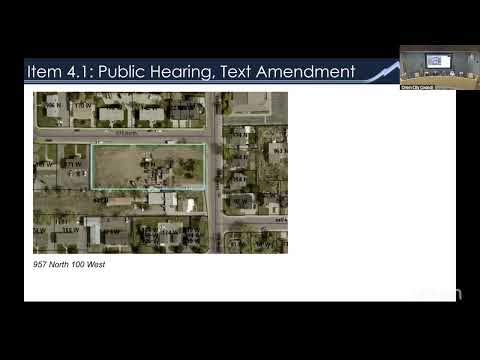
Applicant presentation and neighborhood comment The applicant (owner) told the commission he bought the property in 1991 and described a phased plan for the site that he called "Canyon Court Townhomes." He told commissioners he would construct a first building with five units, retain an elderly tenant in the existing 1925 house while building, and then remove the house and construct two additional buildings, for a total of roughly 15 to 16 units. The applicant said he plans to live on-site as manager during initial operations and indicated an eventual goal of selling units as townhomes or condominiums.
A nearby resident, Chris Marshall of 964 North 100 West, spoke in support and urged the commission to approve the project so the elderly occupant would have stable housing during construction.
Commission discussion and concerns Commissioners expressed a mix of support for allowing redevelopment in appropriate locations and concern about creating a narrowly tailored ordinance that would apply to only a few parcels or could be used more broadly than intended. Several commissioners said the PRD route (planned residential development) would require a minimum acreage (staff noted a 1.5-acre minimum in the PRD rules) and that revising PRD minimums could open more parcels. Members also flagged the proposed block-definition language that would extend eligibility where a block "cannot be circumnavigated" as ambiguous; a commissioner asked that legal tighten that language.
Action taken The commission voted to continue the item to its first meeting in July so staff and legal counsel could further evaluate the draft language and potential citywide implications. Brad (mover) made the motion and Jerry seconded; the commission approved the continuance by voice vote.
Why it matters If the city adopts the proposed changes, a small number of single-family lots that are effectively surrounded by multifamily properties would become eligible for multifamily redevelopment under a clearly defined formula. Commissioners emphasized the need to test any amendment against state limits and to avoid language that could unintentionally change zoning rights across the city.
Next steps Staff will work with city attorneys to refine the block-definition language, clarify density calculations and the timing for removal of existing structures, and return with a revised draft for the planning commission to consider at its first July meeting. The applicant may later seek an exception from the board of adjustments and would still be subject to neighborhood meeting requirements and submittal and review of any multifamily development proposal.