Get Full Government Meeting Transcripts, Videos, & Alerts Forever!
Get email alerts on the Local Media Contracts topic
No spam. Unsubscribe anytime.
Sandy Journal representative defends distribution, questions RFP’s glossy requirement
Summary
Representatives of the Sandy Journal told the City Council they seek a modest contract increase and disputed public reports of a major drop in circulation, while criticizing the city’s recent RFP for requiring a glossy print they say the paper does not provide.
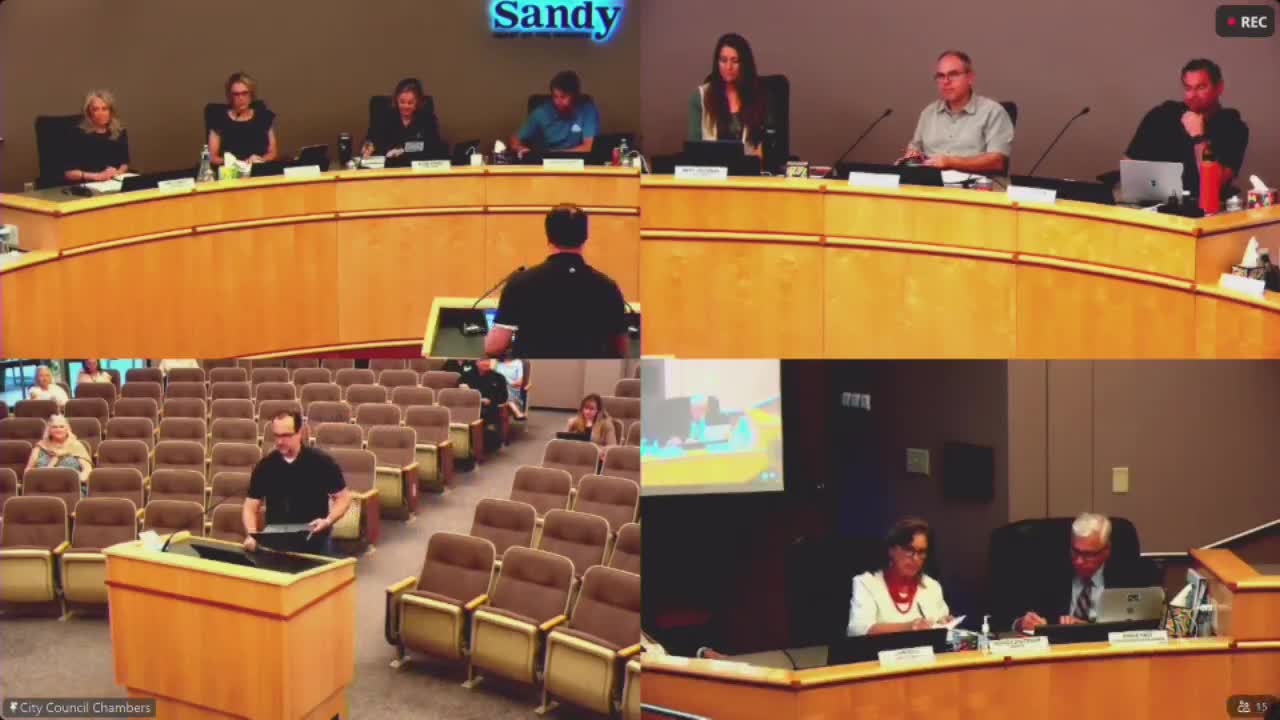
The Sandy City Council heard a presentation from a representative of the Sandy Journal on June 3 defending the paper’s distribution practices and responding to questions about a recent city request for proposals that the publisher said specified glossy printing.
The discussion matters because the city contracts with a private publisher to deliver the city newsletter alongside that paper, and council members raised questions about cost, circulation and how the city should spend public money for mailed notices.
Bridal Scott, representing the Sandy Journal, told the council the paper has worked with the city for decades and described a recent request from the publisher for a $150-a-month increase to a $3,000-per-month contract. Scott said the Journal has tested opt-in/opt-out distribution methods, uses data to target mailings and disputes a widely circulated claim that print distribution dropped from about 30,000 homes to 7,000. “7,000 residents is what responded,” Scott said, adding that the Journal still mails about 30,000 copies and provides rack copies and targeted mailings to make up distribution shortfalls.
Scott also criticized the language of the city’s RFP for the newsletter contract, saying it required an 8.5-by-11 glossy print product and gloss-based mailing that the Journal does not produce and could not economically offer. “It was asking for a gloss print, which we’re not a printer,” Scott said. He said the Journal did not see the RFP until it was published statewide and felt the procurement ignored other services the publisher provides, such as archiving local news online and community engagement.
Council members pressed Scott for details about circulation and the opt-in process. Council Member Haussmann said she did not see the value of glossy printing and asked if a glossy product would increase readership enough to justify higher costs. Scott replied that the Journal has tried glossy formats previously and that his analysis and advertiser feedback did not support a permanent switch to gloss. Council Member Sharkey asked whether circulation actually declined; Scott answered that the 7,000 figure represented responses to a recent survey, not the number of mailed copies, and that total distribution remains near 30,000.
Council members and the publisher also discussed postal logistics such as Every Door Direct Mail (EDDM) and carrier-route constraints. Scott described the Journal’s targeting process as analytical: the paper used respondents’ profiles to create “look-alike” audience segments for delivery and plans to upgrade that system. He said the Journal’s revenue model — advertising that offsets print costs — affects distribution decisions in ways that differ from the city, which pays postage from public funds.
The council did not take formal action on the matter at the June 3 meeting. The exchange was informational; staff and council members said they remain open to additional information and to consider how the city’s RFP and distribution policy align with the city’s objectives for taxpayer-funded mailings.