Get Full Government Meeting Transcripts, Videos, & Alerts Forever!
Get email alerts on the Rental Assistance topic
No spam. Unsubscribe anytime.
Glendale council and housing authority ask staff to design rental-assistance options after data briefing
Summary
City staff briefed the Glendale City Council and Housing Authority on existing and past rental programs, local housing inventory and a forthcoming $2.4 million county renter-program allocation. Council directed staff to return with program designs, cost estimates and eligibility models.
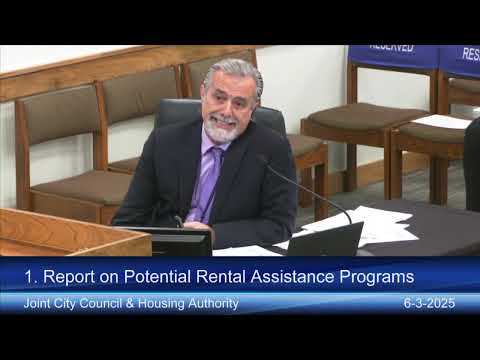
Glendale city staff on June 3 briefed the City Council and the Glendale Housing Authority on current, past and possible rental-assistance programs and asked for direction on program goals, target populations and funding priorities.
The briefing, delivered by Peter Zolvak, assistant director of community development, outlined the city’s rental landscape — a population of about 96,500, roughly 46,000 renter-occupied units, a median gross rent of $2,095 and a median renter-household income of $60,773 — and summarized prior programs such as Section 8 vouchers, the monthly housing subsidy program (MHSP), a low-income student rental-assistance pilot and emergency rental assistance (ERAP) distributed during COVID. “We are not expecting council to approve a program today. We’re simply looking for direction,” Zolvak told councilmembers.
The staff presentation quantified prior and current assistance levels: Section 8 voucher averages roughly $1,500 per household per month; MHSP provided a $300 fixed monthly subsidy; the low-income student pilot averaged about $600 per month; LifeRAP averaged about $1,000 per month; and ERAP payments averaged approximately $1,500 per month. Zolvak said the city has previously committed roughly $86.97 million in local funding and about $49.7 million in federal funding to housing initiatives and programs, and that the city currently administers roughly 2,673 vouchers.
Zolvak highlighted a new funding source under development at the county level. La Casa, the county’s new affordable-housing agency created by a half‑cent sales tax measure, will allocate a portion of funds directly to cities; Glendale is expected to receive a local allocation that staff estimated would include about $2,400,000 earmarked specifically for renter programs (short-term, “shallow” subsidies). Zolvak said those funds would be limited to short-term renter assistance (generally up to six months) and could be used for eviction prevention and arrears assistance but not for homeless‑services programming from that same pot.
Councilmembers pressed staff on design choices staff asked the council to resolve before staff returns with a formal program proposal: the program goal (eviction prevention, relocation assistance, or ongoing rent relief), the target population (seniors, working families, students, people with disabilities, or a mix), the assistance structure (flat monthly amounts versus need‑based awards), budget scope and expected number of households served, and administrative capacity and staffing.
Members asked for numbers and thresholds that will inform eligibility. Zolvak pointed to the staff report table (page 4) showing income cutoffs used by staff: for a single‑person household the “extremely low” threshold was $31,008.50, “very low” roughly $53,000 and “low” about $84,008.50. Councilmembers also asked for program end dates for current pilots (staff said many are winding down this summer), for estimates of how many households remain burdened from COVID arrears (staff said no reliable citywide figure is available now), and for vacancy‑rate data and counts of units both in progress and completed (staff said about 500 units in construction and roughly 1,400 completed affordable units, plus the 2,673 vouchers, yielding roughly 4,500 subsidized units when combined).
Council discussion emphasized tradeoffs between shallow, broad assistance (smaller amounts to more households) and deeper, targeted support (larger awards to fewer households) and the administrative costs of more targeted programs. Several members expressed a priority for eviction prevention as a near‑term objective and interest in pairing rental subsidies with wraparound services — a model previously used in the LifeRAP pilot where training and coaching accompanied rental aid. Council members also asked staff to evaluate coordination opportunities with Glendale Community College and with Glendale Water & Power subsidy programs to “bundle” supports that reduce overall household costs without solely relying on direct rent payments.
Public comment on the housing items included a prior Housing Authority public comment from Beth Brooks seeking clearer online information about programs and contact numbers; Brooks urged separating housing content from the city’s community development web pages so residents can more easily find rental‑assistance information.
Council action: the City Council moved to “note and file” the staff report and to accept the direction provided in members’ comments; the motion passed on a roll‑call vote with all members present voting yes. Staff said it will return with cost projections, eligibility models, administrative frameworks and, where possible, staffing estimates. Zolvak also said La Casa is still finalizing program rules and memoranda of understanding with cities and that timing for the first disbursements is not yet fixed.
Why it matters: staff and council framed the discussion against a backdrop in which about 64% of Glendale renter households are rent‑burdened (paying more than 30% of income for rent). The council’s choices on program goals, population targeting and the scale of funding will shape whether future local efforts are oriented toward short‑term eviction prevention, longer transitional supports tied to services, or broader shallow subsidies.
Next steps: staff will return with program designs and cost estimates for council consideration and recommended administrative approaches; members asked that these proposals be part of upcoming budget discussions so the council can consider recurring versus one‑time allocations.