Get Full Government Meeting Transcripts, Videos, & Alerts Forever!
Get email alerts on the Historic Preservation Ordinance topic
No spam. Unsubscribe anytime.
San Mateo council directs staff to draft historic-preservation ordinance update, seeks owner-consent rules
Summary
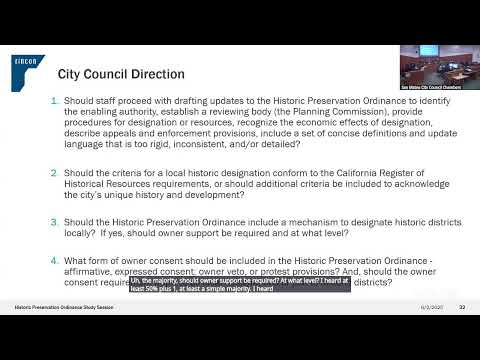
On June 2, 2025, the San Mateo City Council directed staff to move forward with drafting updates to the city's historic-preservation ordinance and to begin community outreach, asking staff to base local criteria on the California Register and to include a local-district mechanism with owner-consent rules.
SAN MATEO, Calif.
On June 2, 2025, the San Mateo City Council directed staff to move forward with drafting updates to the city's historic-preservation ordinance and to begin community outreach, while asking staff to base local designation criteria on the California Register of Historical Resources and to include a mechanism for local historic districts with owner consent requirements, council members and staff said.
The council's direction follows a staff presentation from Zach Dahl, director of community development, and Julianne Murphy, an architectural historian with Rincon Consulting, who outlined the project timeline, the purpose of a historic-context statement and several policy choices for council consideration. The city allocated approximately $330,000 from the advanced planning fund for the effort; staff said the fund holds roughly $6,000,000 in total with about $2,200,000 unencumbered for projects such as this.
City staff told the council the effort implements actions in the city's recently adopted general plan and aims to return a final ordinance for adoption beginning in early 2026. "The purpose of a historic context statement is to provide a framework and ... it does not evaluate individual or groups of properties," Murphy said, describing research and outreach tasks that will accompany the ordinance update.
Why it matters
Changes to the local preservation ordinance would define how San Mateo identifies historic resources, how local designations would be reviewed, and what restrictions or incentives attach to designated properties. Residents and speakers at the meeting raised concerns about insurance impacts, potential costs and the effects on homeowners' ability to modify or rebuild their properties.
What staff proposed and what council asked for
Staff recommended drafting an updated ordinance that uses the planning commission in an advisory role as the initial reviewing body, and said the ordinance should start from California Register criteria while permitting city-specific additions. Staff also presented multiple owner-consent options: affirmative/express consent (owner must opt in), nomination-origin rules (owner-initiated nominations), protest provisions and rarer owner-veto approaches.
After public comment and council discussion, the council gave the following direction: proceed with drafting the ordinance; use the California Register criteria as a starting point but consider additional San Mateo-specific criteria; include a mechanism to designate local historic districts; require owner support for local district designation; and require affirmative/express owner consent for individual designations. Councilmembers debated which city body should serve as the reviewing authority (options raised included the Planning Commission, the Community Relations Commission and a new or advisory body), and asked staff to return with implementation options and a refined owner-consent threshold after outreach.
Public comment and concerns
Seventeen speakers spoke during public comment. A large share of in-person commenters from Baywood and other neighborhoods urged high thresholds for owner consent and favored affirmative, expressed consent. Anna Cure, a Baywood resident, told the council: "This consent-based ordinance needs a very high threshold, like 80." Several speakers raised insurance and cost concerns, saying insurers had told owners that designation could affect coverage; one resident asked whether staff had followed up on an earlier request to research insurance-company practices.
Other speakers and some council members urged a preservation approach that avoids dividing neighborhoods and that preserves downtown and clearly significant buildings while not burdening typical single-family homeowners. Some members urged deferring the final choice of consent threshold to community outreach results.
CEQA, Mills Act and process points
Staff and the consultant emphasized the distinction between local designation and state environmental review under the California Environmental Quality Act (CEQA). Murphy said CEQA review uses the California Register criteria when evaluating whether a project would cause a substantial adverse change to a historical resource and noted that an updated local ordinance and a historic context statement can create screening criteria to streamline CEQA reviews.
Council members also discussed the Mills Act (a state program providing property tax agreements for qualified historic properties). Staff said existing Mills Act properties are already designated and that the city will follow up with owners on those properties as part of the ordinance process.
Timeline and next steps
Staff said community outreach will begin this month and will include focus groups, workshops and online resources; the historic-context research is already under way. Staff aims to publish a draft ordinance for community review and then route the update through the planning commission and city council for adoption beginning in early 2026. Councilmembers asked staff to return with options for an administering or reviewing body, a recommended owner-consent threshold informed by outreach, and clarifications about implementation costs and likely annual workload.
Ending
Councilmembers stressed the need for broad outreach and clear public education materials explaining the practical effects of designation (for example, what work would require review and what would not). The council's direction was procedural rather than a final vote on the ordinance's substance; staff will return with a draft ordinance and implementation plan after the outreach phase.