Get Full Government Meeting Transcripts, Videos, & Alerts Forever!
Get email alerts on the Reentry And Nonprofit Funding topic
No spam. Unsubscribe anytime.
Haytai Reborn Justice Movement seeks county funding to sustain operations, proposes youth bridge and public‑health violence prevention
Summary
Haytai Reborn Justice Movement cofounders LA Jones and Steve Chalmers presented program results, finances and an operating-request to Durham County commissioners and asked the board for $1.5 million: $500,000 to sustain operations and $1 million to launch two new initiatives.
Haytai Reborn Justice Movement (HRJM) cofounders LA Jones and Steve Chalmers presented program results, finances and an operating-request to Durham County commissioners during a budget work session and asked the board for $1.5 million: $500,000 to sustain core operations and $1 million to launch two new initiatives (a youth bridge for disengaged 16–20-year-olds and a public‑health violence-prevention model).
HRJM leaders described services and partnerships Jones emphasized that county dollars had been treated “with intentionality” and framed HRJM as a coordination hub that connects justice‑involved and other vulnerable residents with wraparound services. “Every dollar has been spent with intentionality,” she said. HRJM reported working with Durham Technical Community College and multiple community partners.
Program metrics presented (HRJM slides and remarks) - HRJM said it provided high-touch services and partnerships; presenters reported figures for the current year but the slides and spoken remarks included inconsistent participant totals. Jones said the operation “a 78 participants, 750 services,” while presenter Steve Chalmers later referred to slides showing “178 participants.” Commissioners asked HRJM to clarify the discrepancy and provide demographic breakdowns. - HRJM said it had about 10 full-time staff members supporting programs and partnerships, and that county funds covered four salaries in the current year. - HRJM described a flagship “Bridge” program run with Durham Technical Community College: cohort-based workforce and certification training (stipend of $15/hour during a roughly six-week curriculum, transportation and meals provided), and partnerships for apprenticeship and certification pathways (construction trades, CDL, healthcare pathways named).
Budget and funding history: questions from commissioners Commissioners pressed for a detailed accounting of past public funding and for clarity about which dollars supported core operations vs. time-limited grants. Commissioner Jacobs asked for an itemized history of public support; HRJM said it had submitted a financial packet and agreed to provide additional documentation showing how county, city and federal dollars were used across years. In the meeting a commissioner and HRJM staff discussed prior allocations and federal grants, and Jacob s asked for precise dates and amounts; HRJM agreed to follow up.
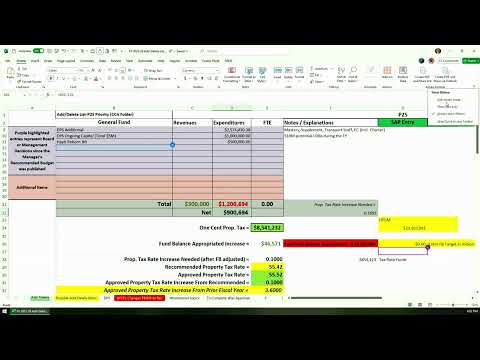
Commissioners’ concerns and possible actions - Commissioners repeatedly requested more granular financial documentation (per-cohort cost, spending by fund source, monthly actuals), participant demographics and clearer KPIs for a one-year return on investment. - Several commissioners noted the county’s tighter fiscal environment; some suggested reducing HRJM’s request in the current budget. During ad/delete budget deliberations later in the session, commissioners discussed reducing HRJM’s FY 2025–26 allocation from the manager’s recommended $1,000,000 to $500,000 as part of balancing the county budget and increasing funding for Durham Public Schools. Commissioners asked HRJM to provide additional documentation, clarified which operating costs county dollars had covered and asked staff to incorporate the group’s materials into the county’s nonprofit funding review process.
What HRJM requested and proposed HRJM asked for two funding tiers: $500,000 to sustain core programs this fiscal year and an additional $1,000,000 to launch the youth-bridge and public‑health violence-prevention initiatives. Leaders emphasized that HRJM uses other funding sources first (federal grants, ARPA funds when available) and said the county dollars were sequenced to avoid lapses when other pots expire.
Next steps and follow-up County staff asked HRJM for a detailed breakdown of prior public revenue and of the organization’s FY-to-date expenditures, and commissioners asked for program-level KPIs and demographic data. Commissioners signaled they will consider a smaller continuation allocation in the near term while requesting fuller documentation before committing to expansion funding.
Ending: HRJM leaders said they will supply the requested financial details and performance metrics; commissioners said staff will include the materials in ad/delete budget work and the board will weigh continuation funding against other county priorities.