Get Full Government Meeting Transcripts, Videos, & Alerts Forever!
Get email alerts on the Water Rates topic
No spam. Unsubscribe anytime.
Kingsburg council adopts Prop 218 water rate plan to cover operations, SGMA costs
Summary
After a Prop 218 public hearing and with 218 written protests out of 4,194 accounts, the Kingsburg City Council approved a multi‑year water rate plan effective July 1, 2025, shifting to meter‑based fees and volume rates to cover rising operating, compliance and infrastructure costs.
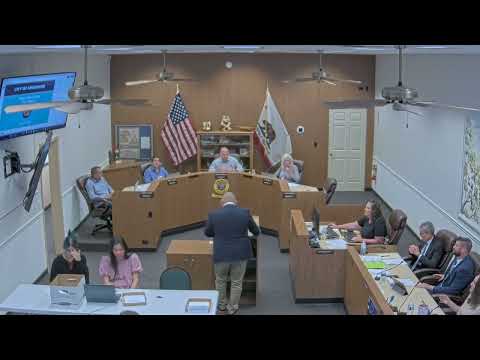
Kingsburg — The Kingsburg City Council voted to adopt a multi‑year water rate plan following a Prop 218 public hearing on May 21, 2025, approving Resolution 2025‑31 to implement the proposed rates effective July 1, 2025. City staff said the changes are intended to eliminate an operating deficit, fund planned infrastructure and ensure compliance with groundwater sustainability rules.
Public Works Director Daniel Galvez and consultant Allison Lejovich presented the Prop 218 rate study, a five‑year financial plan that staff said identifies roughly $3.9 million in capital needs for pipes, pumps, wells and treatment systems and forecasts rising operating and regulatory costs tied to the city’s groundwater obligations. Galvez said notices went to 4,194 accounts and the city received 218 written protest ballots, short of the 50%+1 threshold required to block the proposal under Prop 218; the City Clerk announced that the count did not constitute a majority protest.
Why it matters: City staff and consultants said the rate change is needed so the water utility is “self‑supporting” and can pay ongoing operations, maintenance and compliance costs without using general‑fund dollars. The plan shifts Kingsburg from a single base fee that included the first 11,000 gallons to a meter‑sized base fee plus a single volume rate applied to all customers, staff said, so customers “pay for what you use.” Staff estimated typical bill impacts at roughly $20 in summer, about $10 in winter and $15–$16 on average for most customers.
Details of the plan and staff rationale Public Works Director Daniel Galvez described the study’s findings and the reasons for the proposed structure. The current monthly base fee of $32.25 (which included the first 11,000 gallons) would be adjusted to a meter‑size fee and the separate included allotment removed; instead the city will charge a single volume rate for all customer types that increases over time. Galvez and consultant Allison Lejovich said the change also reflects legal guidance that flat base allowances for substantial volumes can be judged out of proportion under recent case law and Prop 218 principles.
The study accounts for increased costs from treatment (granular activated carbon and chemicals), power and replacement of aging assets. Staff also included ongoing Groundwater Sustainability Act (SGMA)‑related costs passed through the South Kings Groundwater Sustainability Agency (SKGSA) and payments tied to agreements with CID; staff said those GSA/O&M charges are part of the city’s long‑term water fund obligations.
Public comment and council discussion Several residents spoke during the public hearing. Former City Manager Dan Pauli, who identified himself as a low‑use household, said the increases would be a hardship for seniors and urged a different or reduced structure for older residents: “We don't need to be spending any paying any more than the current rate that we're currently paying,” he said. Deborah Maddock and other residents said the increases felt steep and wanted clearer bill examples. John Wright, a Kingsburg resident, said he was confused by the outreach and concluded, “my personal vote is no for the 2 18 system.”
Other residents asked technical questions about test wells, the timing for a new well and whether the city could use bonds, solar or other options to offset costs. Resident Paul Sherpentier asked whether a “test well” in the plan meant an immediate new production well; staff said test wells are often used to confirm viability before committing to a full well and that project timing and funding choices could change when council reviews budgets annually. Resident Dave Greenclaw supported moving ahead with infrastructure investment to avoid repeated smaller projects later.
Council members pressed staff on alternatives and noted that the rate schedule presented represented a maximum that the council could revisit annually. City Manager Alex Henderson and Public Works staff said the council can choose to implement lower increases in subsequent years if fund performance allows. Staff also discussed meter replacement and an eventual AMI (automatic meter infrastructure) program intended to provide near‑daily reads and leak detection, and said grant programs (for example through Bureau of Reclamation/Department of the Interior programs) would be pursued to offset those capital costs.
Formal action After the public hearing closed and the City Clerk confirmed the protest count (218 protests; 4,194 affected accounts), the council voted to adopt Resolution 2025‑31 implementing the proposed rates as presented, effective July 1, 2025, and authorizing annual increases pursuant to Prop 218 procedures. The motion was seconded and the council responded “Aye”; the resolution passed.
Next steps and implementation Staff said the rates authorized by the resolution represent the maximums noticed under Prop 218; council retains annual discretion when setting actual rates within the approved schedule. Staff will move forward with outreach and billing changes, continue pursuing grants for metering and efficiency upgrades, and present the utility budget and any proposed adjustments during the next fiscal‑year budget cycle.