
White County officials weigh tax-rate options to fund pay raises, EMS staffing and capital needs
Get AI-powered insights, summaries, and transcripts
Subscribe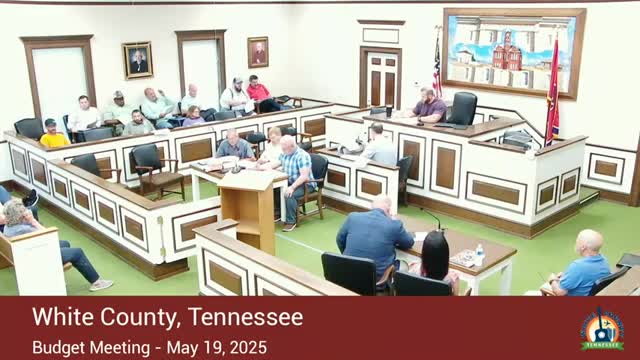
Summary
At a public budget meeting, White County budget committee presented four tax-rate scenarios tied to pay-scale changes, staffing additions for EMS and deputies, and a proposal to set aside tax pennies for county capital rather than strictly debt service. Public commenters urged caution over large tax increases.
White County budget committee members and the full commission discussed four property-tax rate scenarios and a range of budget trade-offs at a public meeting, weighing higher revenue for employee pay and emergency services against the impact on taxpayers.
The committee presented a five-page budget packet that compares a department-request “original” package and three alternate options (A, B and C), and a final scenario (D) set at the estimated certified rate. Director Markham told commissioners the packet shows which positions and non‑salary items are included under each option and the corresponding estimated property-tax rates. The document treats the county general fund separately and shows how “pennies” on the tax rate would be allocated across funds.
Why it matters: county officials said rising property valuations from the state reappraisal mean the commission must choose between keeping the certified rate (which would be revenue‑neutral) and enacting a higher rate that would generate new money for salaries, ambulances, deputies and capital needs. Commissioners and residents said the choice will directly affect household bills and core services such as ambulance availability and road maintenance.
Most significant options
- The packet labels the committee’s baseline as the “original” option, which Director Markham described as generating roughly $1.70 per $100 of assessed value and funds a proposed county pay scale (an average raise the committee estimated at about 15% across full‑time employees) plus some new positions.
- Option A would remove 10 proposed new positions and reduce the proposed general pay adjustment by $1 per hour.
- Option B would also remove the 10 positions but keep the $1 per hour added back to the pay scale.
- Option C would add the 10 positions but roll back the $1 pay increase.
- Option D would adopt an estimated certified rate of $1.21 per $100 — the county’s revenue‑neutral estimate after the state reappraisal — and, as presented, would drop the proposed pay scale changes and the 10 new positions while providing a 3% cost‑of‑living adjustment.
Director Markham emphasized the choices shift where tax “pennies” go: operations, capital or debt service. He explained the proposal to place new pennies in a county capital fund (rather than restricted debt service) so the county could accumulate cash for capital projects or transfer to debt service if needed. He said state rules require interest earned on county accounts to flow into debt service, so the fund would continue to grow even if pennies are not allocated this year.
Employee pay, staffing and emergency services
A central portion of the discussion focused on county employee compensation and staffing, particularly emergency medical services and deputies. The budget committee’s “original” package includes an across‑the‑board pay-scale adjustment the committee described as an average 15.5% increase for full‑time county employees and a proposed longevity payment (listed in the packet as about $188,000 for FY26).
Commissioners and county staff said EMS is operating at high utilization and that adding positions would help relieve long shifts and response pressure. Mike Kerr, introduced by the chairman as the county’s EMS director, said the service is handling heavy demand: “We run 7,000 calls,” he said, noting the county typically has three ambulances available and frequently sends units out of county for hospital transfers.
Committee members repeatedly returned to a choice between trimming non‑salary items and affecting overall employee compensation. One commissioner summarized the tradeoff: reducing compensation is the single budget line that most quickly reduces expenditures, while the ballot and levy options determine whether the county can pay for higher salaries and additional staff.
Capital funding and highway maintenance
The committee also discussed allocating tax pennies to a county capital fund rather than exclusively to debt service. Director Markham said money placed in debt service is restricted to debt payments, while a general capital fund could be saved and used for pay‑as‑you‑go projects or transferred to debt service when needed.
Commissioners flagged a possible maintenance‑of‑effort issue tied to highway/public‑works funding: adding pennies to the Highway Public Works Fund could trigger a state requirement that the county meet a five‑year average maintenance‑of‑effort for that fund. Staff said the highway fund has historically relied on state gas and motor fuel taxes and that additional local pennies would help fund paving and other needs on nearly 900 miles of county road.
Tax math and public response
Throughout the meeting, staff and commissioners repeatedly explained how the state reappraisal affects individual bills versus the county’s certified rate. Director Markham said the estimated certified, revenue‑neutral rate is about $1.21; keeping that rate would largely neutralize the effect of higher valuations on county revenue. The commission’s current rate is $2.05 per $100 of assessed value.
Markham and commissioners explained a county “penny” is the amount of revenue produced by one cent on the tax rate and noted estimates in the meeting packet. At one point a staff presentation used a working figure of about $56,000 per penny under earlier assessments; speakers also noted the penny value rises under the reappraisal and referenced a higher estimate presented later in the meeting.
Public commenters attending the meeting expressed concern about large increases in assessed values and the prospect of a higher tax rate. Robert Taylor, a Sparta resident, summarized a common point: “That assessment was done by the state, not Junior Jones,” and urged commissioners to review committee work before voting. Other residents described steep reappraisal increases and said they were willing to pay more for police, fire and EMS but urged restraint and transparency in how additional revenue would be used.
Next steps
Budget committee members said they want clear direction from the full commission so the committee can narrow choices and return with a proposed rate the board can vote on in June; the goal stated by a committee member was to pass the budget by July 1. The committee scheduled a follow‑up meeting and opened a period for public comment at the end of the session.
No formal budget adoption vote was taken at the meeting; the only recorded procedural action was a motion to adjourn at the end of the session.