Get Full Government Meeting Transcripts, Videos, & Alerts Forever!
Get email alerts on the State Legislation topic
No spam. Unsubscribe anytime.
Collin County staff warns commissioners of late-session changes to HB 23, SB 1450 and other bills
Summary
County staff gave an update on the 80th Texas legislative session, describing late-session "zombie week" activity and raising concerns about provisions in HB 23 and SB 1450 that could change review processes and building-code requirements.
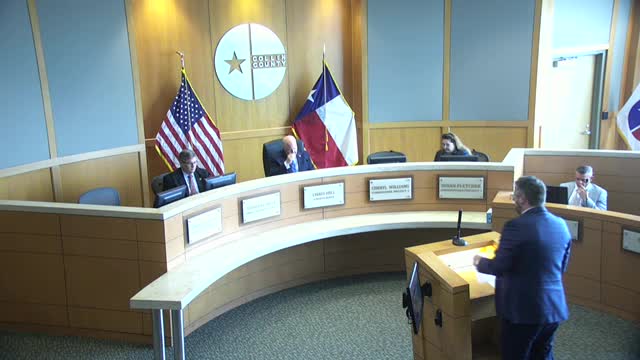
Collin County staff briefed the commissioners court on developments in the 80th Texas legislative session and highlighted potential local impacts from several bills still moving through the Legislature.
Mr. Shoffner, a county staff member who delivered the update during the May meeting, said the final days of the session have led to fast-moving changes when lawmakers attach amendments to other bills. “This is known as zombie week,” he said, describing the period when “amendments become bills become amendments and all sorts of wonderful things start to happen.”
The update flagged two measures county staff are watching closely: HB 23 and SB 1450. Shoffner said HB 23 has been substantially rewritten and that elements of it are now in the Senate. He said SB 1450 is being used in part to try to restore components of the original HB 23 and that the bill “had a hearing today.” He told the court the county’s work has moved HB 23 to a place that could give the commissioner’s court “greater authority” if the bill becomes law.
Shoffner also raised concerns about a provision in SB 1450 that would require or expand use of third‑party engineering reviews and that would reference the International Residential Code in addition to the International Building Code. He told the court the residential code “has a lot more things in that code that are the, junk science,” and said some provisions would regulate appliances such as natural‑gas devices.
Shoffner urged caution about how third‑party review would be implemented, saying there is a risk of creating engineering firms that simply rubber‑stamp projects rather than providing meaningful oversight. He suggested alternative legislative approaches to hold counties and cities accountable for permitting delays rather than broadly forcing third‑party reviews.
A commissioner asked about HB 19; Shoffner said HB 19 remained in committee and “never got the votes to get out of House Ways and Means.” He said portions of HB 19 that had raised county concerns had not, as of the update, been attached successfully to other bills.
The court did not take action on any bills during the meeting; the presentation was an informational update. Shoffner offered to circulate the legislative tracking chart to commissioners for further review.
The update ran during the general discussion portion of the May meeting and was one of several informational items the court considered that day.