Get Full Government Meeting Transcripts, Videos, & Alerts Forever!
Get email alerts on the Economic Development topic
No spam. Unsubscribe anytime.
Council hears first reading to create commercial development district on White Bear Avenue North
Summary
The St. Paul City Council took first reading of an ordinance to create a commercial development district at 1624–1626 White Bear Avenue North; staff said the district would allow on‑sale liquor service past midnight and the council laid the item over for a June 18 public hearing.
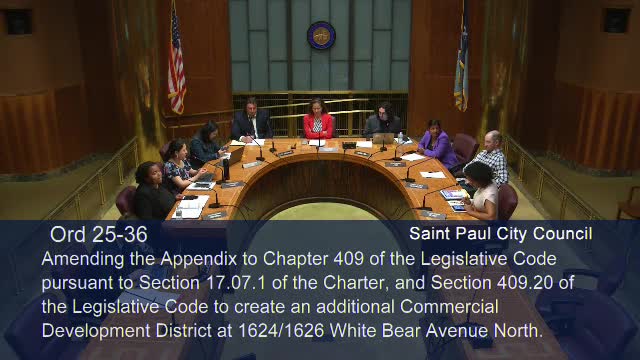
The St. Paul City Council received a staff presentation Wednesday on an ordinance (Ord. 205-536) proposing a new commercial development district for properties at 1624 and 1626 White Bear Avenue North. The item was taken for first reading; the council laid the ordinance over for a required public hearing and second reading on June 18.
Dan Nuschelic, deputy director in the Department of Safety and Inspections, told the council that commercial development districts are geographic exceptions to the city’s charter and ordinance limits on on‑sale liquor licenses. He said those districts are designed for areas that can support higher‑intensity liquor service and entertainment and stressed that “commercial development districts are not tied to businesses. They go to an area and to a property.” The staff report said the proposal followed a petition by local business owners and received a recommendation for approval from the Planning Commission on May 30.
Nuschelic described the legal background: the charter and the Legislative Code limit the type and number of on‑sale licenses outside downtown; restaurants are defined by ordinance as closing by midnight; commercial development districts are the vehicle by which a restaurant can remain open after midnight or by which other on‑sale uses can be authorized. He told the council there are 15 commercial development districts in the city (six in the charter and nine created subsequently) and outlined the post‑2015 policy changes that reduced demand for districts when the council made new restaurant licenses available under specified conditions.
Council members asked for additional context and for the item to be connected to the city’s broader economic‑development strategy. Council Member Pavetsky asked how many establishments actually operate until 2 a.m.; Nuschelic said he would provide a citywide count by email and noted the number has fallen since COVID. Several council members recommended a longer‑term study of where and how commercial development districts should be located to create corridors of nightlife and economic activity rather than “spot” approvals.
Council Member Buie asked the staff to clarify the difference between securing an extended‑hour license for a business and creating a commercial development district; Nuschelic reiterated that, under current rules, a restaurant that closes at midnight cannot remain open past midnight unless it is in a commercial development district.
Director Newton and Director Weasey (planning staff) were identified in the discussion as already working on a larger economic vitality framework that would include commercial development districts; Nuschelic said staff can brief council members and present options at a study session.
Action taken: the council laid the ordinance over to June 18 for the required public hearing and second reading. No vote on adoption occurred at the first reading.