Get Full Government Meeting Transcripts, Videos, & Alerts Forever!
Get email alerts on the Homelessness Safe Bay topic
No spam. Unsubscribe anytime.
Duluth City Council affirms planning commission approval of Safe Bay interim outdoor living site at Vineyard Church
Summary
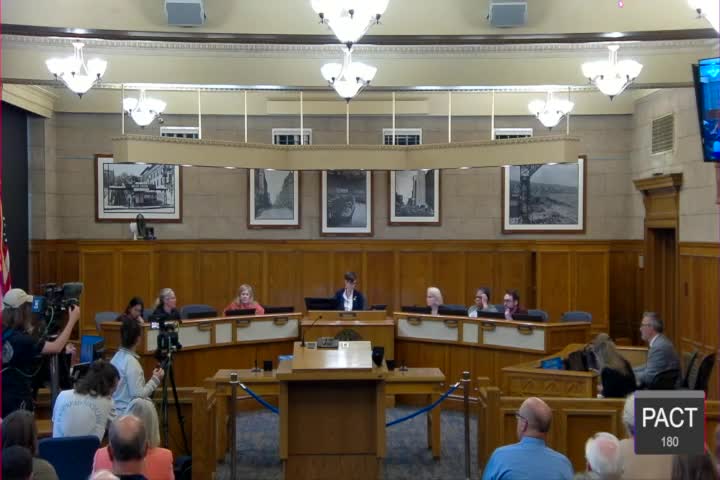
After a public appeal and nearly three hours of testimony from neighbors, service providers and people with lived experience, the Duluth City Council voted 6-0 to affirm the Planning Commission’s May 13 approval of an interim outdoor living site (Safe Bay) at 1533 West Arrowhead Road.
The Duluth City Council on Thursday affirmed the Planning Commission’s May 13 decision to approve an interim outdoor living site — known as Safe Bay — at 1533 West Arrowhead Road, voting to adopt a resolution that passed 6-0.
The appeal, filed May 21 by the Miller Law Office on behalf of neighborhood residents, argued city planning staff and the Planning Commission failed to apply Duluth’s Unified Development Chapter (Chapter 50) and had improperly waived dense urban screening requirements. The council heard a staff report, five‑minute presentations from the appellant’s attorney and the applicant’s representatives, a period of council questions and roughly two hours of public comment before voting.
The council’s vote affirms the commission’s finding that the application complies with applicable UDC standards and is consistent with Imagine Duluth 2035 policy guidance. Councilors who spoke in support of affirming the permit cited the program’s limited seasonal operation (May–October), staffing, on‑site rules, and mitigation measures such as dumpsters, signage and a pet‑waste station.
Attorney Brenda Miller, representing the appellants, told the council the appeal sought to “require city officials to follow their own rules and to ensure the safety of participants” and accused planning staff and a Planning Commissioner of allowing exceptions to the dense urban screen requirement. “City employees illegally granted exceptions to the requirement of a dense urban screen that are not contained in the code,” Miller said during her presentation.
Joel Kilgore, project organizer for Stepping on Up speaking for CHUM and the Vineyard Church, said the program was reinstated to provide people living in vehicles access to staff, toilets and showers and that the stay ordered while the appeal was pending had forced residents back onto the street. “These are necessary for human survival,” Kilgore said of bathroom and shower access, urging the council to weigh that harm in its decision.
Planning Manager Jen Moses summarized the review process and told councilors that staff and the Planning Commission concluded the application met Chapter 50 requirements. Moses noted that the UDC allows an interim outdoor living site to use vehicles or tents for sleeping, that Safe Bay operates seasonally and that staff visited the site after the commission’s approval and documented screening in place at that time.
Many neighbors who spoke during public comment said the screening between the parking lot and adjacent residences was incomplete, fragile, or partly on neighboring property. Speakers described a mix of rock berms, opaque mesh screening on frames, snow fencing and existing trees; several described being able to see into parked vehicles from nearby yards and questioned whether the temporary screening met the UDC definition of a six‑foot, 75% opacity dense urban screen. One appellant provided a signed list of 12 people joining the appeal.
Supporters of Safe Bay — including volunteers, social service leaders and people with lived experience of homelessness — described the program as structured, staffed and necessary. Testimony from CHUM employees and volunteers said staff check the site, that damage to temporary screening has been repaired, and that the program enforces quiet hours and participant expectations. Multiple speakers said the site had produced few or no calls for service while open and called for continued neighborhood partnership.
During deliberations, councilors framed their role as quasi‑judicial: to decide whether the Planning Commission’s decision complied with the UDC and the comprehensive plan, not to revisit the program’s broader merits. Council discussion focused on dense urban screening, notification procedures, the site’s seasonal hours (May–October, with stated operating hours of roughly 6 p.m.–8 a.m.), on‑site staffing, and mitigation measures such as bear‑proof dumpsters and signage. Councilors Mayo, Randolph and others cited Imagine Duluth 2035 principles on housing and equity in supporting the approval.
Councilor Kennedy moved the resolution to affirm the Planning Commission; Councilor Randolph seconded. The motion passed 6‑0. The formal action affirms the interim use permit approval for Safe Bay at 1533 West Arrowhead Road and returns the matter to staff for implementation consistent with the permit conditions and the city code.
The council and multiple speakers urged continued dialogue among CHUM, Vineyard Church volunteers and neighbors to address remaining screening and safety concerns; councilors also noted the permit is reviewed annually under the UDC.