Get Full Government Meeting Transcripts, Videos, & Alerts Forever!
Get email alerts on the Land Development Readiness topic
No spam. Unsubscribe anytime.
Inver Grove Heights EDA directs staff to pursue surveys and environmental studies on 32-acre city-owned land south of American Inn
Summary
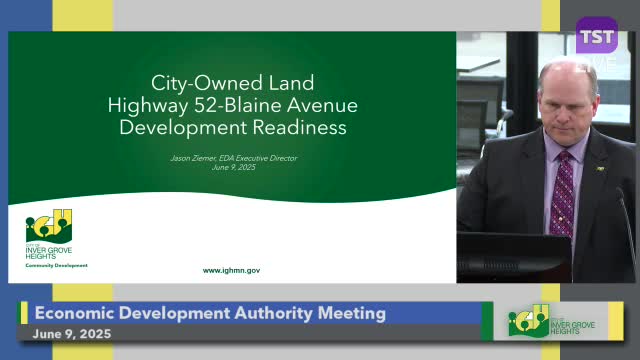
The Inver Grove Heights Economic Development Authority on June 9 authorized staff to pursue consultant surveys and environmental studies on roughly 32.26 acres of city-owned land between Highway 52 and Blaine Avenue to test development readiness.
The Inver Grove Heights Economic Development Authority on June 9 approved a motion recommending staff proceed with consultant work to evaluate roughly 32.26 acres of city-owned land south of the American Inn and between Highway 52 and Blaine Avenue.
Director Zemer told the EDA the request grew from prior discussion about siting a curling center and from broader interest in the city-owned parcels west of Highway 52 and east of Blaine. Staff recommended a package of site-readiness tasks: boundary, topographic and ALTA surveys; preliminary and final plats; soil borings and geotechnical reporting; a wetland delineation; a tree inventory; and a Phase I environmental site assessment.
Zemer said Braun Intertech provided a cost range for soil borings, groundwater monitoring and geotechnical reporting of about $25,000 to $35,000 depending on the number of borings. He said Alliant’s estimates and other items initially led staff to a conservative $60,000 figure, and an updated review put the full scope near $78,000 for all items on the 32-acre tract.
Staff outlined an expedited timeline if work started the week of June 16: tree inventory in June, surveys by July, and many tasks completed by fall if contractor schedules permit. The Phase I environmental study is widely applicable and staff said it could be done once for multiple parcels at a lower unit price than separate assessments.
EDA members discussed funding. Several members said the EDA should contribute because it seeks to develop the land; staff noted the city’s City Properties Fund could also pay part of the cost. Staff reported the City Properties Fund had a documented balance “as of April” of $392,489 and later referenced a figure of $592,000 in the same discussion; staff said they would bring back a proposed split and a Braun cost estimate.
Member Dukach asked whether borings would identify legacy contamination from an old gun club; Zemer said a Phase I could trigger a Phase II if needed and that borings can detect contamination depending on bore placement but cannot guarantee detection in every location.
After discussion an EDA member moved to recommend proceeding with Alliant’s proposal; another member seconded and members voted aye. Staff will return with refined Braun estimates and a proposed funding split between the EDA and the City Properties Fund.