Get Full Government Meeting Transcripts, Videos, & Alerts Forever!
Get email alerts on the Land Use Economy topic
No spam. Unsubscribe anytime.
Council lays over proposal for White Bear Avenue commercial development district to June 18
Summary
Staff presented background on on‑sale liquor licensing and commercial development districts for a proposed expansion at 1624–1626 White Bear Avenue North; council members asked for more context and the item was laid over to a June 18 public hearing.
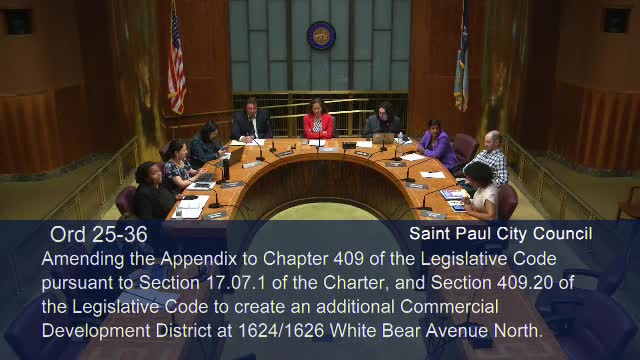
The St. Paul City Council took no final vote on a proposed commercial development district at 1624 and 1626 White Bear Avenue North after an extended staff briefing and council discussion; the matter was laid over to a June 18 public hearing and second reading.
Dan Nacielek, deputy director for the Department of Safety and Inspections, gave a detailed presentation explaining why the city uses commercial development districts (CDDs) to allow on‑sale liquor licenses outside of downtown and beyond standard geographic caps in the city charter and ordinance. He told council members that CDDs are geographic designations tied to property, not to individual businesses, and that they have been used to permit late‑night restaurant and bar activity in concentrated areas where land uses and public safety considerations support higher intensity nighttime activity.
Nacielek said the proposal before the council originated with the owners of an establishment operating as a restaurant at the White Bear Avenue addresses who petitioned for the CDD so the operation could remain open until 2 a.m. Planning and Economic Development reviewed the petition and the Planning Commission recommended approval on May 30. Notice for a public hearing was distributed to property owners and in the official city newspaper; under charter requirements the public hearing must occur within the ward.
Council members pressed staff for additional context. Council Member Povatsky asked how many establishments currently operate until 2 a.m.; Nacielek said the number has fallen since COVID and that he would provide exact counts by email. Council Member Buie and others suggested CDDs have historically been created on an ad hoc basis and recommended tying any wider CDD strategy to the city’s economic‑development planning so districts are intentional rather than created one business at a time.
Council Member Yang moved to lay the ordinance and related materials over to the June 18 meeting for the required public hearing in the ward; the council accepted the motion and the item was formally held over to June 18 for second reading and public hearing.
Ending: Staff offered to provide a follow‑up briefing or study session on liquor licensing, CDDs and related economic development strategy for council members who requested more background; the ordinance remains pending a public hearing and second reading on June 18.