Get Full Government Meeting Transcripts, Videos, & Alerts Forever!
Get email alerts on the Trees Development topic
No spam. Unsubscribe anytime.
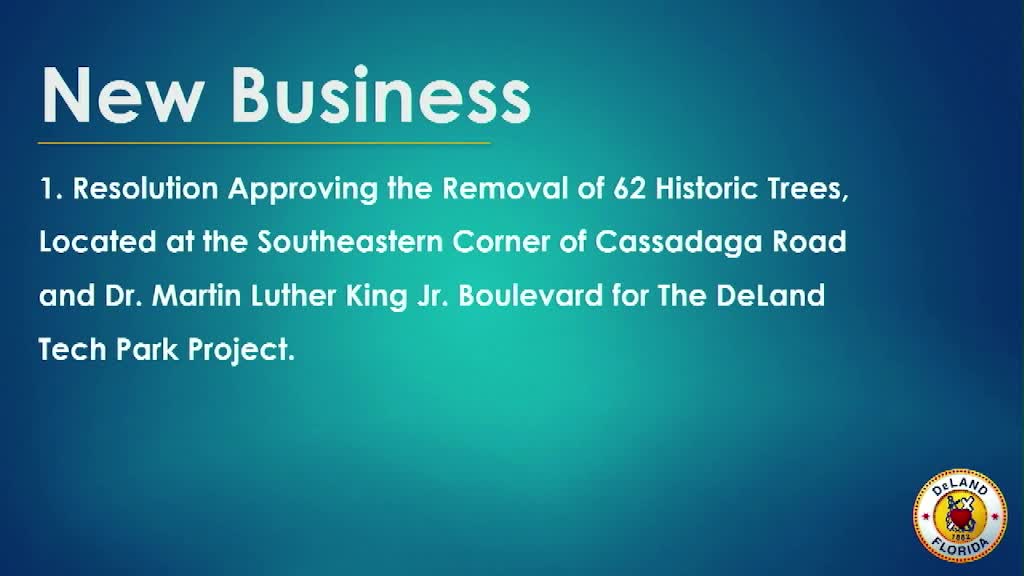
DeLand commission allows removal of 62 "historic" trees for Tech Park; developer to preserve 10‑acre mitigation parcel
Summary
The commission approved a request to remove 62 historic trees across the Deland Tech Park site, accepting an off‑site mitigation plan that preserves a roughly 10‑acre parcel and requires on‑site canopy plantings. The tree advisory committee recommended planting 62 six‑inch canopy trees on site in addition to the conserved parcel.
The City of DeLand City Commission voted to approve the removal of 62 trees classified as historic on the Deland Tech Park site, accepting a mitigation package that preserves a roughly 10‑acre parcel north of Casadega Road and requires additional on‑site canopy plantings.
The action came after a presentation from acting city forester Mary Ellen Calabrio and attorneys for the applicant outlining the development plan and mitigation proposal. “The applicant has requested to remove these 62 trees for the construction of the project,” Calabrio told the commission during the discussion.
Why it matters: the site sits inside an activity center around the SR‑472/MLK interchange that has been planned for employment and industrial uses for decades. Commissioners and the tree advisory committee framed the question as a tradeoff between economic development (jobs and commercial infrastructure) and tree canopy preservation in an area that includes several mature live oaks.
Developer and staff overview Mark Watts, attorney for the applicant, said the removal is needed to construct initial infrastructure — stormwater ponds and a new connector road (referred to in materials as Kirk Drive) — and to support later construction of large industrial buildings. He said the 62 trees identified for removal fall within the grading footprint for those improvements. Watts described the mitigation approach the developer proposed after several meetings with staff and the Tree Advisory Committee: conserve a 10‑acre off‑site parcel under a conservation easement, preserve a 76‑inch live oak within a 200‑foot buffer, and plant larger canopy trees along public frontage so the public sees the benefit of new trees sooner.
Watts summarized mitigation quantities: the 62 trees proposed for removal total “just under 2,000 total inches” of diameter at breast height (DBH) and the acquired 10‑acre preservation parcel contains an estimated 562 live oak, turkey oak and longleaf pine trees representing 5,070 DBH inches, based on the developer’s surveys.
Tree advisory committee and staff position City staff and the Tree Advisory Committee recommended a compromise rather than strict code‑required DBH inch‑for‑inch replacement. The committee recommended planting 62 six‑inch caliper canopy trees from the city’s approved species list in recognition of the off‑site conservation area and other mitigation steps. Mary Ellen Calabrio told the commission the site’s historic trees ranged in condition “from poor to good.”
Commission debate and legal context Commissioners asked about the size and location of the preservation parcel, the condition of trees on site, and legal consequences of denying removal. City attorney Darren (last name not spoken) cautioned that the commission has more discretion under this type of site‑plan/PD request than it would for plat approvals, but that outright denial could raise legal challenges if it effectively prevented all economically viable uses of the property.
Vote and immediate outcome A motion to approve the resolution authorizing removal and mitigation passed on a voice vote. The motion was made by Commissioner Kevin Reed and seconded by Commissioner Paiva; Commissioners Paiva, Vice Mayor Davis, Commissioner Kevin Reed and Mayor Cloudman voted yes. The commission recorded the action as approved.
What remains The commission approved the tree removal authorization tied to the applicant’s mitigation plan and conservation easement. The developer must record the conservation easement and follow the mitigation specifications, and staff indicated it will track implementation during subsequent site plan reviews.
For now, the decision clears the way for initial infrastructure work at the Deland Tech Park site, with the city and the Tree Advisory Committee noting the preservation parcel and the on‑site tree plantings as measures intended to offset canopy loss.