Get Full Government Meeting Transcripts, Videos, & Alerts Forever!
Get email alerts on the Land Development Code topic
No spam. Unsubscribe anytime.
City of DeLand launches 16‑month overhaul of Land Development Regulations
Summary
City staff and consultants from Inspire Placemaking Collective outlined a 16‑month process to rewrite the City of DeLand’s Land Development Regulations, focusing on public outreach, streamlined procedures, design standards (including form‑based rules), and options to encourage infill, “missing‑middle” housing and redevelopment.
Consultants from Inspire Placemaking Collective on May (date not specified) introduced a 16‑month project to overhaul the City of DeLand’s Land Development Regulations (LDRs), describing a phased schedule of launch, direction‑setting, drafting and public review and testing before returning to the commission for adoption.
The consultant team said the rewrite will “overhaul, reformat, reorganize, and modernize this code,” aiming to remove conflicts, refine and streamline processes and make the code easier to use for both applicants and staff. David Henning, a lawyer and planner with Inspire, said, “We are here to clarify the rules. We are here to remove unnecessary burdens and restrictions. And we are here to help embrace the community vision.”
Why this matters: the LDR rewrite would change how development proposals are reviewed and what is allowed by right versus by exception. Commissioners said they want the final product to be user friendly, to increase predictability for developers, and to broaden housing options while ensuring inclusive outreach across neighborhoods.
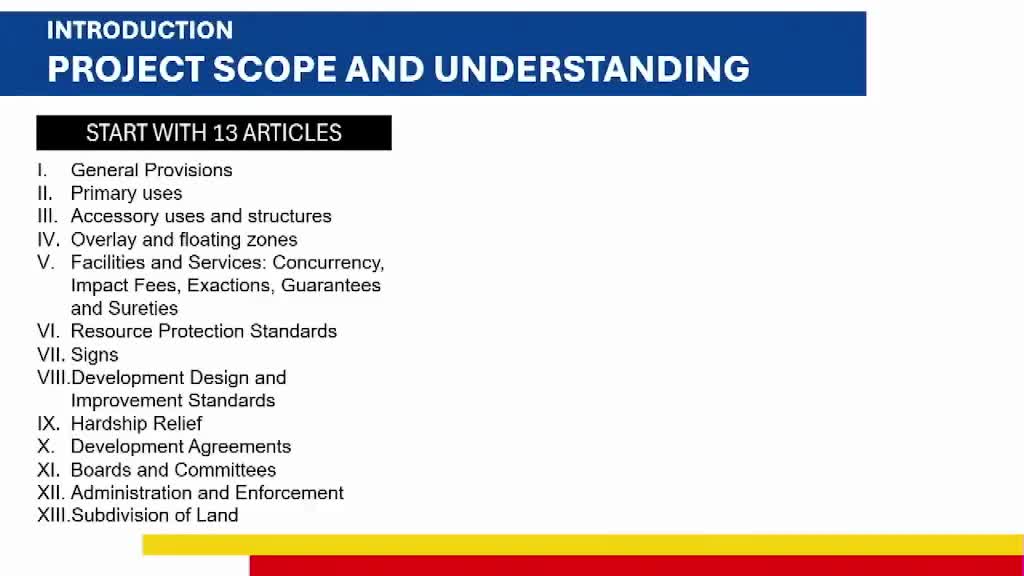
Scope and schedule Inspire summarized the project as beginning with the city’s 13 LDR articles and working through constituent rules that make up the regulations. The firm described four broad phases across roughly 16 months: (1) project launch and initial outreach, (2) confirming direction with staff, advisory groups and the public, (3) intensive drafting and mapping of changes against existing code language, and (4) public review, testing on example properties and final refinement before formal adoption hearings. The consultants said workshops are tentatively shown in October on the project timeline as placeholders and that staff and the commission will set final workshop topics and dates.
Public engagement and tools Consultants said outreach will include targeted stakeholder meetings (developers, neighborhood groups, housing advocates, downtown organizations and other frequent code users), technical advisory group reviews, public open houses and an interactive project website. The site will publish project materials, a timeline, frequently asked questions and allow the public to comment on specific areas of the city. Inspire said the website should be publicly accessible within two weeks of the presentation and will include visuals and example projects to help non‑technical users understand proposed changes.
Branding and public materials The consultants showed draft branding intended to make the project visible in public outreach. The logo presented includes a courthouse dome image that consultants said is frequently used as a recognizable civic symbol; several commissioners discussed the image (including concerns about showing a nearby empty lot and whether the Putnam courthouse image was appropriate). Commissioners emphasized that outreach materials should prioritize clarity over logo design and use photographs, diagrams and a “pamphlet” or table of processes so residents and small applicants can easily find steps and requirements.
Topics likely to arise in the rewrite Consultants said they expect multiple substantive topics to surface during review, including: missing‑middle housing types (duplexes, triplexes, courtyard developments, cottage courts and townhouses), adaptive reuse and infill strategies, form‑based regulations or hybrid form/use districts for parts of downtown, building massing and articulation standards, redevelopment incentives or streamlined processes, and alternative compliance pathways (clear guardrails for tradeoffs such as reduced parking in exchange for active ground‑floor uses or pedestrian plazas).
Commissioner priorities and staff direction Commissioners said success for them would include a finished, user‑friendly code with clear process charts, photographs and examples so residents and small applicants can follow steps without hiring consultants. Commissioner Reed said a useful product would include a clear pamphlet or chart showing the process and requirements. Vice Mayor Davis emphasized inclusion and outreach across demographic and neighborhood groups, urging community activations and off‑site open houses to reach residents who do not use social media. Commissioner Pfeiffer highlighted the need for standards that accommodate projects such as affordable housing where the existing code forces frequent variances (for example, parking reductions).
Staff commitments and next steps City planning staff and the consultants agreed to schedule community workshops and targeted stakeholder outreach, and to make the project website interactive. Planning staff indicated they will provide monthly updates to the commission as the work progresses and will coordinate community activations (including outreach events and QR‑coded business cards to drive traffic to the website). No formal vote or ordinance was taken at the meeting; the presentation was a kickoff and direction to proceed with the outreach and drafting phases.
What was not decided No changes to specific LDR provisions were adopted; the presentation set the process and scope but did not modify code language. Budgetary sources for the consultant work already appear to be in place (contract previously awarded), but staff did not specify additional funding amounts or deadlines tied to statutory requirements at the session. Specific dates for workshops, the precise list of testing properties and the final draft language remain to be determined during phase‑two and phase‑three work.
The commission and consultants agreed to continue with targeted stakeholder meetings, public workshops, and iterative drafts and to return to the commission for formal adoption steps once the draft ordinance is completed and refined.