Get Full Government Meeting Transcripts, Videos, & Alerts Forever!
Work group urges immediate capital planning and governance review for Portland’s five city-owned performing arts venues
Summary
The Arts and Economy Committee on July 8 heard the Performing Arts Venues Work Group Recommendations Report, which urges immediate capital planning for Portland’s five city‑owned venues, recommends that the city lead a governance review and possible dissolution of the existing operating agreement with Metro, and identifies five operating models for further study.
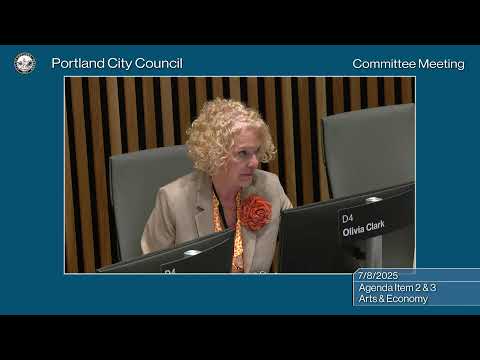
PORTLAND, Ore. — The Arts and Economy Committee held a presentation and public hearing July 8 on the Performing Arts Venues Work Group Recommendations Report, which reviews the management, funding and future of the five city-owned performing arts facilities known as the Portland 5 centers for the arts.
The work group — a 19-member panel convened by the city and Metro that included venue operators, labor representatives, nonprofit presenters and industry consultants — concluded that the backlog of deferred maintenance and reliance on operating funds to pay for capital repairs is unsustainable. The group recommended that the City of Portland, as owner of the buildings, lead further investigation, public engagement and planning, and that the city and Metro begin preparing a plan to dissolve the existing intergovernmental agreement (IGA) that places Metro in the operating role. Short-term recommendations include increasing earned revenue, improving food-and-beverage and booking policies, and strengthening relations with local arts organizations; long-term recommendations call for more time and analysis of future operating models.
Why it matters: The five venues — Arlene Schnitzer Concert Hall, Keller Auditorium, Antoinette Hatfield Hall (which contains three performance spaces), the Newmark Theatre and the Brunish (Bluenish) Theater — draw more than 800,000 attendees annually and are central to Portland’s downtown arts economy. The work group’s consultant, AMS Planning and Research, found that most major performing arts centers in North America are operated by private nonprofits even when the buildings are publicly owned, and that Portland 5’s revenue profile differs from peers because it relies more on rental fees than on ticketing and philanthropic income.
Key findings and recommendations
- Capital planning and funding: The work group called for an immediate facility conditions assessment and capital planning process to size the capital investment needed and identify dedicated funding sources. Committee presenters said Portland 5 has relied primarily on operating surpluses to fund capital projects; Metro and Portland 5 staff reported that the city currently…
Already have an account? Log in
Subscribe to keep reading
Unlock the rest of this article — and every article on Citizen Portal.
- Unlimited articles
- AI-powered breakdowns of topics, speakers, decisions, and budgets
- Instant alerts when your location has a new meeting
- Follow topics and more locations
- 1,000 AI Insights / month, plus AI Chat